
 Group
Group
 Group
Group


 Preferred Source

 Google Discover
Preparing for JEE Mains 2027 within five months may sound difficult, particularly if you have not completed the syllabus or have weak subjects from Classes 11 and 12. However, five months can be sufficient to cover a significant portion of the syllabus if you follow a consistent plan.
An effective JEE Mains 2027 5-month study plan must consider four key factors: completing important chapters, building concepts, solving previous-year questions and analysing mock tests. The purpose is not to study for 15–18 hours every day but to ensure that your daily study time is focused, efficient and consistent.
JEE Mains 2027 5-Month Study Plan
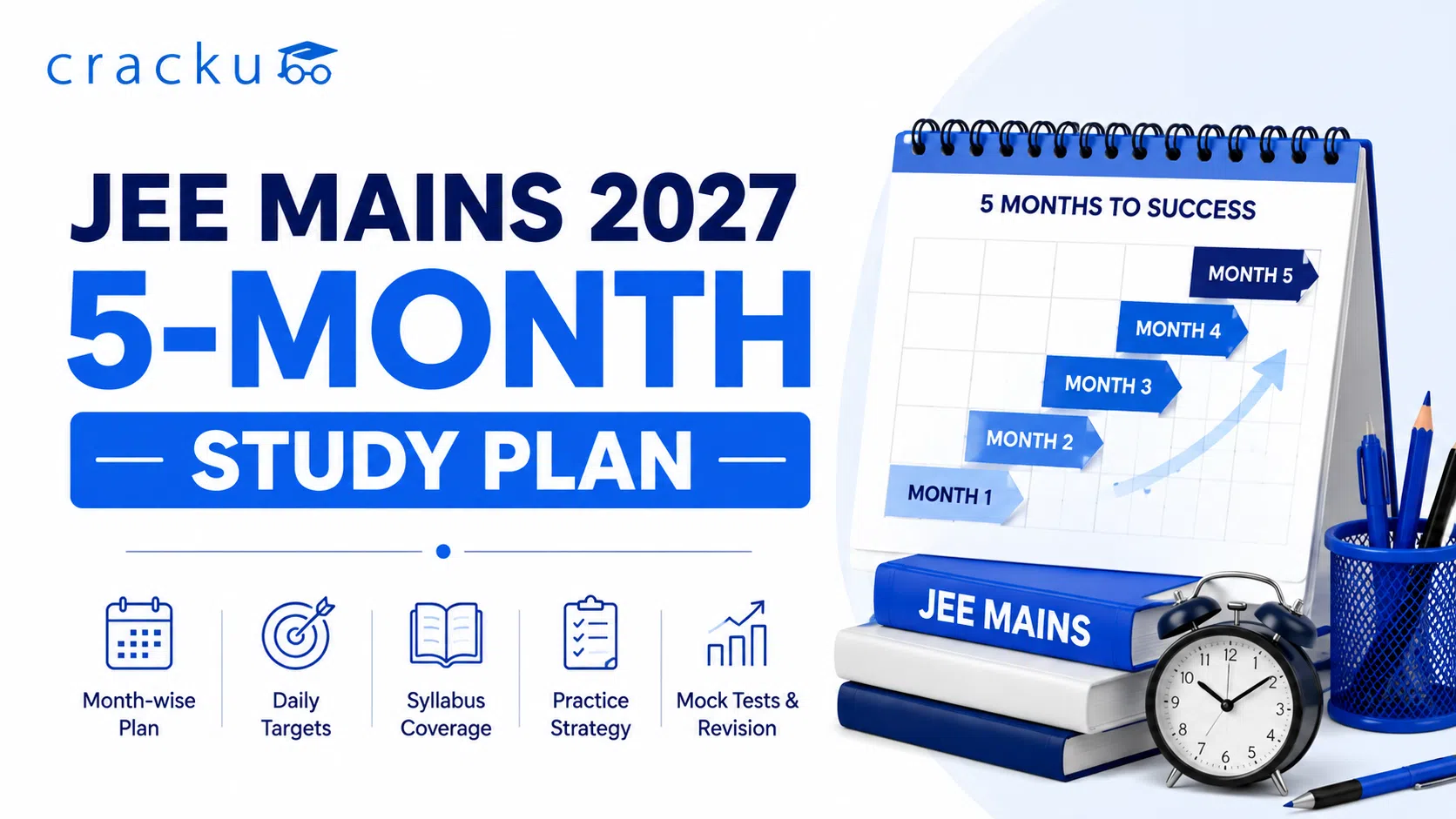
A five-month preparation strategy should be divided into different stages instead of treating every month equally. The first three months should focus on concept building and syllabus completion. The next two months should focus on revision, PYQs, mock tests and score improvement.
The main targets are to strengthen the basics by mid-September, complete important chapters by mid-October, finish the syllabus by mid-November and begin full-length mock tests by mid-December.
| Timeline | Primary Focus | Target |
|---|---|---|
| Month 1 | Foundation and concepts | Strengthen important Physics, Chemistry and Maths chapters |
| Month 2 | High-weightage and scoring chapters | Cover major chapters and continue revision |
| Month 3 | Syllabus completion | Finish the remaining syllabus |
| Month 4 | Revision, PYQs and mocks | Revise the complete syllabus and start regular full-length tests |
| Month 5 | Mock-test intensive preparation | Mock → Analyse → Repair → Repeat |
JEE Mains 2027 Foundation and Concept-Building Plan
The first stage should focus on building strong fundamentals. If your Class 11 preparation is weak, do not try to complete the entire Class 11 syllabus in one month while completely ignoring Class 12. This approach can create another backlog.
Physics Foundation Chapters
Prioritise the following Physics chapters:
- Kinematics
- Newton’s Laws of Motion
- Work, Energy and Power
- Rotational Motion
- Gravitation
- Electrostatics
- Current Electricity
Chemistry Foundation Chapters
Focus on the following Chemistry chapters:
- Mole Concept
- Atomic Structure
- Thermodynamics
- Equilibrium
- Periodicity
- Chemical Bonding
- General Organic Chemistry (GOC)
GOC deserves particular attention because it provides an important foundation for subsequent Organic Chemistry chapters.
Mathematics Foundation Chapters
The initial Mathematics preparation should include:
- Quadratic Equations
- Sequences and Series
- Trigonometry
- Matrices and Determinants
- Functions
- Limits
- Continuity and Differentiability
How to Study Each Chapter
Adopt a method comprising four simple steps:
Concepts → Questions → PYQs → Timed Test
For example, after studying Current Electricity, do not move directly to the next chapter. First, revise the concept, solve relevant questions, attempt previous-year questions and then take a timed test to evaluate your application of the concepts.
Also Read: Is 5 Months Enough to Crack JEE Main 2027? Check Now
JEE Mains 2027 High-Weightage Chapters Preparation
During this phase, the emphasis should be on larger JEE syllabus blocks and short revision sessions for chapters that have already been completed. This phase can be followed from September 16 to October 15.
Physics
| Area | Chapters |
|---|---|
| Heat and Thermodynamics | Thermodynamics and Kinetic Theory of Gases |
| Oscillations and Waves | Simple Harmonic Motion and Waves |
| Electromagnetism | Magnetism, Electromagnetic Induction and Alternating Current |
Chemistry
Prioritise the following chapters:
- Solutions
- Electrochemistry
- Chemical Kinetics
- d- and f-Block Elements
- Coordination Compounds
- Hydrocarbons
- Haloalkanes and Haloarenes
Mathematics
This phase should give substantial attention to Calculus and Coordinate Geometry:
- Applications of Derivatives
- Indefinite Integration
- Definite Integration
- Differential Equations
- Straight Lines
- Circles
- Vectors
- Three-Dimensional Geometry
If Mathematics is your weakest subject, avoid switching randomly between lectures and study materials. Follow one structured resource and practise questions regularly.
Do Not Forget Your Completed Chapters
Another common mistake is ignoring completed chapters. Keep older topics fresh through short mixed-question exercises.
For example, if you have started preparing for Magnetism, you can practise 15 Magnetism questions, five Current Electricity questions and five Mechanics questions. This method keeps older chapters active without affecting your current syllabus.
Students can combine their chapter-wise preparation with the JEE Question Bank and JEE Questions for additional practice.
JEE Mains 2027 Syllabus Completion Strategy
The third phase should focus on completing the remaining syllabus. The target should be to finish one complete syllabus cycle by November 15. Your aim should not be to perfect every chapter during this stage. Instead, ensure that no significant portion of the syllabus remains untouched.
Physics
Complete the following chapters:
- Optics
- Electromagnetic Waves
- Dual Nature of Matter
- Atoms and Nuclei
- Semiconductors
- Experimental Skills
Chemistry
Complete the following chapters:
- p-Block Elements
- Alcohols, Phenols and Ethers
- Aldehydes and Ketones
- Carboxylic Acids
- Amines
- Biomolecules
- Practical Chemistry
Mathematics
Complete the following chapters:
- Permutations and Combinations
- Binomial Theorem
- Parabola
- Ellipse
- Hyperbola
- Statistics
- Probability
Syllabus Completion Rule
Follow this order:
Unfinished Chapter → Basic Concepts → Questions → PYQs → Short Test → Revision
Do not spend four or five days trying to perfect one difficult chapter while several other chapters remain incomplete. Your priority should be completing one syllabus cycle so that revision can begin on time.
JEE Mains 2027 Revision and PYQ Practice Plan
After November 15, your preparation approach should change. Instead of continuously adding new chapters, focus on revision, PYQs, accuracy and the reasons behind lost marks.
Divide your revision into four weekly blocks instead of restarting the entire syllabus from the beginning.
| Revision Week | Focus Areas |
|---|---|
| Week 1 | Mechanics, Physical Chemistry and Algebra |
| Week 2 | Electricity and Magnetism, Organic Chemistry Basics and Differentiation |
| Week 3 | SHM, Waves, EMI and AC, Remaining Organic Chemistry and Integration |
| Week 4 | Optics and Modern Physics, Inorganic Chemistry, Coordinate Geometry, Vectors and 3D Geometry |
How to Use PYQs Effectively
Do not treat PYQs as just another set of questions. Use them to understand:
- Which topics are asked regularly
- Which questions can be answered quickly
- Which topics cause recurring mistakes
- Where your calculation speed is lacking
- Which formulas require repeated revision
Revise topics using your JEE Study Material before attempting PYQs. Maintain a record of questions that you could not answer independently.
The objective is to move from learning → practising → recognising patterns → solving under time pressure.
JEE Mains 2027 Mock Test and Score Improvement Strategy
Mock tests become especially important after completing one full syllabus cycle. You should aim to complete approximately eight to ten mock tests by December 15. However, attempting several mocks without proper analysis will not necessarily improve your score.
Analyse the following areas after every mock test:
| Problem | Possible Reason | Improvement Action |
|---|---|---|
| Wrong answer | Conceptual gap | Revise the concept |
| Wrong formula | Formula forgotten | Add it to revision notes |
| Calculation error | Speed or accuracy issue | Practise calculations |
| Question left unattempted | Concept or time-management issue | Revisit the topic |
| Too much time spent | Poor question selection | Practise timed tests |
| Silly mistake | Lack of attention | Slow down and check the answer |
For example, suppose you score 145 in a mock test. You should not simply conclude that “Maths is weak.” Instead, identify precisely why marks were lost.
Was there a conceptual gap? Did you forget important formulas? Were your calculations slow? Did you spend too much time solving one difficult question? This type of detailed analysis makes mock tests valuable.
Students can use the JEE Mains Mock Test to practise under exam-like conditions and analyse their performance regularly.
How to Manage Weak Chapters During JEE Mains 2027 Preparation
Not all weak chapters should be treated in the same way. Classify your chapters into Green, Yellow and Red categories. This will help you decide where an additional hour of preparation can produce the greatest improvement.
| Category | Current Situation | What You Should Do |
|---|---|---|
| Green | You can solve most questions comfortably | Maintain through regular revision |
| Yellow | Concepts are understood, but speed or accuracy is weak | Give high priority to practice |
| Red | Basic concepts are unclear | Return to the fundamentals |
JEE Mains 2027 5-Month Study Plan: Conclusion
The JEE Mains 2027 5-month study plan should be treated as an organised preparation framework rather than an inflexible schedule. Begin with foundation chapters, move to important scoring topics, complete the remaining syllabus before the November deadline and then focus on revision, PYQs and mock tests.
The most important shift takes place after completing the syllabus. At that stage, your main question should not be, “What should I study now?” but “Why am I losing marks?” With consistent implementation, regular PYQ practice and detailed mock-test analysis, the available five months can be used effectively.
The goal is simple: complete, practise, test, analyse and improve every week.
.webp)