
 Group
Group
 Group
Group
SN1 Reactions vs SN2 Reactions
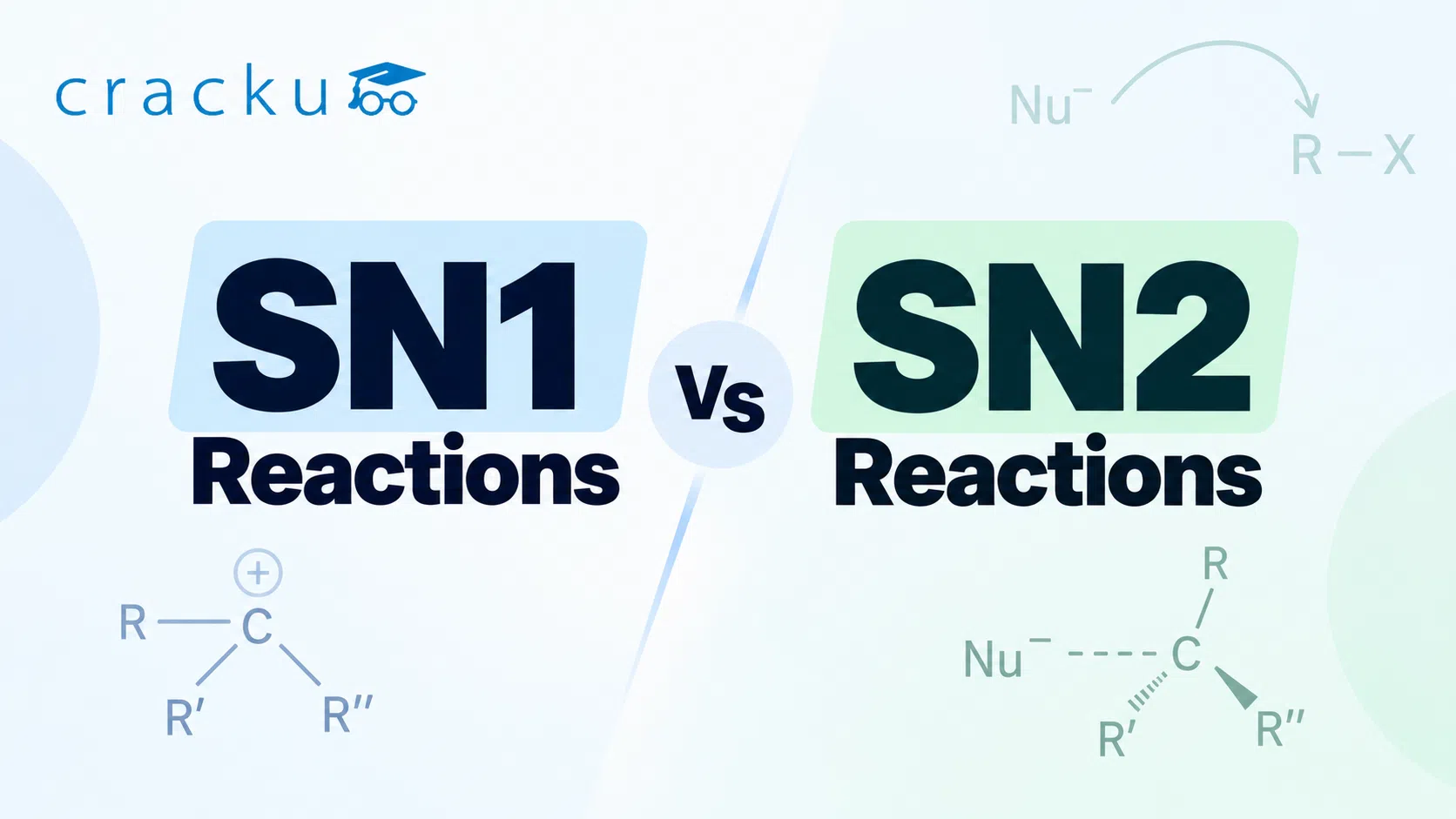
The difference between SN1 and SN2 reactions comes down to how the bond to the leaving group breaks and when the nucleophile attacks. Both are nucleophilic substitution reactions of haloalkanes from the NCERT Class 12 chapter on Haloalkanes and Haloarenes, but they differ in kinetics, stereochemistry, substrate preference and solvent requirement. JEE regularly asks you to pick the pathway for a given substrate and then predict the product, including its configuration. This comparison gives you every distinguishing point you need, with verified examples.
What are SN1 and SN2 Reactions?
An SN1 reaction is a unimolecular nucleophilic substitution. It proceeds in two steps. In the slow, rate-determining step the carbon to halogen bond ionises on its own to give a planar carbocation; in the fast second step the nucleophile adds to that carbocation. Because only the substrate is involved in the slow step, the rate depends on the substrate concentration alone.
An SN2 reaction is a bimolecular nucleophilic substitution. Bond formation by the nucleophile and bond breaking by the leaving group happen at the same time, in a single concerted step. The nucleophile attacks from the side opposite the leaving group, passing through a transition state in which carbon is partially bonded to five groups. Both the substrate and the nucleophile appear in the rate law.
Take two hydrolysis reactions to see the contrast:
- SN1: tert-butyl bromide, (CH3)3CBr, reacts with water in aqueous ethanol through the stable tertiary carbocation (CH3)3C+.
- SN2: bromomethane, CH3Br, reacts with hydroxide ion in aqueous acetone in one step, with no intermediate at all.
The same reagent pair can therefore follow two completely different mechanisms depending only on how substituted the carbon carrying the halogen is.
Key Differences Between SN1 and SN2 Reaction
The table below collects every point that examiners test. Read it column by column first, then row by row while revising.
| Property | SN1 Reaction | SN2 Reaction |
|---|---|---|
| Molecularity | Unimolecular: one species in the slow step | Bimolecular: two species in the single step |
| Rate law | Rate $$= k[RX]$$, first order overall | Rate $$= k[RX][Nu^-]$$, second order overall |
| Number of steps | Two steps | One concerted step |
| Intermediate | Planar, $$sp^2$$ hybridised carbocation | No intermediate, only a trigonal bipyramidal transition state |
| Substrate order | 3° $$\gt$$ 2° $$\gt$$ 1° $$\gt$$ CH3 | CH3 $$\gt$$ 1° $$\gt$$ 2° $$\gt$$ 3° |
| Stereochemistry | Racemisation, usually with slight inversion excess | Complete inversion of configuration (Walden inversion) |
| Nucleophile strength | Almost no effect; weak nucleophiles work | Strong effect; a strong nucleophile speeds it up |
| Preferred solvent | Polar protic: water, ethanol, formic acid | Polar aprotic: acetone, DMSO, DMF, acetonitrile |
| Steric hindrance | Bulky groups help by stabilising the carbocation | Bulky groups block backside attack and slow the reaction |
| Rearrangement | Possible: 1,2-hydride or 1,2-methyl shifts occur | Never observed |
| Leaving group order | I- $$\gt$$ Br- $$\gt$$ Cl- $$\gt$$ F- | I- $$\gt$$ Br- $$\gt$$ Cl- $$\gt$$ F- |
| Effect of added common ion | Rate falls (common ion effect) | No common ion effect |
If you remember only one line from this article, make it the rate law contrast, because almost every kinetics-based question is built on it.
SN1: Rate $$= k[RX]$$ | SN2: Rate $$= k[RX][Nu^-]$$
Mechanism and Kinetics: How Each Pathway Proceeds
In the SN1 pathway, heterolysis of the C to X bond is slow and endothermic, so it decides the rate. The carbocation formed is flat and sp2 hybridised, which means the nucleophile can approach either face with nearly equal probability. That is exactly why an optically pure substrate gives a nearly racemic product. When the leaving group stays close as an ion pair, the front face is partially blocked, so you often see a small excess of the inverted product rather than a perfect fifty-fifty mixture.
In the SN2 pathway there is no intermediate. The nucleophile approaches along the line of the C to X bond from the back, the three remaining bonds flatten out in the transition state, and then they flip over like an umbrella in the wind as the leaving group departs. This forced geometry is what makes inversion compulsory.
Worked kinetics example (SN2): for CH3Br with OH-, take $$k = 2.0 \times 10^{-3}$$ dm3 mol-1 s-1, $$[CH_3Br] = 0.10$$ mol dm-3 and $$[OH^-] = 0.20$$ mol dm-3.
Rate $$= (2.0 \times 10^{-3})(0.10)(0.20) = 4.0 \times 10^{-5}$$ mol dm-3 s-1
Double the hydroxide concentration to 0.40 mol dm-3 and the rate doubles to $$8.0 \times 10^{-5}$$ mol dm-3 s-1.
Worked kinetics example (SN1): for (CH3)3CBr with $$k = 1.5 \times 10^{-4}$$ s-1 and $$[RX] = 0.20$$ mol dm-3:
Rate $$= (1.5 \times 10^{-4})(0.20) = 3.0 \times 10^{-5}$$ mol dm-3 s-1
Doubling the nucleophile concentration here changes nothing, because the nucleophile is absent from the rate-determining step. Practising mixed mechanism and kinetics sets from the JEE Questions trains you to spot which variable the examiner has changed before you start calculating.
Factors Affecting SN1 and SN2 Reactions
Substrate structure. The two orders are exact opposites, and that single fact settles most questions. SN1 needs a stable carbocation, so tertiary halides win and methyl halides essentially never react this way. SN2 needs an open backside, so methyl and primary halides win and tertiary halides are effectively unreactive. Allylic and benzylic halides are special: they are fast in SN1 because of resonance stabilisation of the cation, and they are also reasonably fast in SN2 because the adjacent pi system stabilises the transition state.
Nucleophile. A strong, concentrated nucleophile such as OH-, CN-, RO- or I- pushes the reaction toward SN2. A weak, neutral nucleophile such as H2O, CH3OH or CH3COOH lets the substrate ionise first, favouring SN1. Nucleophilicity order itself depends on the medium: in polar protic solvents it is I- $$\gt$$ Br- $$\gt$$ Cl- $$\gt$$ F-, while in polar aprotic solvents the order reverses to F- $$\gt$$ Cl- $$\gt$$ Br- $$\gt$$ I- because the small fluoride ion is no longer locked in a hydrogen-bonded cage.
Solvent. Polar protic solvents hydrogen bond to both the carbocation and the departing halide ion, lowering the energy of the ionisation step and accelerating SN1. Polar aprotic solvents solvate the cation of the reagent but leave the anion relatively bare and highly reactive, which accelerates SN2.
Leaving group. Both mechanisms improve with a weaker base as the leaving group, so reactivity rises from fluoride to iodide, matching the decreasing C to X bond strength. Vinyl and aryl halides resist both pathways because of partial double bond character in the C to X bond.
Rearrangement. Only SN1 rearranges. Isobutyl bromide under ionising conditions can give a tert-butyl product through a 1,2-hydride shift, while neopentyl halides are notorious: they are too hindered for SN2 and must rearrange to react at all. Sorting these traps out against worked solutions in the JEE Mains Previous Papers shows how often the rearranged product is offered as the correct option.
Similarities Between SN1 and SN2 Reactions
The two mechanisms share more than students expect, and questions sometimes test exactly this overlap.
- Both are nucleophilic substitutions: a nucleophile replaces a leaving group at an sp3 carbon.
- Both follow the same leaving group ability order, with iodide best and fluoride worst.
- Both are blocked at vinylic and aryl carbons.
- Both compete with elimination: E1 accompanies SN1, and E2 accompanies SN2, with heat and bulky bases pushing toward elimination.
- Secondary halides sit on the borderline and can follow either route depending on nucleophile and solvent.
- Both convert haloalkanes into the same functional groups: alcohols, ethers, nitriles, amines and esters.
The practical takeaway is that mechanism selection is a judgement call built on three inputs: the substrate class, the nucleophile strength and the solvent type. Get those three right and the product follows automatically.
JEE Exam Perspective
Haloalkanes and Haloarenes contributes a dependable question or two to JEE Main almost every session, and SN1 versus SN2 reasoning is the most frequently used idea in that chapter. The common formats are:
- Arrange four halides in order of SN1 or SN2 reactivity.
- Predict whether the product is optically active, racemic or inverted.
- Identify the effect of changing solvent from ethanol to DMSO, or of doubling a concentration.
- Match a given rate law to the correct mechanism.
- Spot the rearranged product from a primary or neopentyl halide.
In JEE Advanced the same ideas appear inside multi-step organic sequences and in matrix-match items where stereochemical outcome has to be reported for each substrate. Ring systems such as bridgehead halides also turn up: they resist both SN1 and SN2 because a planar carbocation cannot form at a bridgehead and backside attack is geometrically impossible. Timed practice with JEE Advanced Previous Papers makes clear how the examiner hides these constraints inside a larger synthesis question rather than asking about them directly.
For revision, keep one page in your notes with the two reactivity orders written side by side, the two rate laws, and the two solvent categories. That single page answers the large majority of objective questions from this topic.
SN1 Reactions vs SN2 Reactions: Conclusion
Understanding the difference between SN1 and SN2 reactions is important for mastering Organic Chemistry for JEE Main and Advanced. While both involve nucleophilic substitution, they differ in mechanism, kinetics, substrate preference, and stereochemistry. SN1 reactions proceed through a carbocation intermediate and generally favour tertiary substrates, whereas SN2 reactions occur in a single step and favour methyl and primary substrates.
By understanding the role of the substrate, nucleophile, and solvent, you can identify the correct reaction mechanism, predict products, and solve questions related to reaction rates and stereochemical outcomes. Regular practice of these concepts will help strengthen your fundamentals and improve your JEE Chemistry preparation.