Group
Group
 Group
Group


 Preferred Source

 Google Discover
JEE Weathering vs Erosion
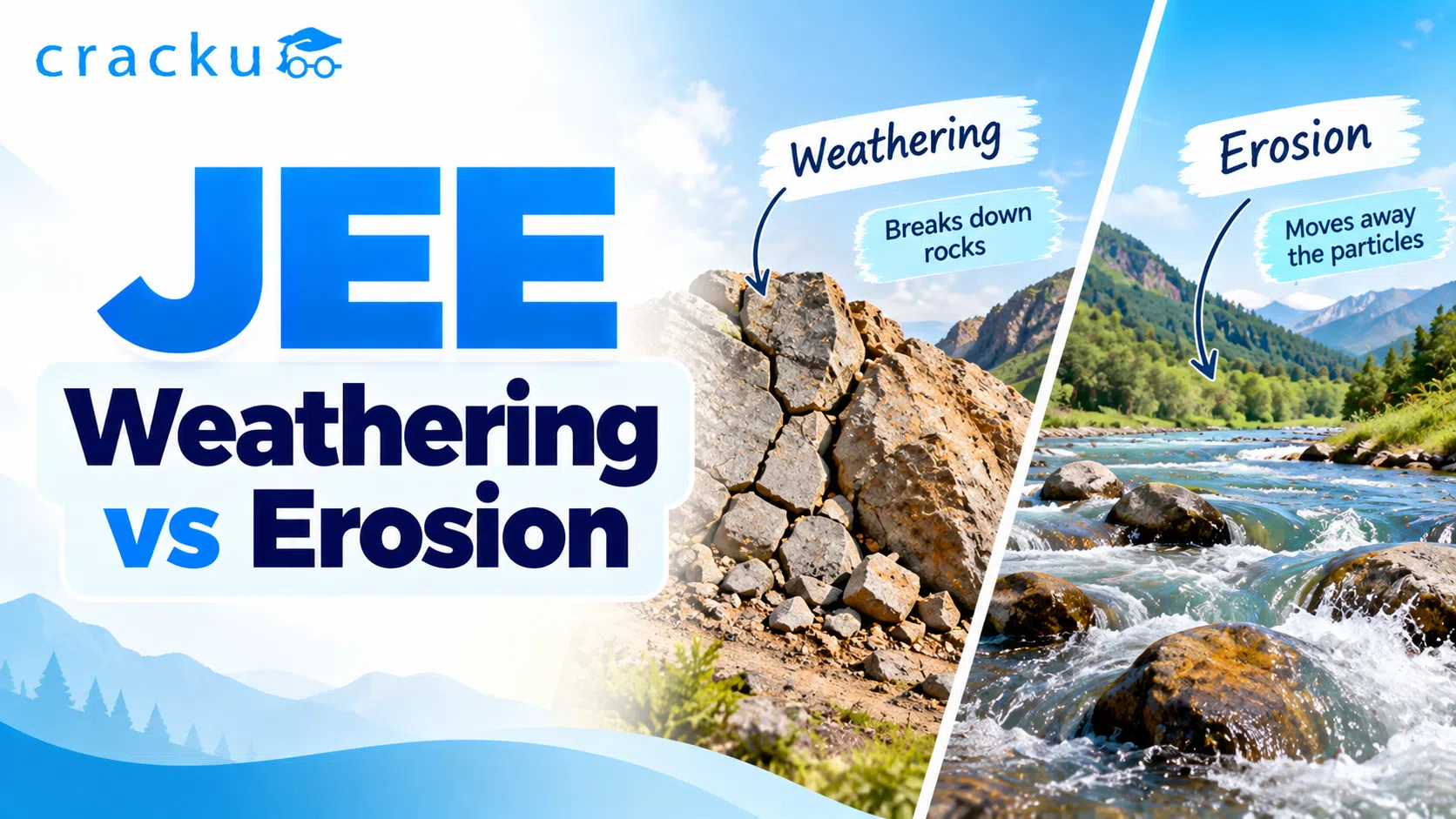
The difference between weathering and erosion comes down to one idea: weathering breaks rock down where it stands, while erosion carries the broken material away. For JEE Chemistry, weathering matters because it is driven by real reactions you already study: carbonation, hydrolysis, oxidation and acid rain attack. Erosion is the physical transport step that follows, and knowing where one ends and the other begins keeps your environmental chemistry answers clean.
What are Weathering and Erosion?
Weathering is the in-situ breakdown of rocks, minerals and man-made stone by physical, chemical or biological agents. No net transport occurs. A marble slab losing its polish to acid rain, or granite crumbling into clay minerals, is being weathered.
Erosion is the removal and transport of already loosened material by a moving agent: running water, wind, glaciers, waves or gravity. Erosion needs kinetic energy and a carrier; weathering does not.
The two are sequential. Weathering supplies the debris, erosion moves it, and deposition dumps it somewhere else. In chemistry terms, weathering is mostly a reaction, while erosion is mostly a mass-transfer process.
Key Differences Between Weathering and Erosion
| Property | Weathering | Erosion |
|---|---|---|
| Basic nature | Breakdown or decomposition of rock material | Detachment and transport of loosened material |
| Movement | In situ; material stays at the parent site | Material is displaced, often over long distances |
| Chemistry involved | Frequently chemical: hydrolysis, carbonation, oxidation, dissolution | Usually no chemical change; physical removal dominates |
| Main agents | Water, dissolved CO2, O2, acids, temperature cycles, lichens and roots | Rivers, rainfall runoff, wind, glaciers, sea waves, gravity |
| Energy requirement | Chemical potential energy; no bulk flow needed | Kinetic energy of the moving medium is essential |
| Typical products | Clay minerals, soluble bicarbonates, oxides, hydroxides, soil | Sediment, silt, sand deposits, deltas, dust in air |
| Rate control | Temperature, pH, partial pressure of CO2, surface area, humidity | Velocity of the agent, slope, vegetation cover, particle size |
| Climate link | Chemical weathering peaks in hot, humid climates | Wind erosion peaks in arid regions; water erosion in high-rainfall areas |
| Role in soil | Creates soil by generating fine mineral matter | Destroys soil by stripping the fertile topsoil |
| Reversibility | Chemical changes are effectively irreversible on human timescales | Transport can be reversed by deposition elsewhere |
| Everyday example | Yellowing and pitting of the Taj Mahal marble | Gully formation on a deforested hillside after monsoon rain |
Chemical Weathering: The Reactions That Matter
This is the part JEE actually tests. Four reaction types cover almost everything.
Carbonation. Rainwater dissolves atmospheric CO2 to form carbonic acid, which attacks carbonate rock. Unpolluted rain has a pH near 5.6 for exactly this reason.
CaCO3(s) + CO2(g) + H2O(l) → Ca(HCO3)2(aq)
This single equation explains limestone caves, stalactites, and the temporary hardness of groundwater in limestone belts. Reversing it by boiling precipitates CaCO3 back out.
Hydrolysis of silicates. Feldspar reacting with carbonic acid produces kaolinite clay, silicic acid and soluble ions:
2KAlSi3O8 + 2H2CO3 + 9H2O → Al2Si2O5(OH)4 + 4H4SiO4 + 2K+ + 2HCO3−
Oxidation. Iron-bearing minerals oxidise in moist air. Pyrite oxidation is the classic acid mine drainage reaction:
4FeS2 + 15O2 + 14H2O → 4Fe(OH)3 + 8H2SO4
Acid rain attack. SO2 and NOx from fossil fuel burning are oxidised in the atmosphere to H2SO4 and HNO3, dropping rain pH below 5.6. On marble:
CaCO3 + H2SO4 → CaSO4 + H2O + CO2
The CaSO4 formed is bulkier and flaky, which is why the damage is called stone leprosy. Drilling short reaction-based sets from JEE Questions is the quickest way to check whether you can balance these equations under time pressure rather than only recognise them.
Worked example. Water charged with 0.44 g of CO2 percolates through limestone. Moles of CO2 = 0.44/44 = 0.01 mol. From the carbonation equation the mole ratio is 1:1, so 0.01 mol of CaCO3 dissolves, that is 0.01 × 100 = 1.0 g of limestone. Scale that over centuries and you get a cave system.
Erosion: Agents, Transport and Quantitative Effects
Erosion is graded by the agent and by the mode of transport.
Water erosion: sheet, rill and gully erosion on land; abrasion and hydraulic action in riverbeds. Carries material as bed load, suspended load and dissolved load.
Wind erosion: deflation and abrasion in dry, sparsely vegetated regions; produces loess deposits and dust storms.
Glacial erosion: plucking and abrasion by ice; produces U-shaped valleys and moraines.
Coastal and gravity erosion: wave attack on cliffs, plus landslides and soil creep on slopes.
The chemistry link sits in the dissolved load. Ions released by weathering, mainly Ca2+, Mg2+, Na+, K+ and HCO3−, travel with the river water. That is why hard water occurs downstream of carbonate terrain.
Hardness calculation. Suppose river water contains 14.6 mg of Mg(HCO3)2 per litre. With molar mass 146 g mol−1, that is $$1.0 \times 10^{-4}$$ mol L−1. Expressed as CaCO3 equivalent: $$1.0 \times 10^{-4} \times 100 = 0.010$$ g L−1 = 10 mg L−1, so the hardness is 10 ppm. Conversions of this type between ppm, molarity and mass sit alongside the other standard relations in the JEE Formula Sheets, which is worth keeping open while you practise water-chemistry sums.
Similarities Between Weathering and Erosion
- Both are exogenic processes driven by energy from the Sun and the atmosphere, not from the Earth's interior.
- Both need water in most settings; moisture accelerates reaction rates and provides the transport medium.
- Both are accelerated by human activity: industrial SO2 speeds weathering, deforestation speeds erosion.
- Both contribute to the rock cycle, feeding sediment that eventually forms sedimentary rock.
- Both increase with surface area, so fragmented rock weathers and erodes faster than a monolith.
- Both influence soil quality, one by building it and the other by removing it.
Also Read: JEE SN1 Reactions vs SN2 Reactions: Differences & Examples
JEE Exam Perspective
Weathering and erosion do not appear as a standalone chapter. They surface inside topics you are already revising:
- Acid rain and atmospheric pollution: the pH threshold of 5.6, the oxidation of SO2 and NOx, and the damage to CaCO3 monuments.
- Hardness of water: temporary hardness from Ca(HCO3)2 and Mg(HCO3)2, permanent hardness from chlorides and sulphates, and removal by Clark's method, washing soda or ion exchange.
- s-block chemistry: solubility trends of carbonates and sulphates, thermal stability, and why CaSO4 is sparingly soluble.
- Metallurgy and corrosion: oxidation of iron-bearing minerals mirrors the rusting mechanism.
The standard trap is the definition swap: an option that describes transport of sediment but labels it weathering, or vice versa. Scanning statement-based questions in the JEE Mains Previous Papers shows how often environmental chemistry is set as assertion-reason rather than calculation.
Revision priority: memorise the four weathering reaction types with one balanced equation each, the 5.6 pH figure, and the hardness conversion. That covers almost every way the topic has been framed.
Also Read: JEE Thermoplastic vs Thermosetting Plastic: Differences & Examples
JEE Weathering vs Erosion: Conclusion
Weathering decomposes rock in place through chemical and physical action; erosion transports the debris using water, wind, ice or gravity. Weathering is where the chemistry lives, with carbonation, hydrolysis, oxidation and acid attack producing clays, oxides and soluble bicarbonates. Erosion is the follow-up physical step, though it carries the dissolved ions that create water hardness. Keep the in-situ versus transport test in your head and you will never confuse the two in an exam.