
 Group
Group
 Group
Group


 Preferred Source

 Google Discover
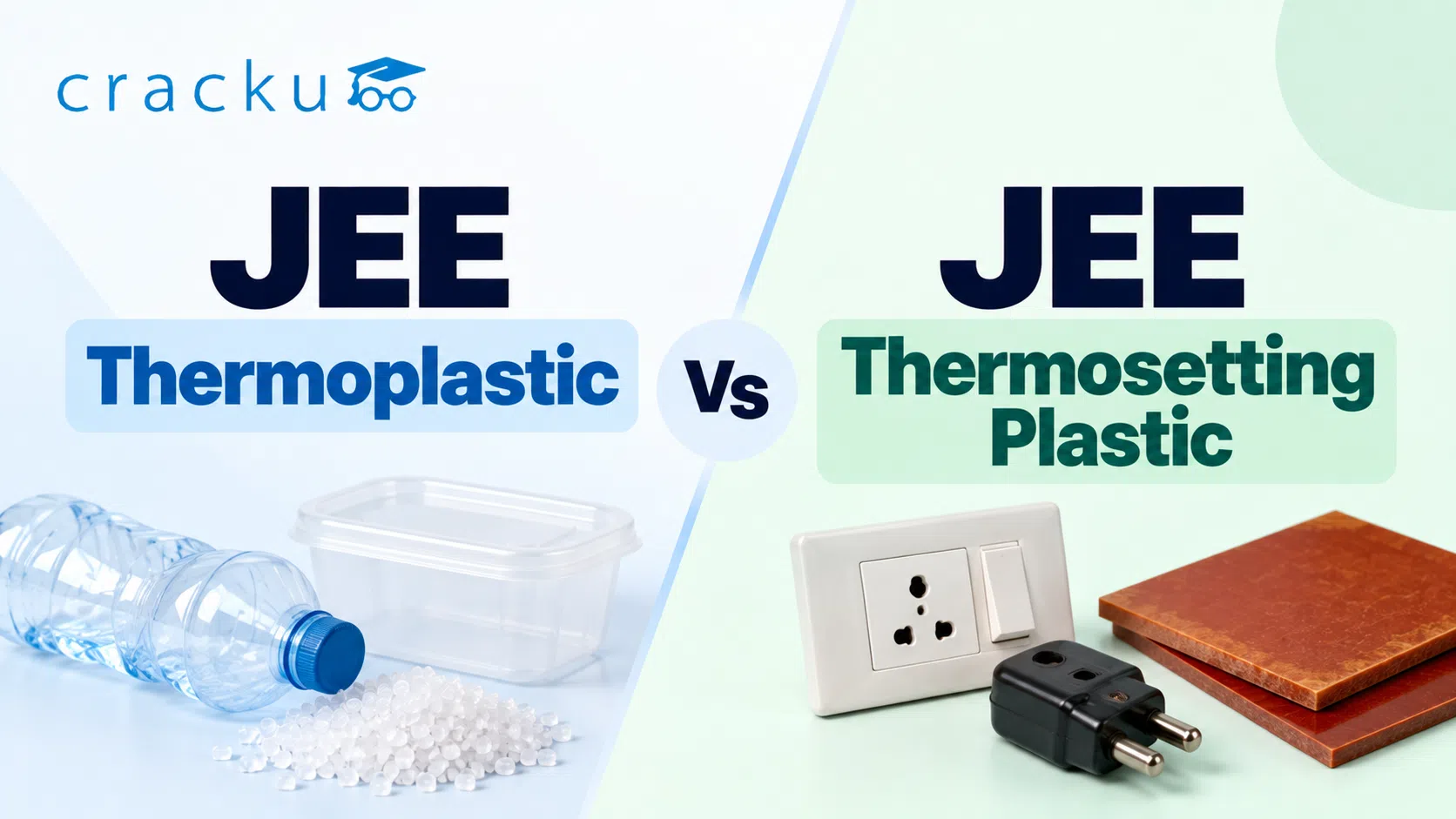
JEE Thermoplastic vs Thermosetting Plastic
The Difference Between Thermoplastic and Thermosetting Plastic often confuses students because both appear in the same NCERT chapter but behave very differently in the lab. Two minutes of clear comparison can save you from mixing them up in a six-mark JEE question.
What are Thermoplastic and Thermosetting Plastic?
Thermoplastics are linear or slightly branched polymers that soften on heating, can be moulded repeatedly, and harden on cooling. They show reversible physical change because their chains are held together mainly by weak van der Waals forces or dipole interactions.
Thermosetting plastics start as low-molecular-mass liquids or soft solids. On heating, they undergo an irreversible curing reaction, form extensive covalent cross-links, become rigid, and cannot be remoulded without charring. Think of bakelite handles: once set, they stay set.
Both classes arise from addition or condensation polymerisation but differ sharply in bonding, processing temperature, recyclability, and use cases. Grasping those contrasts helps you avoid losing marks in conceptual MCQs and assertion-reason pairs.
Key Differences Between Resistance and Resistivity
The table below collects every distinguishing point that JEE questions exploit. Read the geometry rows carefully, since most trap questions are built by changing dimensions and checking whether you wrongly change resistivity too.
| Property | Resistance | Resistivity |
|---|---|---|
| Definition | Opposition offered by a specific conductor to current flow | Opposition offered by unit length and unit area of a material |
| Symbol | $$R$$ | $$\rho$$ |
| Defining formula | $$R = \dfrac{V}{I}$$ | $$\rho = \dfrac{RA}{L}$$ |
| SI unit | ohm | ohm metre |
| Dimensional formula | $$[M L^2 T^{-3} A^{-2}]$$ | $$[M L^3 T^{-3} A^{-2}]$$ |
| Nature of quantity | Extensive, depends on the sample | Intensive, characteristic of the material |
| Effect of length | Directly proportional to length | Independent of length |
| Effect of area | Inversely proportional to area of cross-section | Independent of area of cross-section |
| Effect of shape | Changes on stretching, folding or cutting | Unchanged by any reshaping |
| Effect of temperature | Changes with temperature | Changes with temperature |
| Reciprocal quantity | Conductance, unit siemens | Conductivity, unit siemens per metre |
| Microscopic expression | $$R = \dfrac{mL}{n e^2 \tau A}$$ | $$\rho = \dfrac{m}{n e^2 \tau}$$ |
| Typical use | Circuit calculations, series and parallel networks | Material selection, comparing conductors and insulators |
The single relation that ties both quantities together, and the one that decides most objective questions, is:
$$R = \rho \frac{L}{A}$$
Key Differences Between Thermoplastic and Thermosetting Plastic
| Property | Thermoplastic | Thermosetting Plastic |
|---|---|---|
| Primary bonding | Weak intermolecular forces between chains | Strong covalent cross-links within a 3-D network |
| Softening behaviour | Softens repeatedly on heating | Softens only once; then hardens permanently |
| Melting/Curing point | Sharp melting point $$T_m$$ (e.g., HDPE 130 °C) | Curing range $$T_c$$ (e.g., phenol-formaldehyde 150 – 180 °C) |
| Recyclability | Can be remelted and recycled | Non-recyclable after setting |
| Mechanical toughness | Ductile; can be drawn into films/fibres | Brittle but hard; high dimensional stability |
| Chemical resistance | Moderate to high (depends on polymer) | Generally excellent against solvents and heat |
| Typical examples | Polyethylene, PVC, PTFE, Nylon-6 | Bakelite, Melamine, Epoxy resin, Urea-formaldehyde |
| Common uses | Pipes, packaging films, electrical insulation | Circuit boards, saucepan handles, auto parts |
For thermoplastics, viscosity changes with temperature as $$\eta = \eta_0 \exp\left(\frac{E_a}{RT}\right)$$; for fully cured thermosets, $$\eta \to \infty$$, hence no melting.
Molecular Structure and Bonding
Begin with the backbone. Most thermoplastics, such as polyvinyl chloride, contain long, flexible C–C chains with limited branching. The chains slide past one another when thermal energy overcomes van der Waals attractions, so the sample softens near $$T_g$$ and flows near $$T_m$$. No covalent bridges hinder movement.
Thermosetting systems are different at the molecular stage. Each monomer possesses two or more functional groups. During curing, these groups react to generate a vast cross-linked network. A phenol molecule, for instance, links with multiple formaldehyde units to form bakelite. Once created, the network locks each segment in place, preventing viscous flow even at high temperatures.
Degree of polymerisation need not be very high in thermosets because cross-link density, not chain length, dictates rigidity. Contrastingly, thermoplastics achieve toughness by increasing chain length and crystallinity. When revising polymers, keep a pocket copy of the relevant bond energies from the JEE Formula Sheets; they give you quick numeric proof of why cross-linked matrices resist heat better.
A sample point: HDPE contains about two branches per 1000 carbon atoms, promoting 80 % crystallinity and hence strength. Epoxy resin, however, has negligible crystallinity; its strength comes from the 3-D covalent lattice.
Thermal and Mechanical Behaviour
Thermoplastics follow a clear thermal cycle. Heat polypropylene above 165 °C, and it melts. Cool it, and it solidifies without chemical alteration. This cycle repeats a hundred times with minimal degradation, which is why PET bottles can be recycled by remelting and blow-moulding.
Thermosets behave more like concrete than metal. During the first heating, epoxy resin undergoes exothermic cross-linking. The glass transition temperature $$T_g$$ rises from 40 °C in the uncured state to around 120 °C post-cure. Beyond this, further heating only carbonises the sample. Mechanical testing shows that cured epoxy has a tensile modulus near 3 GPa, triple that of all-purpose polyethylene.
Stress–strain curves reflect these differences: thermoplastics give long plastic flow regions; thermosets fracture after a short elastic stretch. Such plots feature often in assertion-reason pairs. While practising end-chapter problems in JEE Questions, note how examiners couple “ductility” with “linear chains” to trap those who confuse the two plastics.
Finally, remember the role of fillers: adding glass fibres to a thermoplastic boosts modulus modestly, but the same fibre in a thermoset gives composite stiffness rivalling aluminium because the matrix itself does not yield under heat.
Similarities Between Thermoplastic and Thermosetting Plastic
- Both originate from organic monomers like ethylene, phenol, or formaldehyde.
- Both may be synthesised by free-radical, ionic, or coordination mechanisms, depending on the catalyst.
- Both can include additives: pigments, stabilisers, plasticisers, though thermosets need fewer.
- Electrical insulation is excellent for both, hence extensive use in electronics.
- Combustibility depends on the specific backbone; halogenated versions of both classes are flame-retardant.
- Environmental stress cracking can occur in either if design ignores notch sensitivity.
Yet the processing window, recyclability, and post-curing thermal limits remain the decisive separators, so keep the common points in perspective without losing sight of the distinctions.
JEE Exam Perspective
Polymer Chemistry contributes roughly 3 % of JEE Main and up to 6 % of JEE Advanced. Within that, at least one MCQ every alternate year contrasts thermoplastic behaviour with thermosetting curing. Solved examples from 2019 and 2022 papers show that examiners prefer conceptual wording “softens when heated”, “irreversibly hardens” rather than brand names.
Work through the polymer block in the JEE Mains Previous Papers to see a pattern: numerical questions rarely appear; instead, you get statement-based MCQs or match-the-columns pairing uses with polymer type. Memorise one unique property–example pair, such as “Bakelite: thermoset”. It helps eliminate distractors quickly.
When time is tight, apply this flowchart: check reversibility on heating, check presence of cross-links, assign class. Keep HT of softening or curing only as secondary evidence. This structured approach lets you answer within 30 s, freeing minutes for tougher physical-chemistry numericals.
Thermoplastic and Thermosetting Plastic: Conclusion
Thermoplastic and thermosetting plastics differ mainly in their molecular bonding, heating behaviour, and ability to be remoulded. Thermoplastics soften on heating and can be reshaped repeatedly, while thermosetting plastics develop permanent cross-links during curing. These structural differences influence their recyclability, mechanical properties, and industrial applications.
Understanding the difference between thermoplastic and thermosetting plastic is important for JEE Main and JEE Advanced preparation. Students should focus on bonding, thermal behaviour, examples such as PVC, Nylon-66, and Bakelite, and the distinction between reversible softening and irreversible curing. A clear understanding of these concepts helps solve conceptual questions and revise polymer chemistry effectively.