JEE WhatsApp Group


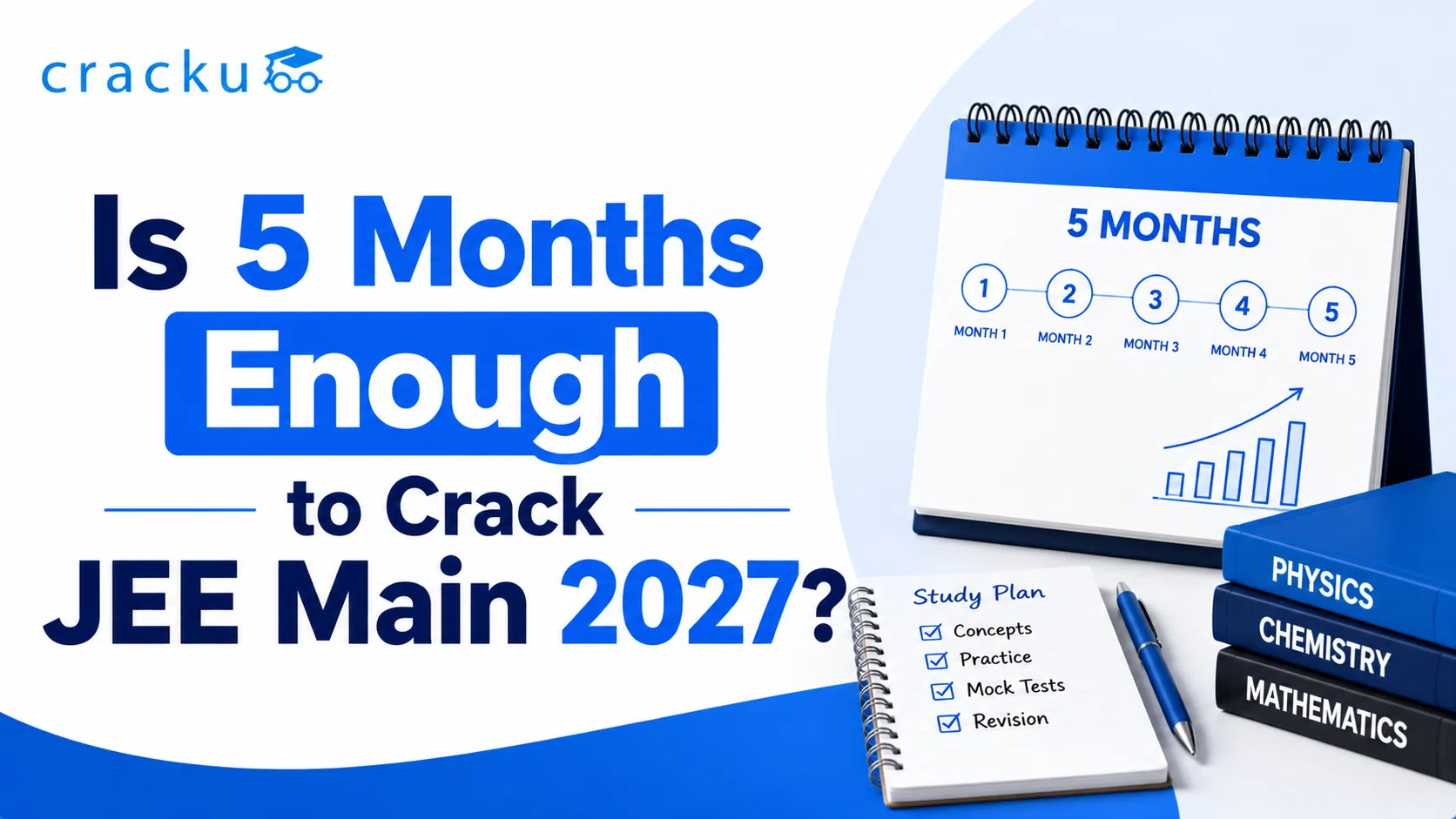
Preparing for JEE Main 2027 in five months requires a focused approach, smart time management and consistent effort. With a limited preparation window, students need to prioritize the right topics, strengthen core concepts and make every study session count. Instead of trying to cover the entire syllabus at once, it is important to follow a structured JEE Mains preparation strategy that balances syllabus coverage, practice, revision and testing.
Solving JEE Mains Previous Papers, setting a realistic JEE Daily Target and regularly taking mock tests can help track progress and identify areas that need improvement. Whether you are starting your preparation, catching up on unfinished topics or revising what you have already studied, a well-planned five-month approach can help you make the most of the available time and improve your chances of achieving a good score in JEE Main 2027.
How to Prepare for JEE Main 2027 in 5 Months
Preparing for JEE Main 2027 in just five months may seem challenging, but with a structured plan, consistent practice and the right resources, you can make significant progress. The key is to balance concept building, revision, problem-solving and regular testing throughout your preparation.
Understand the JEE Mains Syllabus
Start by going through the complete JEE Main syllabus and identify chapters based on your current preparation level. Divide the syllabus into three categories:
- Strong topics that need regular revision
- Moderate topics that require more practice
- Weak topics that need concept building from scratch
Prioritize high-weightage and frequently asked chapters while ensuring that you gradually cover the entire syllabus.
Create a 5-Month JEE Mains Preparation Strategy
Divide your five months into clear phases instead of trying to complete everything at once.
Month | Primary Focus |
Month 1 | Build concepts and cover important chapters |
Month 2 | Complete more syllabus and practice questions of the |
Month 3 | Finish remaining topics and begin intensive revision |
Month 4 | Full-length tests, PYQs and targeted revision |
Month 5 | Mock tests, revision and exam strategy |
Set realistic weekly goals and track your progress using a JEE Daily Target. This will help you stay consistent without getting overwhelmed.
Focus on JEE Mains Important Topics
Not every chapter requires the same amount of preparation time. Identify the important topics in Physics, Chemistry and Mathematics based on previous years' questions and your strengths and weaknesses.
For every chapter, follow this sequence:
Learn the concept → Revise formulas → Solve basic questions → Attempt JEE Questions → Practise PYQs → Take a chapter test
This approach helps you move from understanding a topic to applying it under exam conditions.
Practice JEE Mains Previous Papers
Previous-year questions are among the most useful resources for understanding the actual level and pattern of JEE Questions.
Solve JEE Mains Previous Papers chapter-wise initially. Once you have covered a substantial portion of the syllabus, start solving complete papers within the prescribed time limit.
While analyzing your mistakes, categories them as:
- Conceptual errors
- Calculation mistakes
- Incorrect question selection
- Time-management issues
- Careless errors
Take JEE Mains Mock Tests Regularly
Testing should become an important part of your preparation by the third month. Initially, take chapter-wise and part-syllabus tests. As you approach the exam, increase the frequency of full-length JEE Mains Mock Test attempts.
After every test, spend sufficient time analysing:
- Which questions were left unanswered?
- Which questions took too long?
- Where did you lose marks?
- Which chapters need revision?
- How accurate were your attempts?
Revise Every Week
Do not postpone revision until the final month. Keep one regular revision session every week to revisit formulas, concepts, mistakes and previously solved questions.
A simple revision cycle can be:
Daily revision → Weekly revision → Monthly revision → Final revision
This reduces the chances of forgetting chapters that you completed several weeks earlier.
Also Read: Is August Too Late to Start JEE Main 2027 Preparation?
JEE Main 2027 5-Month Study Plan
Month | Preparation Focus | Physics | Chemistry | Mathematics | Practice & Revision |
August 2026 | Build fundamentals | Strengthen basics and start JEE Mains high-weightage chapters | Build concepts across Physical, Organic & Inorganic Chemistry | Cover fundamental chapters | Start chapter-wise JEE Questions and make short notes |
September 2026 | Accelerate syllabus coverage | Complete major Class 11 & 12 topics | Focus on important concepts, reactions and NCERT | Cover high-weightage chapters and practice regularly | Solve JEE Mains Previous Papers chapter-wise |
October 2026 | Complete major syllabus | Finish remaining important chapters | Complete major topics and revise reactions/formulas | Complete important chapters and strengthen weak areas | Begin part-syllabus tests and maintain an error log |
November 2026 | Finish syllabus + first revision | Revise completed chapters and formulas | Revise NCERT, reactions and important concepts | Revise formulas and difficult topics | Start regular JEE Mains Mock Test practice |
December 2026 | Intensive revision | Revise full syllabus and practice PYQs | Rapid revision of NCERT, formulas and reactions | Revise important concepts and PYQs | Take full-length mocks and analyze mistakes |
January 2027 | Final revision & exam readiness | Formula revision + weak topics | NCERT revision + important reactions | Formula revision + selected PYQs | Full-length mocks, JEE Mains Formula Sheet, error-log revision and time-management practice |
How Many Hours Should You Study for JEE Main 2027?
The number of hours you should study for JEE Main 2027 depends on your current preparation level, school or college schedule, and how much of the syllabus you have completed. Instead of simply counting study hours, focus on productive study time that includes learning concepts, solving questions, revision and mock-test analysis.
Preparation Stage | Daily Study Hours | Primary Focus |
Starting preparation | 4–6 hours | Concept building and syllabus coverage |
Regular preparation | 6–8 hours | Concepts, problem-solving and PYQs |
Intensive preparation | 8–10 hours | Syllabus completion, revision and tests |
Final 1–2 months | 8–10 hours | Mock tests, PYQs and revision |
How to Divide Your Study Hours
A balanced daily schedule can look like this:
Activity | Daily Time |
Physics | 2–2.5 hours |
Chemistry | 2–2.5 hours |
Mathematics | 2–2.5 hours |
Revision & formula practice | 1 hour |
PYQs / test analysis | 1–2 hours |
Also Read: How Many Hours Should JEE Mains Aspirants Study Daily?
How to Score 99 Percentile in JEE Main 2027 in 5 Months
Scoring 99 percentile in JEE Main 2027 within five months is challenging, but a focused preparation strategy can make it achievable. The key is not simply studying for long hours but using the available time efficiently through syllabus coverage, JEE Questions, previous-year papers, revision and regular mock tests.
1. Know Where You Stand
Before starting your five-month preparation, take a diagnostic test covering topics you have already studied. Analyze your score and identify:
- Chapters you are confident in
- Chapters requiring revision
- Completely untouched topics
- Frequently repeated mistakes
- Your speed and accuracy
This gives you a realistic starting point and helps you build a personalized JEE Mains preparation strategy.
2. Follow a 5-Month Strategy
Month | Main Goal | What to Focus On |
August 2026 | Build momentum | Strengthen concepts and cover important chapters |
September 2026 | Syllabus coverage | Complete more chapters and practice JEE Questions |
October 2026 | Complete major syllabus | Finish important topics and start systematic revision |
November 2026 | Revision + testing | Solve PYQs and begin regular mock tests |
December 2026 | Intensive practice | Full-syllabus revision, PYQs and full-length tests |
January 2027 | Final preparation | Mock tests, formula revision, error correction and exam strategy |
3. Priorities: High-Value Topics
With only five months available, avoid spending disproportionate time on a single difficult chapter. Start with important chapters, relatively scoring and aligned with your current preparation level.
For every chapter, use this sequence:
Concepts → Short notes → JEE Questions → PYQs → Chapter test → Revision
Once a chapter is consistently producing good accuracy in tests, move on rather than repeatedly studying the same material.
4. Make PYQs a Daily Habit
JEE Mains Previous Papers can help you understand the types of questions asked, recurring concepts and the level of difficulty.
Initially, solve PYQs chapter-wise. Once you have completed most of the syllabus, start attempting complete papers under exam-like conditions.
After solving each paper, don't just check your score. Record:
- Questions you got wrong
- Questions you guessed
- Questions that took too long
- Concepts you forgot
- Calculation and silly mistakes
5. Take Mock Tests Strategically
Don't wait until the final month to start testing.
A practical progression is:
Period | Test Strategy |
August–September | Chapter-wise tests |
October | Part-syllabus tests |
November | Full-length tests every 1–2 weeks |
December | 2–3 full-length tests per week |
January | Regular full-length mocks with detailed analysis |
What to Do in the Final Month
By December, your priority should shift from learning to revision and performance improvement.
In January:
- Revise important chapters
- Solve selected PYQs
- Take full-length mock tests
- Analyse every mock
- Revise your error log
- Review your formula sheet
- Strengthen repeatedly weak areas
- Practise exam-time management
What Should You Study First for JEE Main 2027?
If you are starting your JEE Main 2027 preparation in August 2026, don't try to study all chapters simultaneously. Start with topics that build your fundamentals and connect to multiple chapters later. Before making your chapter priority list, check the latest syllabus issued by NTA.
1. Start With High-Impact Chapters
Subject | Study These Topics First |
Physics | Units & Measurements, Kinematics, Laws of Motion, Work, Energy & Power, Current Electricity, Electrostatics, Modern Physics |
Chemistry | Mole Concept, Atomic Structure, Chemical Bonding, Periodic Table, Thermodynamics, Equilibrium, GOC, Hydrocarbons |
Mathematics | Basic Mathematics, Quadratic Equations, Sequence & Series, Straight Lines, Matrices & Determinants, Limits, Differentiation, Probability |
2. Follow This Order
Instead of randomly picking chapters, follow a progression:
Concepts → Important chapters → JEE Questions → JEE Mains Previous Papers → Chapter tests → Revision
For example, in Physics, build your mechanics fundamentals before moving to more advanced applications. In Chemistry, complete foundational topics such as Mole Concept, Atomic Structure and Chemical Bonding before moving deeper into Physical and Inorganic Chemistry.
3. Priorities According to Your Strengths
Your chapter order should also depend on your current preparation.
Your Situation | What to Study First |
Starting from scratch | Basic + foundational chapters |
Some preparation done | Important chapters you haven't completed |
Strong in concepts | PYQs + high-weightage chapters |
Weak in a subject | Scoring and foundational chapters first |
Syllabus mostly complete | PYQs + revision + mock tests |
4. Don't Ignore NCERT Chemistry
For Chemistry, particularly Inorganic Chemistry, make NCERT a regular part of your preparation. Read the relevant sections carefully, make concise notes and revise them repeatedly.
5. Start PYQs Early
Don't wait until the entire syllabus is complete to solve JEE Main previous papers. Once you finish a chapter, solve its PYQs immediately.
This helps you understand:
- What concepts are repeatedly tested
- The type of questions asked
- Your actual level of preparation
- Which areas require more practice
Also Read: JEE Mains Important Chapters 2027, Subject-Wise Weightage
Conclusion
Yes, five months can be enough to crack JEE Main 2027 if you follow a focused and realistic preparation plan. Prioritise foundational and high-weightage chapters, set achievable weekly targets and solve JEE Main questions after completing each concept. Regular practice with previous-year papers will help you understand recurring topics and improve your problem-solving skills.
During the final two months, shift your focus towards revision, full-length mock tests, formula practice and detailed performance analysis. Maintain an error log, revise weak areas and improve your question-selection strategy after every test. A good JEE Main 2027 score will depend more on consistent and productive preparation than simply studying for long hours.