Join WhatsApp Icon JEE WhatsApp Group
JEE Chemical Bonding & Molecular Structure Questions

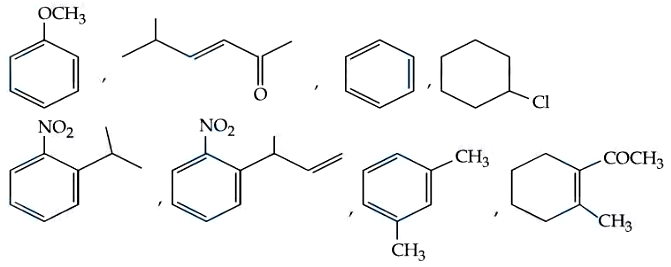
Question 1

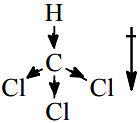
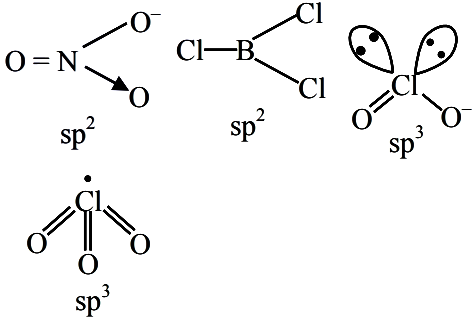
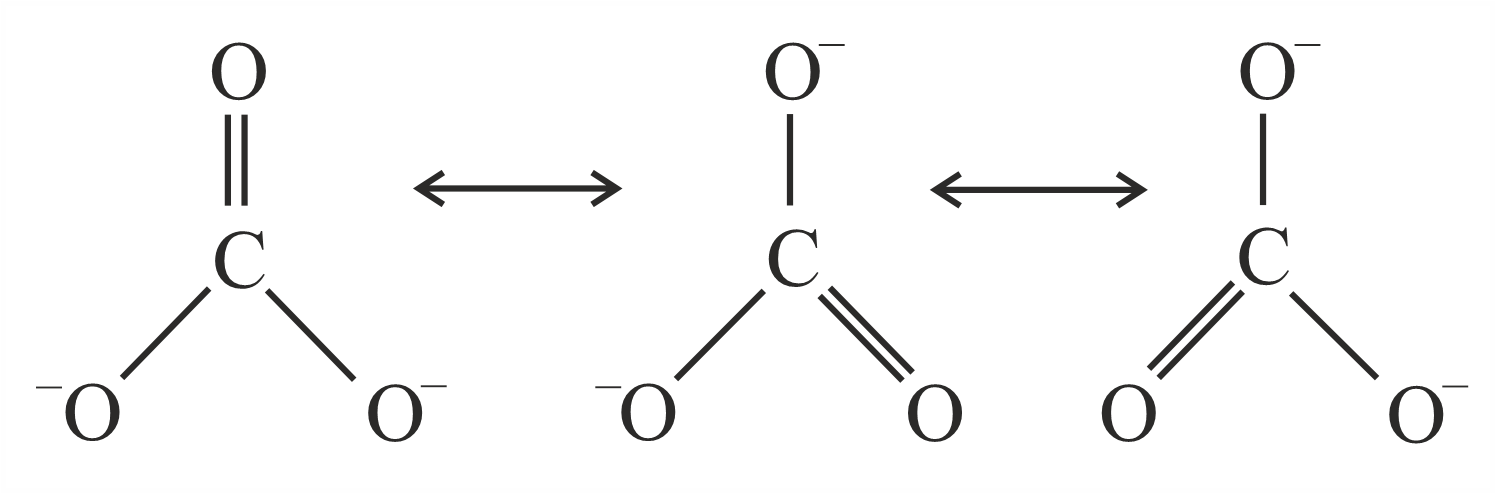
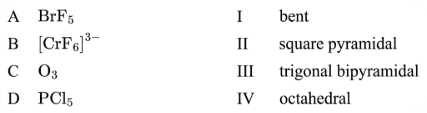
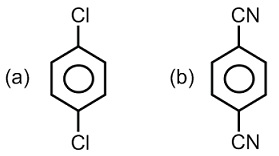
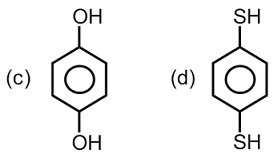
The correct order of dipole moments for the given species is

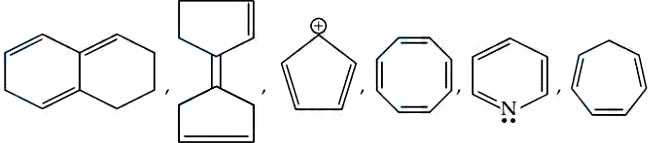
Question 2

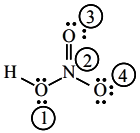
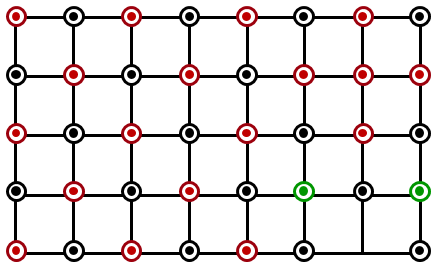
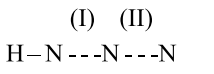
The correct order of ONO bond angle in the given species is

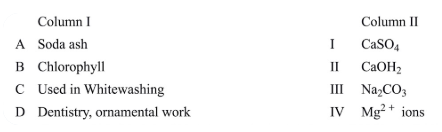
Question 3

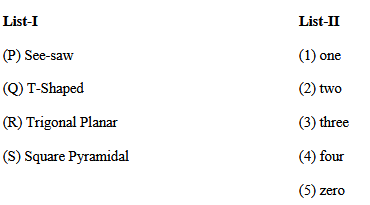
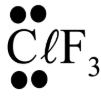
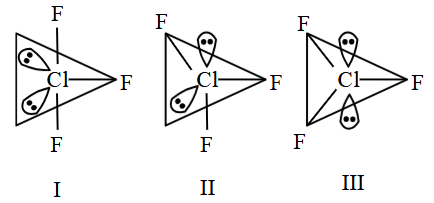
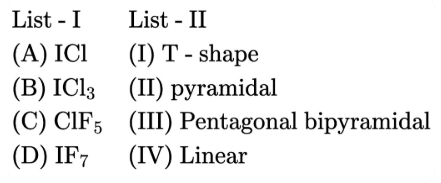
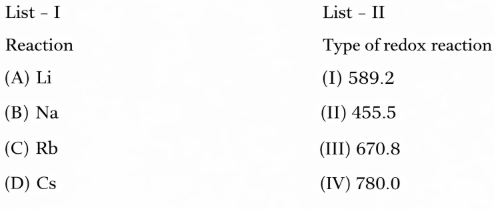
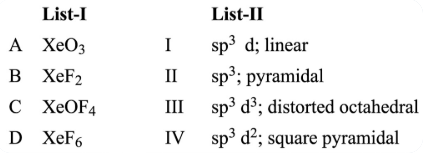
Consider the following species:

$$SOCl_2$$, $$XeOF_4$$, $$ClF_3$$, $$ClF_5$$, $$XeF_5^{+}$$, $$SO_3^{2-}$$, $$XeF_3^{+}$$, $$SF_4$$

List-I contains different molecular shapes and List-II contains total number of species with the same molecular shapes from the given species. Match each entry in List-I with the appropriate entry in List-II and choose the correct option.

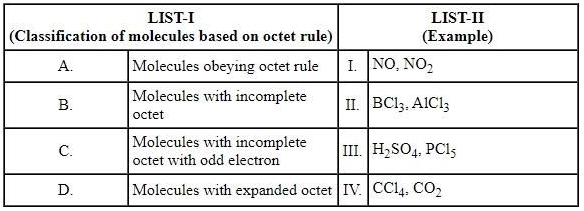
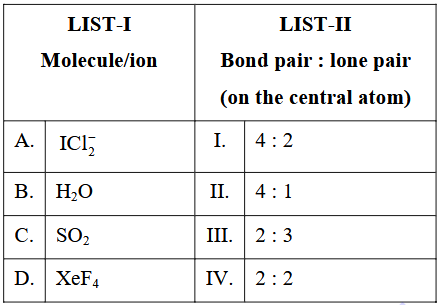
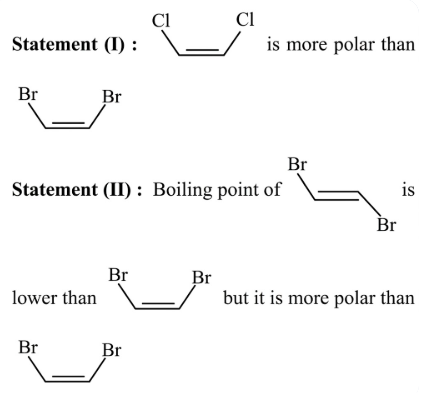
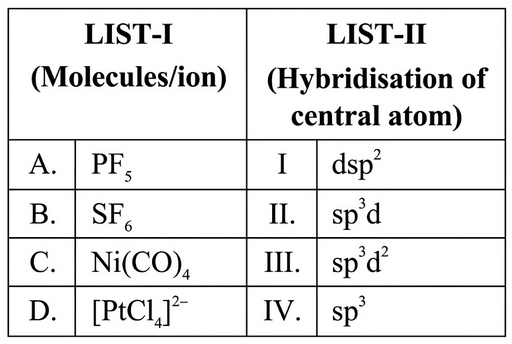
image
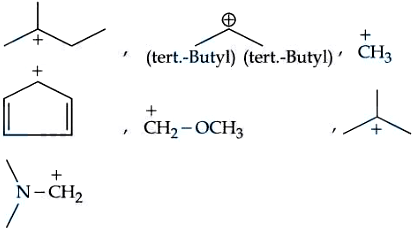
Question 4

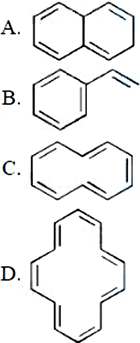
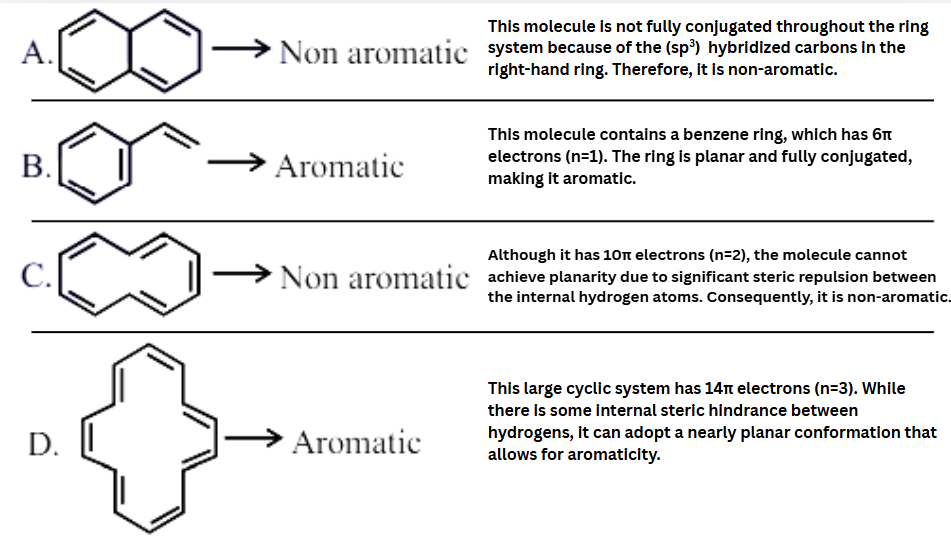
Find out the statements which are not true.
A. Resonating structures with more number of covalent bonds and lesser charge separntion are more stable.
B. In electromeric effect, an unsaturated system shows +E effect with nucleophile and -E effect with electrophile.
C. Inductive effect is responsible for high melting point, boiling point and dipole moment of polar compotmds.
D. The greater the number of alkyl groups attached to the doubly bonded carbon atoms, higher is the heat of hydrogenation.
E. Stability of carbanion increases with the increase in s - character of the carbon carrying the negative charge.

Choose the correct answer from the options given below:

Question 5

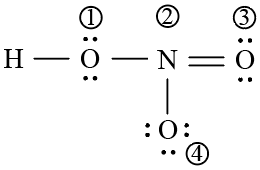
The formal charges on the atoms marked as (1) to (4) in the Lew is representation
of $$HNO_{3}$$ molecule respectively are

Screenshot_45
Question 6

Bromine trifluoride autoionizes to form $$\text{BrF}_2^+$$ and $$\text{BrF}_4^-$$. The shapes of the cation and anion are respectively __________, and __________.

Question 7

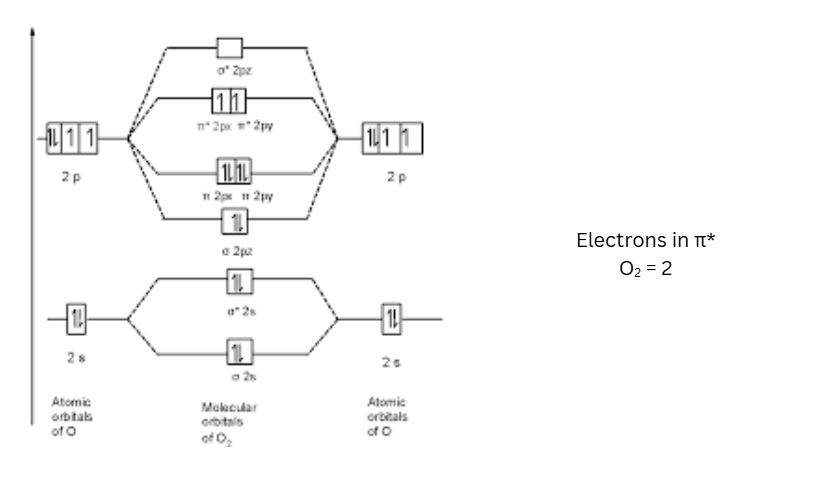
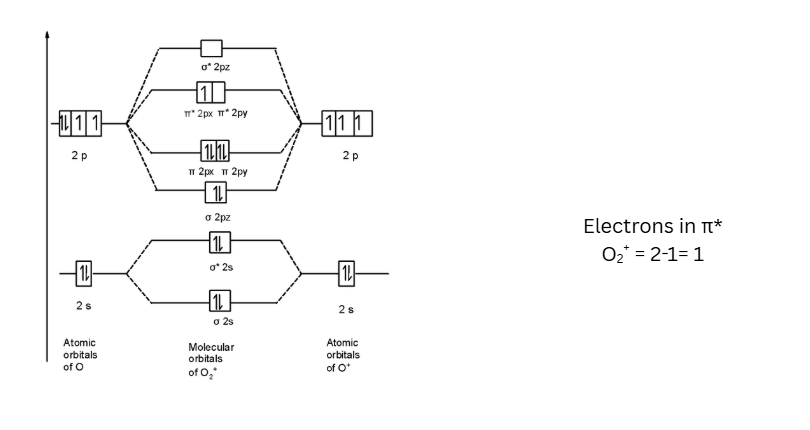
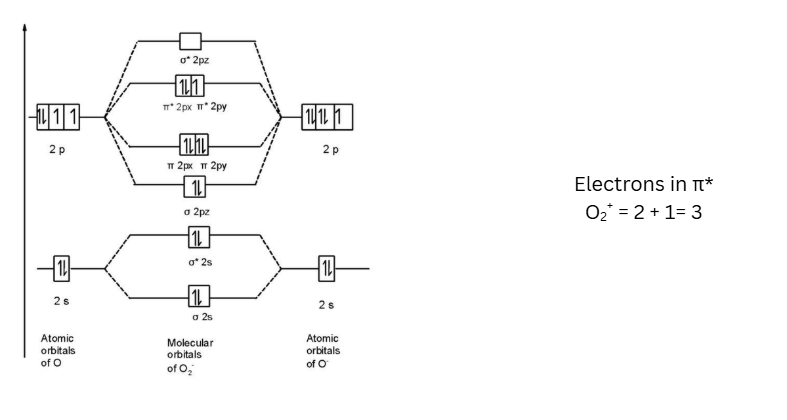
Given below are two statements : **Statement (I) :** The correct sequence of bond lengths in the following species is : $$O_2^+ < O_2 < O_2^- < O_2^{2-}$$ **Statement (II) :** The correct sequence of number of unpaired electrons in the following species is : $$O_2 > O_2^+ > O_2^- > O_2^{2-}$$ In the light of the above statements, choose the correct answer from the options given below :

Question 8

Given below are two statements :
Statement I : The number of compounds among SO$$_2$$, SO$$_3$$, SF$$_4$$, SF$$_6$$ and H$$_2$$S in which sulphur does not obey the Octet rule is 3.
Statement II : Among [H$$_2$$O, ClF$$_3$$, SF$$_4$$], [NH$$_3$$, BrF$$_5$$, SF$$_4$$], [BrF$$_5$$, ClF$$_3$$, XeF$$_4$$] and [XeF$$_4$$, ClF$$_3$$, H$$_2$$O], the number of sets in which all the molecules have one lone pair of electrons on the central atom is 1.
In the light of the above statements, choose the correct answer from the options given below :

Question 9

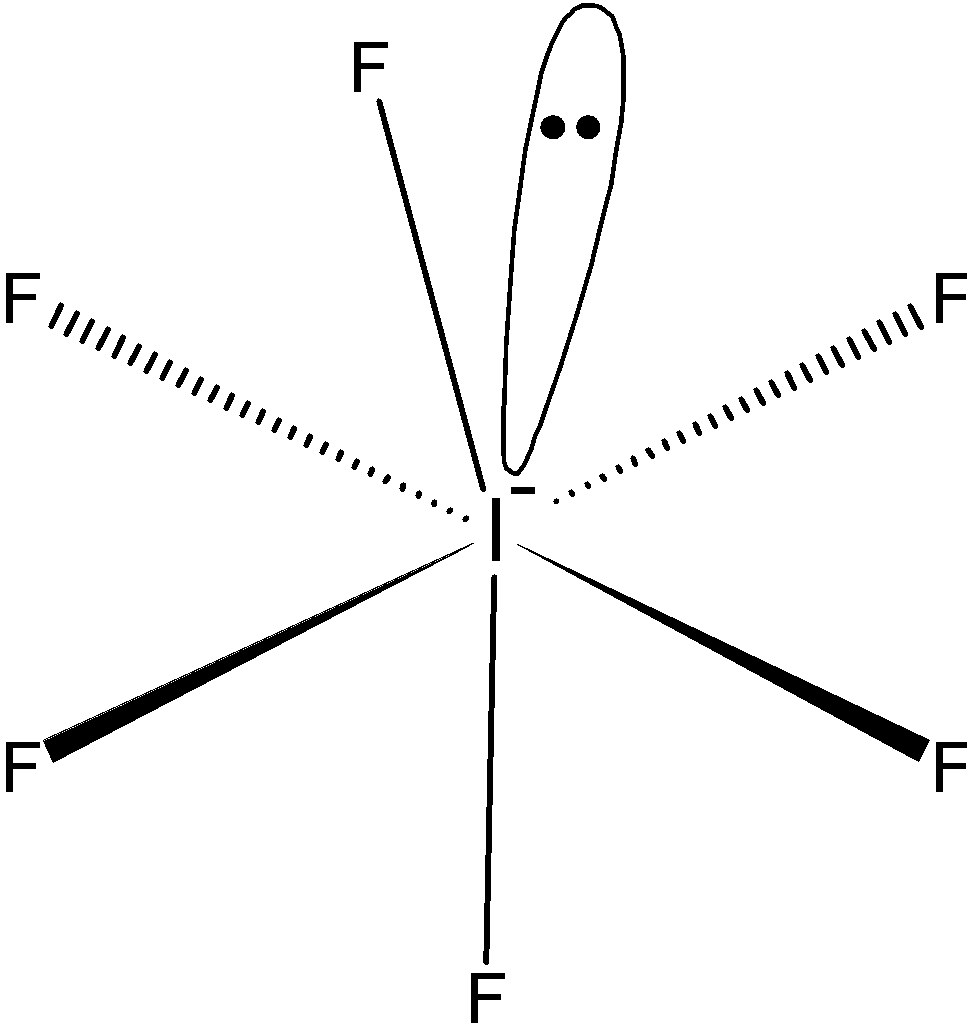
$$SF_4$$ is isostructural with :
A. $$BrF_4^\ominus$$
B. $$CH_4$$
C. $$IF_4^\oplus$$
D. $$XeF_4$$
E. $$XeO_2F_2$$
Choose the correct answer from the options given below :

Question 10

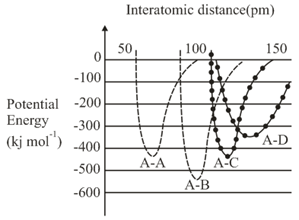
The covalent radii of atoms A and B are $$r_A$$ and $$r_B$$ respectively. The covalent bond length and total length of $$AB$$ molecule are respectively  :

Question 11

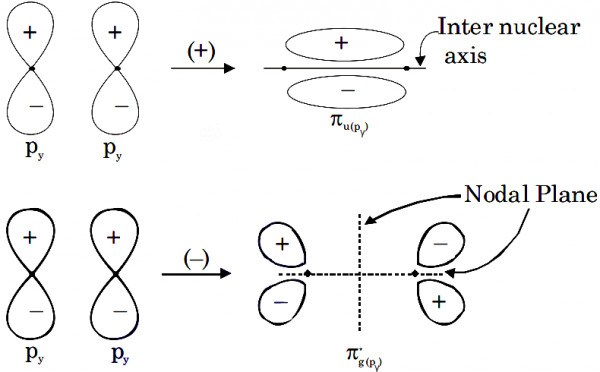
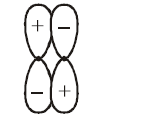
Which of the following pictorial diagram most correctly represents the $$\pi^*$$ ($$\pi$$ - antibonding) molecular orbital between two atoms if the internuclear axis is taken to be in the z-direction $$(\xrightarrow{z-axis})$$?

Question 12

The pairs among
$$A = [SO_3^{2-}, CO_3^{2-}]$$, $$B = [O_2^{2-}, F_2]$$, $$C = [CN^-, CO]$$, $$D = [NH_3, H_3O^+]$$ and $$E = [MnO_4^{2-}, CrO_4^{2-}]$$ that do not have similar Lewis dot structure are:

Question 13

Given below are statements about some molecules/ions.
Identify the CORRECT statements.
A The dipole moment value of $$NF_{3}$$ is higher than that of $$NH_{3}$$.
B. The dipole moment value of $$BeH_{2}$$ is zero.
C. The bond order of $$O_{2}^{2-}$$ and $$F_{2}$$ is same.
D. The formal charge on the central oxygen atom of ozone is -1 .
E. In $$NO_{2}$$, all the three atoms satisfy the octet rule, hence it is very stable.
Choose the correct answer from the options given below:

Question 14

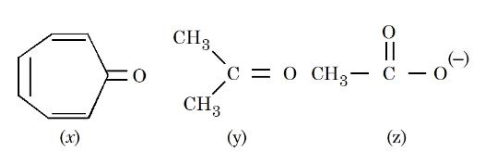
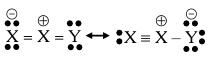
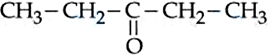
Consider the following molecules/species:

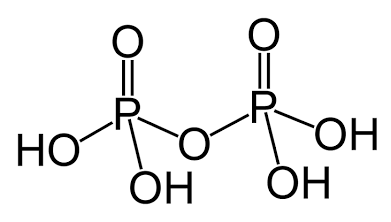
image

The correct order of carbon-oxygen double bond length is:

Question 15

Given below are two statements:
Statement I: The correct order in terms of bond dissociation enthalpy is $$Cl_{2} > Br_{2} > F_{2} > I_{2}$$.
Statement II : The correct trend in the covalent character of the metal halides is $$[SnCl_{4} > SnCl_{2}]$$, $$[PbCl_{4}> PbCl_{2}]$$, and $$[UF_{4} > UF_{6}]$$.
In The light oh the above statements, choose the correct answer from the options given below:

Question 16

Pair of species among the following having same bond order as well as paramagnetic character will be-

Question 17

Among $$H_{2}S$$, $$H_{2}O$$, $$NF_{3}$$, $$NH_{3}$$ and $$CHC1_{3}$$, identify the molecule (X) with lowest dipole moment value. The number of lone pairs of electrons present on the central atom of the molecule (X) is :

Question 18

Consider the transition metal ions $$Mn^{3+}, Cr^{3+}, Fe ^{3+}$$ and $$Co^{3+}$$ and all form low spin octahedral complexes. The correct decreasing order of unpaired electrons in their respective d-orbitals of the complexes is

Question 19

ldentify the molecule (X) with maximum number of lone pairs of electrons (obtained using Lewis dot structure) among $$HNO_{3},H{2}SO_{4},NF_{3}\text{ and }O_{3}$$. Choose the correct bond angle made by the central atom of the molecule (X).

Question 20

Given below are two statements:
Statement I: The number of species among $$BF_{4}^{-},SiF_{4},XeF_{4}\text{ and }SF_{4}$$,that have unequal E-F bond lengths is two. Here, E is the central atom.
Satement II: Among $$O_{2}^{-},O_{2}^{2-},F_{2}\text{ and }O_{2}^{+},O_{2}^{-}$$ has the highest bond order.
In the light of the above statements, choose the correct answer from the options given below

Question 21

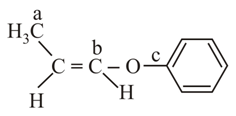
The correct increasing order of C - H(A), C - 0 (B), C = O(C) and C = N (D) bonds in terms of covalent bond length is :

Question 22

Which statements are NOT TRUE about $$XeO_2 F_2$$?

A. It has a see-saw shape.
B. Xe has 5 electron pairs in its valence sheU in XeO 2 F 2.
C. The $$O - Xe- O$$ bond angle is close to $$180^{o}$$.
D. The $$F- Xe -F$$ bond angle is close to $$180^{o}$$.
E. $$Xe$$ has 16 valence electrons in $$XeO_2 F_2$$.

Choose the correct answer from the options given below:

Question 23

According to Lewis theory, the total number of $$\sigma$$ bond-pairs and lone pair of electrons around the central atom of $$\text{XeO}_6^{4-}$$ ion is _____.

Question 24

Consider the following species:
$$BrF_5$$, $$XeF_5^-$$, $$BF_4^-$$, $$ICl_4^-$$, $$XeF_4$$, $$SF_4$$, $$NH_4^+$$, $$ClF_3$$, $$XeF_2$$, $$ICl_2^-$$
Number of species having $$sp^3d$$ hybridized central atom is _______.

Chemical Bonding and Molecular Structure is one of the highest-weightage and most conceptually central chapters in JEE Chemistry. It explains how atoms combine, the geometry molecules adopt, and the properties that result - making it the lens through which all of Inorganic and Organic Chemistry becomes logical. The chapter covers Lewis structures, formal charge, VSEPR theory and geometry, hybridisation, valence bond theory, molecular orbital theory and bond order, dipole moment and polarity, and hydrogen bonding. JEE Main tests hybridisation, VSEPR geometry, molecular orbital bond order, and polarity consistently. JEE Advanced probes molecular orbital theory and structure-property links in depth. Practise topic-wise questions on JEE Chemistry Questions to determine geometry, hybridisation, and bond order quickly.

Chemical Bonding and Molecular Structure Topic Overview

ParameterDetails
Topic NameChemical Bonding and Molecular Structure
SubjectChemistry – Physical and Inorganic
JEE Main Weightage~5–7% (2–3 questions on average)
JEE Advanced Weightage~5–8% (conceptual and structure-based)
Difficulty LevelModerate to High
Important ConceptsVSEPR, Hybridisation, Molecular Orbital Theory, Bond Order, Dipole Moment
Recommended Practice LevelVery High – attempt 80+ mixed problems

Why Practice JEE Chemical Bonding and Molecular Structure Questions?

  • Very high weightage: Contributes 2–3 questions in JEE Main consistently.
  • Cross-subject foundation: Bonding underpins both Inorganic and Organic Chemistry throughout the paper.
  • VSEPR and hybridisation: These yield direct, frequently tested geometry questions.
  • Molecular orbital theory: Bond-order and magnetic-property questions are JEE staples.
  • Polarity and dipole moment: Connect structure directly to physical properties.
  • Strong in Advanced: Structure-property and MOT problems appear regularly.
  • Conceptual leverage: Understanding bonding clarifies reactivity across the entire subject.

Important Concepts and Subtopics

ConceptImportanceDifficulty LevelFrequently Asked In
Lewis Structures and Formal ChargeHighModerateJEE Main
VSEPR Theory and Molecular GeometryVery HighModerateJEE Main and Advanced
HybridisationVery HighModerateJEE Main and Advanced
Valence Bond TheoryHighModerateJEE Main
Molecular Orbital Theory and Bond OrderVery HighModerate–HighJEE Main and Advanced
Dipole Moment and PolarityHighModerateJEE Main and Advanced
Hydrogen BondingHighEasy–ModerateJEE Main
Bond Parameters (Length, Strength)ModerateModerateJEE Main and Advanced

Preparation Strategy for JEE Chemical Bonding and Molecular Structure

Concept learning: Begin with Lewis structures and formal charge, then master VSEPR theory to predict geometry from electron-pair arrangement. Learn hybridisation as the bridge between geometry and orbital description. Then study molecular orbital theory, focusing on energy-level diagrams and bond order for diatomic molecules.

Formula revision: Keep the VSEPR geometry chart, the hybridisation steric-number rule, the molecular orbital filling order, the bond-order formula, and the conditions for polarity together for quick review. Organised JEE Study Material helps you compile geometry charts, hybridisation tables, and MOT diagrams in one reference for fast and reliable recall.
Problem-solving techniques: For geometry, count bonding pairs and lone pairs and apply VSEPR. For hybridisation, compute the steric number as sigma bonds plus lone pairs. For bond order, fill the molecular orbital diagram and apply the (bonding minus antibonding) divided by 2 formula. For polarity, sum the bond-dipole vectors considering the molecule's symmetry.

Common mistakes: Ignoring lone pairs in geometry determination, incorrect steric-number counting, filling molecular orbitals in the wrong order, and assuming a molecule is polar without checking symmetry cancellation.

Exam strategy: Solve direct hybridisation and geometry questions first for quick marks, then tackle molecular orbital and polarity problems that require more analysis.

JEE Main and Advanced Weightage Analysis

ExamAverage QuestionsExpected Marks
JEE Main2–38–12
JEE Advanced2–3 (conceptual)8–14

Chemical Bonding and Molecular Structure is one of the most heavily weighted chapters in both exams. In Main it focuses on hybridisation, VSEPR, and bond order; in Advanced it appears in structure-property and molecular-orbital reasoning problems.

Tips to Solve Chemical Bonding Questions Faster

  • Count bonding pairs and lone pairs first, then match to the VSEPR shape table.
  • Compute the steric number as sigma bonds plus lone pairs on the central atom for hybridisation.
  • Fill the molecular orbital diagram and apply the bond-order formula to determine magnetism.
  • A molecule is non-polar if bond dipoles cancel due to symmetry, even when individual bonds are polar.
  • Predict paramagnetic behaviour from unpaired electrons in the molecular orbital diagram.
  • Recall that hydrogen bonding strongly affects boiling points and explains anomalies in physical properties.

Reinforce these with a timed JEE Mock Test to build geometry and hybridisation fluency under exam conditions.

Frequently Asked Questions