
Join Our JEE Preparation Group
Prep with like-minded aspirants; Get access to free daily tests and study material.
Sign in
Please select an account to continue using cracku.in
↓ →
Join Our JEE Preparation Group
Prep with like-minded aspirants; Get access to free daily tests and study material.
First, we recall the VSEPR-hybridisation relation:
For any species, the total number of hybrid orbitals required (also called the steric number) equals the total number of electron pairs around the central atom. The formula is
Steric number } = \dfrac{$$\text{(valence electrons of central atom)} + \text{(electrons donated by surrounding atoms)}$$ \;$$\pm$$\; $$\text{(charge)}$$}{2
Each value of the steric number corresponds to a set of hybrid orbitals:
$$\begin{aligned} \text{Steric number } 2 &\to sp \\ \text{Steric number } 3 &\to sp^2 \\ \text{Steric number } 4 &\to sp^3 \\ \text{Steric number } 5 &\to sp^3d \\ \text{Steric number } 6 &\to sp^3d^2 \\ \text{Steric number } 7 &\to sp^3d^3 \end{aligned}$$
Now we test each option one by one.
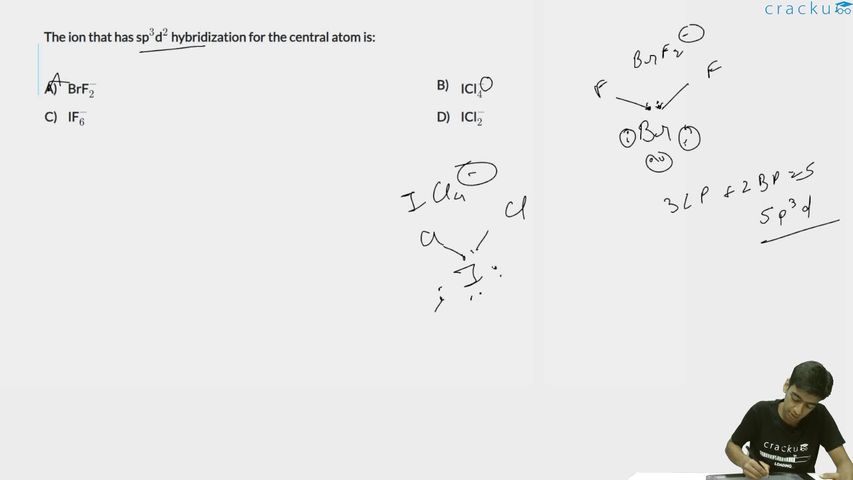
Option A : BrF$$_2^{-}$$
We have Br as the central atom.
Valence electrons on Br = 7
Electrons coming from two F atoms = 2
Negative charge contributes one extra electron = 1
So, total electrons around Br = $$7+2+1 = 10$$
Number of electron pairs (steric number) = $$\dfrac{10}{2}=5$$
Steric number 5 means $$sp^3d$$ hybridisation, not $$sp^3d^2$$.
Option B : ICl$$_4^{-}$$
The central atom is I.
Valence electrons on I = 7
Electrons from four Cl atoms = 4
Extra electron due to -1 charge = 1
Total electrons around I = $$7+4+1 = 12$$
Number of electron pairs = $$\dfrac{12}{2}=6$$
Steric number 6 corresponds to $$sp^3d^2$$ hybridisation. Hence this ion indeed possesses $$sp^3d^2$$ hybridisation for the central atom.
Option C : IF$$_6^{-}$$
Central atom I.
Valence electrons on I = 7
Electrons from six F atoms = 6
Extra electron for -1 charge = 1
Total electrons = $$7+6+1 = 14$$
Number of electron pairs = $$\dfrac{14}{2}=7$$
Steric number 7 means $$sp^3d^3$$ hybridisation, not $$sp^3d^2$$.
Option D : ICl$$_2^{-}$$
Central atom I.
Valence electrons on I = 7
Electrons from two Cl atoms = 2
One extra electron for -1 charge = 1
Total electrons = $$7+2+1 = 10$$
Number of electron pairs = $$\dfrac{10}{2}=5$$
Steric number 5 gives $$sp^3d$$ hybridisation, not $$sp^3d^2$$.
So only ICl$$_4^{-}$$ has a steric number of 6 and therefore exhibits $$sp^3d^2$$ hybridisation.
Hence, the correct answer is Option 2.
Was this solution helpful?
Click on the Email ☝️ to Watch the Video Solution
Create a FREE account and get:
_1.webp)

Educational materials for JEE preparation

Ask our AI anything

AI can make mistakes. Please verify important information.
AI can make mistakes. Please verify important information.


