
Join Our JEE Preparation Group
Prep with like-minded aspirants; Get access to free daily tests and study material.
Sign in
Please select an account to continue using cracku.in
↓ →
Join Our JEE Preparation Group
Prep with like-minded aspirants; Get access to free daily tests and study material.
We begin by recalling the basic idea of VSEPR (Valence Shell Electron Pair Repulsion) theory. According to VSEPR, the arrangement of electron pairs (bonding pairs + lone pairs) around a central atom is chosen so that the repulsions among these pairs are minimised. First, we find the total number of valence‐shell electron pairs (abbreviated as $$\text{VSEPR}$$ pairs) around the central atom, then we locate how many of them are bonding pairs (BP) and how many are lone pairs (LP). The electron-pair geometry is decided by the total number of pairs, while the observed molecular shape is obtained after “removing” (i.e., not showing) the lone pairs.
Let us apply this step by step to the two species in the question.
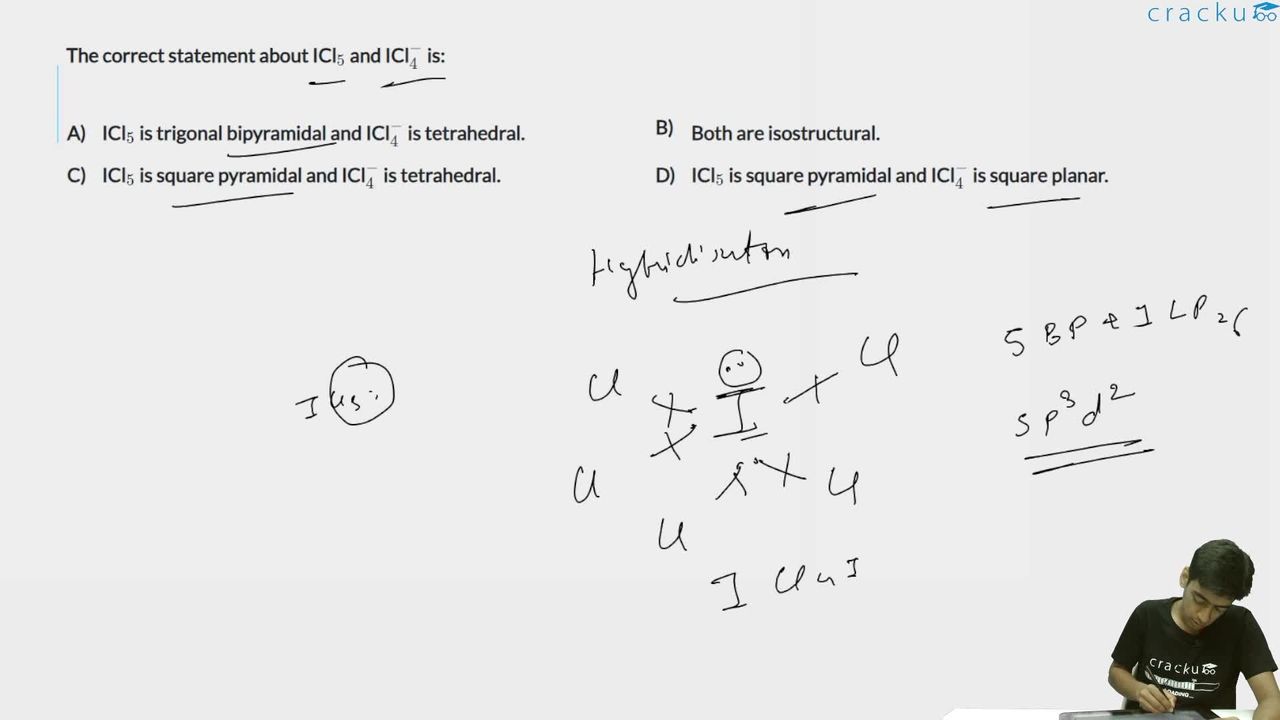
For $$\mathrm{ICl_5}:$$
• Iodine brings $$7$$ valence electrons because it is in group $$17.$$ • Each of the five chlorine atoms forms one single bond with iodine, using $$5 \times 1 = 5$$ electrons from iodine’s valence shell. • Electrons used in bonding pairs $$= 5 \text{ BP} \times 2 \text{ e}^- = 10 \text{ e}^-,$$ but for VSEPR counting we simply note the number of pairs, i.e., $$5 \text{ BP}.$$ • Electrons left on iodine $$= 7 - 5 = 2,$$ which constitute one lone pair (because $$2 \text{ e}^- = 1 \text{ LP}$$).
So the total number of electron pairs around iodine in $$\mathrm{ICl_5}$$ is
$$\text{Total pairs} = \text{BP} + \text{LP} = 5 + 1 = 6.$$
Six electron pairs correspond to an octahedral electron-pair geometry. When one of those six positions is occupied by a lone pair, the remaining five bonding pairs occupy a square-pyramidal arrangement (a square base with one atom above the centre of the square). Thus,
$$\boxed{\mathrm{ICl_5}\ \text{is square pyramidal}.}$$
Now for $$\mathrm{ICl_4^-}:$$
• Iodine again supplies $$7$$ valence electrons. • The extra negative charge contributes $$1$$ more electron. • Hence total electrons on iodine $$= 7 + 1 = 8.$$ • Four chlorine atoms form four single bonds, so iodine uses $$4$$ electrons in bonding, corresponding to $$4 \text{ BP}.$$ • Electrons left on iodine $$= 8 - 4 = 4,$$ which make up $$2 \text{ LP}$$ (because $$4 \text{ e}^- = 2 \text{ LP}$$).
The total number of electron pairs around iodine in $$\mathrm{ICl_4^-}$$ is therefore
$$\text{Total pairs} = \text{BP} + \text{LP} = 4 + 2 = 6.$$
Again we have octahedral electron-pair geometry. When two opposite (axial) positions are occupied by lone pairs, the four bonding pairs remain in a square plane. Consequently,
$$\boxed{\mathrm{ICl_4^-}\ \text{is square planar}.}$$
Combining our two results, $$\mathrm{ICl_5}$$ is square pyramidal, while $$\mathrm{ICl_4^-}$$ is square planar. This description matches exactly with option D.
Hence, the correct answer is Option D.
Was this solution helpful?
Click on the Email ☝️ to Watch the Video Solution
Create a FREE account and get:
_1.webp)

Educational materials for JEE preparation

Ask our AI anything

AI can make mistakes. Please verify important information.
AI can make mistakes. Please verify important information.


