
Join Our JEE Preparation Group
Prep with like-minded aspirants; Get access to free daily tests and study material.
Sign in
Please select an account to continue using cracku.in
↓ →
Join Our JEE Preparation Group
Prep with like-minded aspirants; Get access to free daily tests and study material.
First, let us recall what we mean by interstitial compounds. These are solid phases formed when relatively small atoms such as $$\text{H}$$, $$\text{B}$$, $$\text{C}$$ or $$\text{N}$$ occupy the interstitial voids (octahedral or tetrahedral holes) present in the crystal lattices of transition metals. The resulting entity is not a true stoichiometric compound; rather it is a solid solution in which the host metal lattice remains essentially intact while the guest atoms merely slip into the gaps.
Because the metal lattice is still present, and because the guest atoms fit tightly into the voids without destroying that lattice, interstitial compounds display properties that are quite similar to those of the parent transition metal, albeit modified to some extent. Let us examine each property mentioned in the four options one by one, comparing it with what is known from standard inorganic-solid-state chemistry.
High melting points
We know that transition metals themselves possess very high melting points, mainly owing to strong metallic bonding. When small non-metal atoms are locked into the voids, the lattice is further strengthened because the additional atoms resist the motion of metal planes past one another. Thus the thermal energy required to break the lattice increases even more. Therefore interstitial compounds do indeed have higher or at least very high melting points relative to the parent metal. So statement A, “They have high melting points,” is correct.
Very hard
Hardness in a metallic lattice is reduced when layers of atoms can slip past one another. The presence of small interstitial atoms blocks such slip and makes the lattice rigid. A common textbook example is $$\text{Fe}_{3}\text{C}$$ (cementite) in steel, which is much harder than pure iron. Therefore interstitial compounds are indeed extremely hard. Hence statement B, “They are very hard,” is also correct.
Chemically reactive
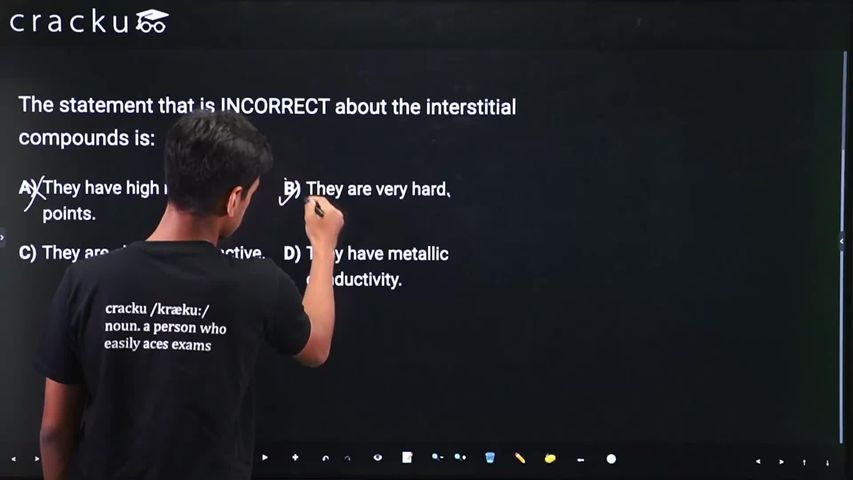
Even though a few interstitial phases such as metal hydrides can participate in reversible hydrogen storage, the majority of typical interstitial compounds (e.g., $$\text{TiC}$$, $$\text{WC}$$, $$\text{VN}$$) are chemically quite inert. They resist oxidation, are not attacked by acids easily, and can be used to line furnace crucibles or coat cutting tools specifically because they do not react readily. Thus the blanket statement that “They are chemically reactive” contradicts the accepted chemical behaviour. Therefore statement C is incorrect.
Metallic conductivity
Because the parent transition-metal lattice remains and provides the delocalised $$d$$-electron cloud responsible for conduction, interstitial compounds conduct electricity well, nearly as efficiently as the pure metal. Consequently statement D, “They have metallic conductivity,” is correct.
We have now analysed each option. Only statement C conflicts with the known properties of interstitial compounds. All the others agree with experimental fact.
Hence, the correct answer is Option C.
Was this solution helpful?
Click on the Email ☝️ to Watch the Video Solution
Create a FREE account and get:
_1.webp)

Educational materials for JEE preparation

Ask our AI anything

AI can make mistakes. Please verify important information.
AI can make mistakes. Please verify important information.


