
Join Our JEE Preparation Group
Prep with like-minded aspirants; Get access to free daily tests and study material.
Sign in
Please select an account to continue using cracku.in
↓ →
Join Our JEE Preparation Group
Prep with like-minded aspirants; Get access to free daily tests and study material.
First, we recall an important fact from coordination chemistry and medicinal chemistry: certain square-planar platinum(II) complexes have been found to interfere with DNA replication and, therefore, can inhibit the uncontrolled cell division that characterises tumours.
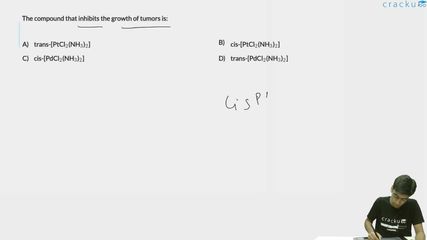
The well-known drug that performs this function is called cisplatin. Chemically, cisplatin is written as $$\text{cis}\!-\![\text{PtCl}_2(\text{NH}_3)_2]$$. The term “cis” tells us that the two chloride ligands are adjacent to each other in the square-planar geometry, while the two ammonia ligands occupy the remaining adjacent positions. Because of this cis arrangement, the molecule can bend and bind effectively to the N-atoms of adjacent guanine bases on a DNA strand, forming intrastrand crosslinks. These crosslinks distort the DNA helix, blocking replication and ultimately triggering apoptosis (programmed cell death) in rapidly dividing tumour cells.
On the other hand, the trans isomer $$\text{trans}\!-\![\text{PtCl}_2(\text{NH}_3)_2]$$, where the two chlorides are opposite each other, cannot form the same type of adjacent crosslinks on DNA; therefore, it shows very little or no anticancer activity. Similarly, when platinum is replaced by palladium to give either $$\text{cis}\!-\![\text{PdCl}_2(\text{NH}_3)_2]$$ or $$\text{trans}\!-\![\text{PdCl}_2(\text{NH}_3)_2]$$, the complexes are not clinically useful because they are either too reactive (leading to rapid decomposition) or biologically inactive.
Thus, among the four choices, only the compound $$\text{cis}\!-\![\text{PtCl}_2(\text{NH}_3)_2]$$—that is, cisplatin—possesses the well-established property of inhibiting tumour growth.
Hence, the correct answer is Option 2.
Was this solution helpful?
Click on the Email ☝️ to Watch the Video Solution
Create a FREE account and get:
_1.webp)

Educational materials for JEE preparation

Ask our AI anything

AI can make mistakes. Please verify important information.
AI can make mistakes. Please verify important information.


