
Join Our JEE Preparation Group
Prep with like-minded aspirants; Get access to free daily tests and study material.
Sign in
Please select an account to continue using cracku.in
↓ →
Join Our JEE Preparation Group
Prep with like-minded aspirants; Get access to free daily tests and study material.
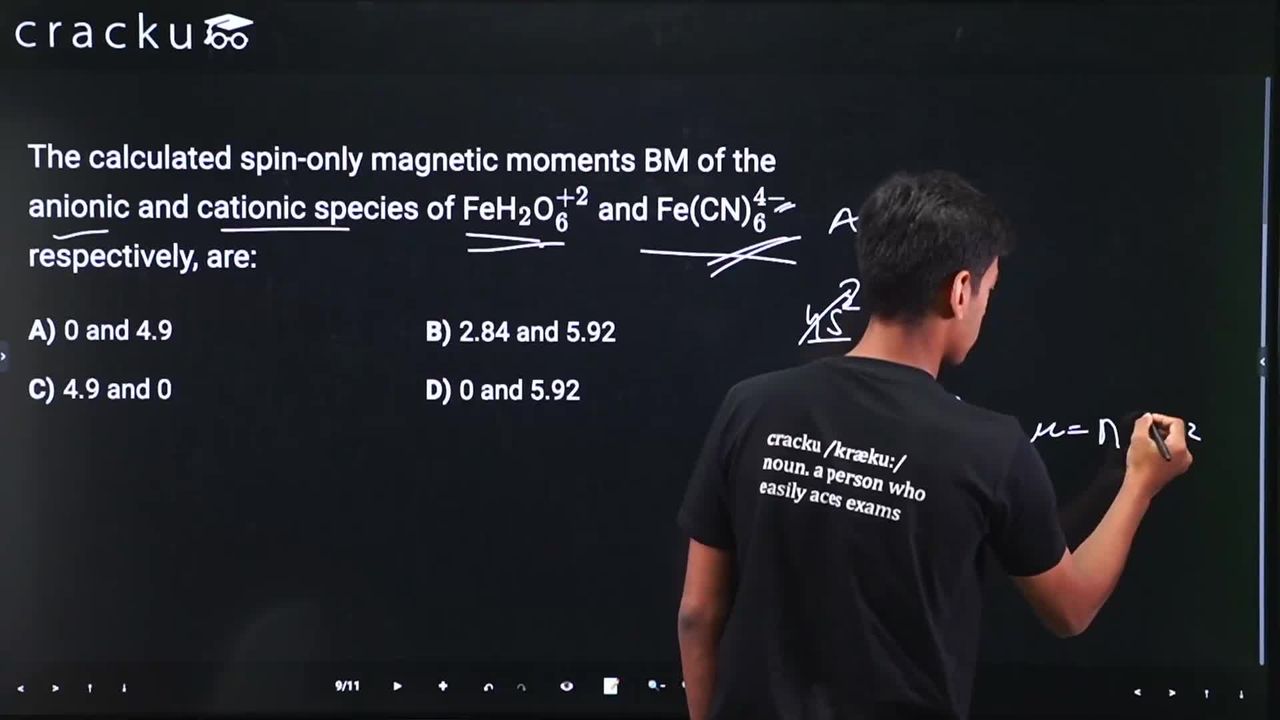
The calculated spin-only magnetic moments BM of the anionic and cationic species of FeH$$_2$$O$$_6^{+2}$$ and Fe(CN)$$_6^{4-}$$ respectively, are:
First we look at the anionic complex $$\mathrm{[Fe(CN)_6]^{4-}}$$.
Each cyanide ion carries a charge of $$-1$$, so six of them contribute $$-6$$. Let the oxidation state of iron be $$x$$. We have
$$x + (-6) = -4$$
$$\Rightarrow x = +2$$
Thus iron is in the $$\mathrm{Fe^{2+}}$$ state. The ground-state electronic configuration of a neutral iron atom is
$$\mathrm{Fe : [Ar]\; 3d^{6}\;4s^{2}}$$
For $$\mathrm{Fe^{2+}}$$ the two $$4s$$ electrons are removed, giving
$$\mathrm{Fe^{2+} : [Ar]\; 3d^{6}}$$
Cyanide, $$\mathrm{CN^-}$$, is a strong field ligand, so the complex is low-spin. In an octahedral field the five d-orbitals split into three lower-energy $$t_{2g}$$ and two higher-energy $$e_g$$ orbitals. Because the ligand field is strong, all six d electrons pair in $$t_{2g}$$:
$$t_{2g}^{6}\;e_g^{0}$$
Number of unpaired electrons $$n = 0$$.
The spin-only magnetic moment for transition-metal ions is given by the formula
$$\mu = \sqrt{n(n+2)}\; \text{BM}$$
Substituting $$n = 0$$, we obtain
$$\mu_{\text{anionic}} = \sqrt{0(0+2)} = 0\; \text{BM}$$
Now we consider the cationic complex $$\mathrm{[Fe(H_2O)_6]^{2+}}$$.
Water is a neutral ligand, so the overall charge $$+2$$ is the oxidation state of iron. Again, iron is $$\mathrm{Fe^{2+}}$$ with configuration $$3d^{6}$$.
Water is a weak field ligand, so the complex is high-spin. The electron distribution in the split d-levels is therefore
$$t_{2g}^{4}\;e_g^{2}$$
Counting unpaired electrons:
• In $$t_{2g}$$, the first three electrons occupy the three orbitals singly, the fourth pairs with one of them.
Thus two electrons remain unpaired in $$t_{2g}$$.
• In $$e_g$$, each of the two orbitals receives one electron, both unpaired.
So, $$n = 2 + 2 = 4$$ unpaired electrons.
Using the same formula,
$$\mu_{\text{cationic}} = \sqrt{4(4+2)} = \sqrt{24} \approx 4.90\; \text{BM}$$
We therefore have
$$\mu(\text{anionic}) = 0\; \text{BM}, \qquad \mu(\text{cationic}) \approx 4.9\; \text{BM}$$
Hence, the correct answer is Option A.
Was this solution helpful?
Click on the Email ☝️ to Watch the Video Solution
Create a FREE account and get:
_1.webp)

Educational materials for JEE preparation

Ask our AI anything

AI can make mistakes. Please verify important information.
AI can make mistakes. Please verify important information.


