Join WhatsApp Icon JEE WhatsApp Group
Question 54

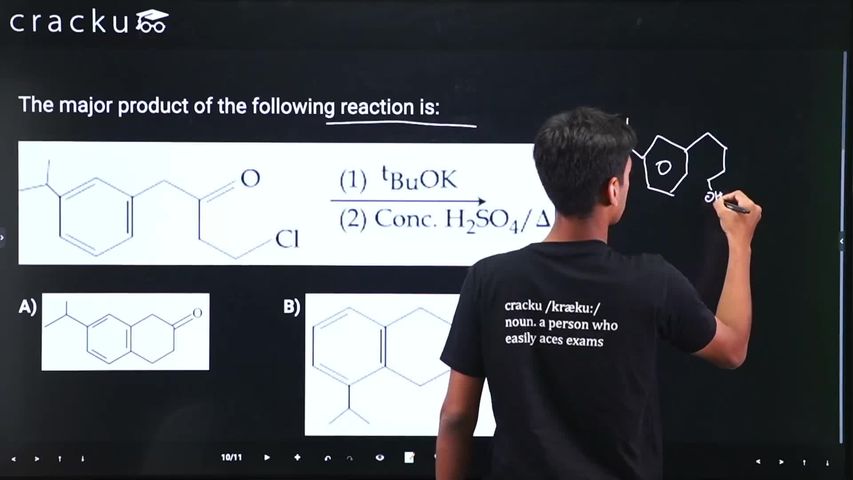
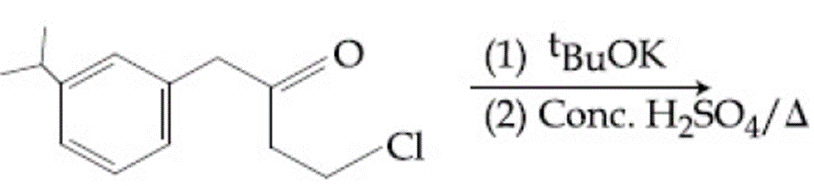
The major product of the following reaction is:

Intramolecular Alkylation 

  • Reagent: Potassium tert-butoxide is a strong, bulky base.
  • Action: It deprotonates the alpha-carbon of the ketone (the carbon between the benzene ring and the carbonyl). This creates a nucleophilic enolate.
  • Cyclization: The enolate then undergoes an intramolecular SN2 reaction, attacking the carbon attached to the chlorine atom at the end of the chain.
  • Result: This forms a five-membered or six-membered ring attached to the original chain. In this specific structure, the chain length favours the formation of a six-membered ring, creating a tetralone skeleton.

2. Acid-Catalyzed Cyclization/Dehydration 

  • Reagent: Concentrated sulfuric acid and heat.
  • Action: This promotes an electrophilic aromatic substitution (Friedel-Crafts-like cyclization).
  • Mechanism: The acid protonates the carbonyl oxygen, making the carbonyl carbon highly electrophilic. This carbon then attacks the electron-rich benzene ring (specifically at the ortho position relative to the alkyl chain).
  • Dehydration: Under heating and acidic conditions, the resulting intermediate loses a water molecule to restore aromaticity and complete the bicyclic system.

Get AI Help

Video Solution

video

Create a FREE account and get:

  • Free JEE Mains Previous Papers PDF
  • Take JEE Mains paper tests
Ask AI