
Join Our JEE Preparation Group
Prep with like-minded aspirants; Get access to free daily tests and study material.
Sign in
Please select an account to continue using cracku.in
↓ →
Join Our JEE Preparation Group
Prep with like-minded aspirants; Get access to free daily tests and study material.
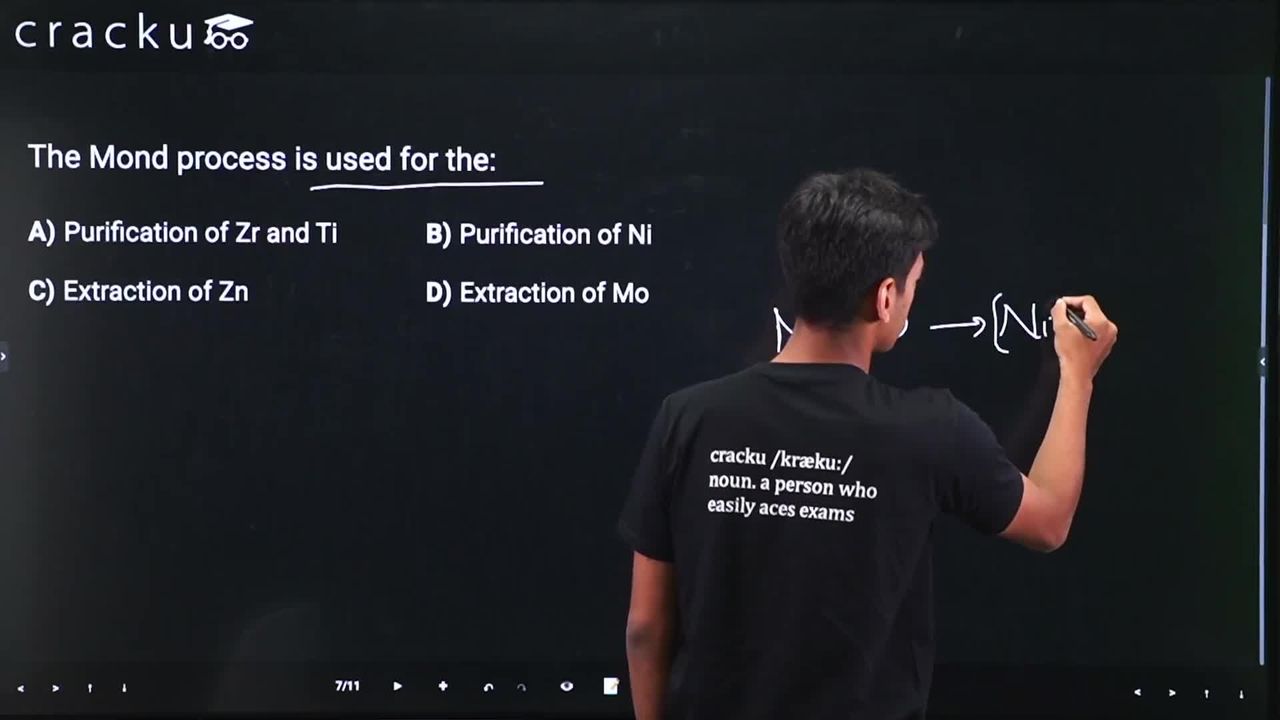
The question is asking, “The Mond process is used for the …” and then gives us four possibilities. We need to recall exactly what the Mond process is and which metal it is connected with.
The Mond process is a well-known metallurgical technique in which impure nickel metal reacts with carbon monoxide gas at a temperature of about $$50\,^{\circ}\mathrm{C}$$ to form a volatile complex, nickel tetracarbonyl. The key reversible chemical step is
$$\mathrm{Ni(s)} + 4\,\mathrm{CO(g)} \;\;\longrightarrow\;\; \mathrm{Ni(CO)_4(g)}$$
This gaseous complex can be separated from the solid impurities that do not form similar carbonyls. After the separation, the gas is heated to approximately $$200\,^{\circ}\mathrm{C}$$ where it decomposes back to pure nickel metal and carbon monoxide:
$$\mathrm{Ni(CO)_4(g)} \;\;\longrightarrow\;\; \mathrm{Ni(s)} + 4\,\mathrm{CO(g)}$$
Because the nickel obtained after this decomposition is extremely pure, the Mond process is explicitly classified as a purification method for nickel.
Now we compare this information with the options given:
A. “Purification of Zr and Ti” — The usual method for Zr and Ti purification is the van Arkel (iodide) process, not the Mond process.
B. “Purification of Ni” — This exactly matches what we have derived from the chemical equations above. The Mond process produces very pure nickel.
C. “Extraction of Zn” — Zinc is industrially extracted by roasting and reduction, not by the Mond process.
D. “Extraction of Mo” — Molybdenum is obtained by roasting molybdenite and reduction, again not by the Mond route.
Therefore, the only correct choice consistent with the facts is Option B.
Hence, the correct answer is Option B.
Was this solution helpful?
Click on the Email ☝️ to Watch the Video Solution
Create a FREE account and get:
_1.webp)

Educational materials for JEE preparation

Ask our AI anything

AI can make mistakes. Please verify important information.
AI can make mistakes. Please verify important information.


