
Join Our JEE Preparation Group
Prep with like-minded aspirants; Get access to free daily tests and study material.
Sign in
Please select an account to continue using cracku.in
↓ →
Join Our JEE Preparation Group
Prep with like-minded aspirants; Get access to free daily tests and study material.
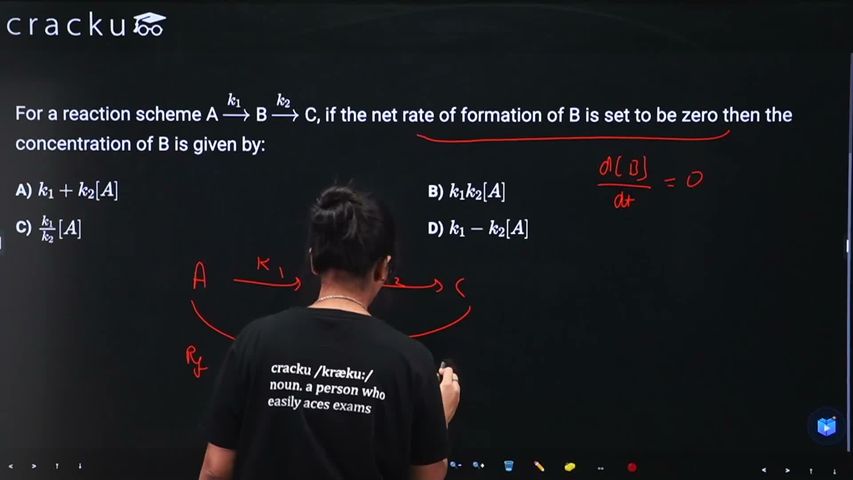
For a reaction scheme A $$\xrightarrow{k_1}$$ B $$\xrightarrow{k_2}$$ C, if the net rate of formation of B is set to be zero then the concentration of B is given by:
For the consecutive first-order reaction scheme $$A \xrightarrow{k_1} B \xrightarrow{k_2} C$$ we first recall the basic kinetic expressions for each elementary step.
The rate of formation of $$B$$ from $$A$$ is given by the first-order rate law $$\text{Rate of formation of }B = k_1[A]$$ because the step $$A \to B$$ is first order in $$A$$ with rate constant $$k_1$$.
Simultaneously, $$B$$ is being consumed in the next first-order step $$B \to C$$, so its rate of disappearance is $$\text{Rate of consumption of }B = k_2[B]$$, where $$k_2$$ is the corresponding rate constant.
The net rate of change of the concentration of $$B$$ is therefore the difference between its formation and its consumption:
$$\frac{d[B]}{dt}=k_1[A]-k_2[B].$$
The problem states that the net rate of formation of $$B$$ is set to zero. In mathematical form, this is the steady-state approximation:
$$\frac{d[B]}{dt}=0.$$
Substituting this condition into the net rate expression gives
$$0 = k_1[A] - k_2[B].$$
We now isolate $$[B]$$ algebraically. First, add $$k_2[B]$$ to both sides:
$$k_2[B] = k_1[A].$$
Next, divide both sides by $$k_2$$ to solve for $$[B]$$:
$$[B] = \frac{k_1}{k_2}[A].$$
This final expression matches option C in the list provided.
Hence, the correct answer is Option 3.
Was this solution helpful?
Click on the Email ☝️ to Watch the Video Solution
Create a FREE account and get:
_1.webp)

Educational materials for JEE preparation

Ask our AI anything

AI can make mistakes. Please verify important information.
AI can make mistakes. Please verify important information.


