
Join Our JEE Preparation Group
Prep with like-minded aspirants; Get access to free daily tests and study material.
Sign in
Please select an account to continue using cracku.in
↓ →
Join Our JEE Preparation Group
Prep with like-minded aspirants; Get access to free daily tests and study material.
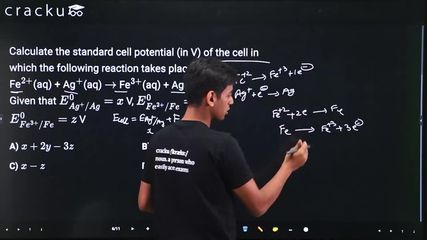
Calculate the standard cell potential (in V) of the cell in which the following reaction takes place:
Fe$$^{2+}$$(aq) + Ag$$^+$$(aq) $$\rightarrow$$ Fe$$^{3+}$$(aq) + Ag(s)
Given that $$E^{0}_{Ag^+/Ag} = x$$ V, $$E^{0}_{Fe^{2+}/Fe} = y$$ V, $$E^{0}_{Fe^{3+}/Fe} = z$$ V
For a galvanic cell, the overall standard cell potential $$E^{0}_{\text{cell}}$$ is obtained by combining the standard reduction potential of the cathode half-reaction with the standard oxidation potential of the anode half-reaction, because
$$\Delta G^{0} = -nF\,E^{0}$$
and the Gibbs energies of the individual half-reactions are additive.
First, we identify the two half-reactions that together give the net reaction
$$\text{Fe}^{2+}(aq) + \text{Ag}^{+}(aq) \rightarrow \text{Fe}^{3+}(aq) + \text{Ag}(s).$$
The silver ion is reduced:
$$\text{Ag}^{+} + e^{-} \rightarrow \text{Ag}(s)\qquad E^{0}_{\text{red}} = x \text{ V}.$$
The iron(II) ion is oxidised to iron(III):
$$\text{Fe}^{2+} \rightarrow \text{Fe}^{3+} + e^{-}.$$
For this step we need the standard reduction potential of the couple $$\text{Fe}^{3+}/\text{Fe}^{2+}$$, but only $$E^{0}_{\text{Fe}^{2+}/\text{Fe}}$$ and $$E^{0}_{\text{Fe}^{3+}/\text{Fe}}$$ are given. We therefore calculate $$E^{0}_{\text{Fe}^{3+}/\text{Fe}^{2+}}$$ from the data provided.
The two given reduction half-reactions are
$$\text{Fe}^{3+} + 3e^{-} \rightarrow \text{Fe}(s)\qquad E^{0}_1 = z \text{ V},$$
$$\text{Fe}^{2+} + 2e^{-} \rightarrow \text{Fe}(s)\qquad E^{0}_2 = y \text{ V}.$$
Writing the corresponding standard Gibbs energies, we have
$$\Delta G^{0}_1 = -3Fz,\qquad \Delta G^{0}_2 = -2Fy.$$
To obtain $$\text{Fe}^{3+} + e^{-} \rightarrow \text{Fe}^{2+}$$ we combine reactions (1) and (2) as follows. Reverse reaction (2) so that Fe(s) cancels:
$$\text{Fe}(s) \rightarrow \text{Fe}^{2+} + 2e^{-}\qquad \Delta G^{0} = +2Fy.$$
Adding this to reaction (1):
$$\bigl[\text{Fe}^{3+} + 3e^{-} \rightarrow \text{Fe}(s)\bigr] + \bigl[\text{Fe}(s) \rightarrow \text{Fe}^{2+} + 2e^{-}\bigr]$$
gives
$$\text{Fe}^{3+} + e^{-} \rightarrow \text{Fe}^{2+}.$$
The overall Gibbs energy change becomes
$$\Delta G^{0}_{\text{Fe}^{3+}/\text{Fe}^{2+}} = (-3Fz) + (+2Fy) = -F(3z - 2y).$$
Because $$\Delta G^{0} = -nF E^{0}$$ with $$n = 1$$ for this step, the required reduction potential is
$$E^{0}_{\text{Fe}^{3+}/\text{Fe}^{2+}} = 3z - 2y.$$
The anode, however, undergoes oxidation, so its standard oxidation potential is the negative of the above:
$$E^{0}_{\text{ox}}(\text{Fe}^{2+} \rightarrow \text{Fe}^{3+}) = -(3z - 2y) = 2y - 3z.$$
Now we assemble the cell. The cathode is silver with $$E^{0}_{\text{red}} = x$$ V, and the anode oxidation potential is $$2y - 3z$$ V. Therefore,
$$E^{0}_{\text{cell}} = E^{0}_{\text{cathode (red)}} + E^{0}_{\text{anode (ox)}} = x + \bigl(2y - 3z\bigr).$$
Simplifying,
$$E^{0}_{\text{cell}} = x + 2y - 3z.$$
Comparing with the options, this matches Option A.
Hence, the correct answer is Option A.
Was this solution helpful?
Click on the Email ☝️ to Watch the Video Solution
Create a FREE account and get:
_1.webp)

Educational materials for JEE preparation

Ask our AI anything

AI can make mistakes. Please verify important information.
AI can make mistakes. Please verify important information.


