
Join Our JEE Preparation Group
Prep with like-minded aspirants; Get access to free daily tests and study material.
Sign in
Please select an account to continue using cracku.in
↓ →
Join Our JEE Preparation Group
Prep with like-minded aspirants; Get access to free daily tests and study material.
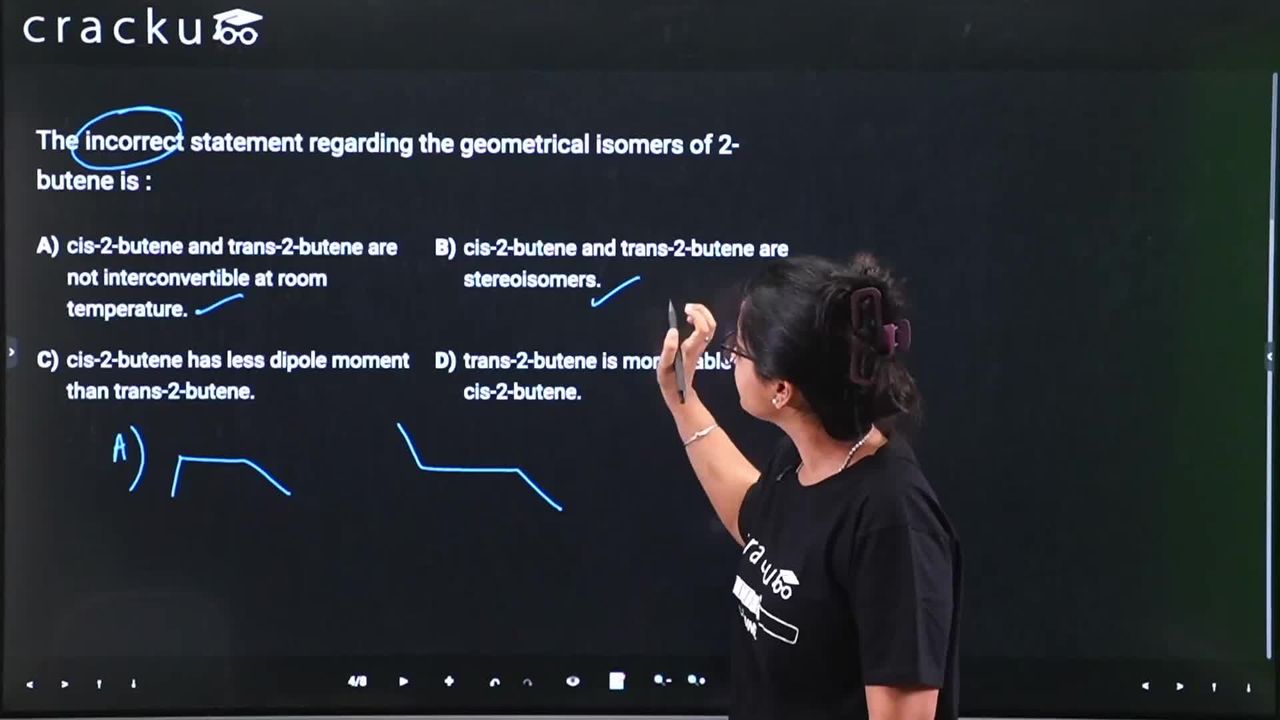
We need to identify the incorrect statement about geometrical isomers of 2-butene.
2-Butene (CH$$_3$$CH=CHCH$$_3$$) exists as two geometrical isomers due to restricted rotation around the C=C bond:
(i) cis-2-butene: Both methyl groups are on the same side of the double bond.
(ii) trans-2-butene: The methyl groups are on opposite sides of the double bond.
Evaluate each statement:
(1) "cis- and trans-2-butene are not interconvertible at room temperature": This is CORRECT. The energy barrier for rotation around a C=C bond is very high (~250 kJ/mol), preventing interconversion at room temperature.
(2) "cis- and trans-2-butene are stereoisomers": This is CORRECT. They have the same molecular formula and connectivity but differ in the spatial arrangement of atoms. Geometrical isomers are a type of stereoisomers.
(3) "cis-2-butene has less dipole moment than trans-2-butene": This is INCORRECT. In cis-2-butene, the two methyl groups are on the same side, so their bond dipoles add up, resulting in a net dipole moment. In trans-2-butene, the methyl groups are on opposite sides, and their dipoles cancel out, giving a dipole moment of approximately zero. Therefore, cis-2-butene has a HIGHER dipole moment than trans-2-butene.
(4) "trans-2-butene is more stable than cis-2-butene": This is CORRECT. trans-2-butene is more stable because the methyl groups are farther apart, reducing steric strain.
The correct answer is Option (3).
Was this solution helpful?
Click on the Email ☝️ to Watch the Video Solution
Create a FREE account and get:
_1.webp)

Educational materials for JEE preparation

Ask our AI anything

AI can make mistakes. Please verify important information.
AI can make mistakes. Please verify important information.
