
Join Our JEE Preparation Group
Prep with like-minded aspirants; Get access to free daily tests and study material.
Sign in
Please select an account to continue using cracku.in
↓ →
Join Our JEE Preparation Group
Prep with like-minded aspirants; Get access to free daily tests and study material.
Given below are two statements:
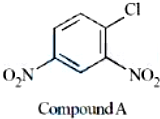
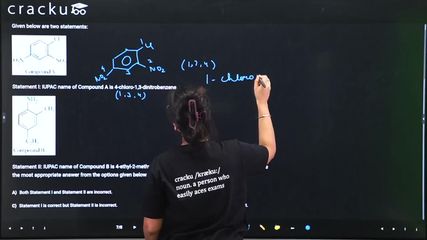
Statement I: IUPAC name of Compound A is 4-chloro-1,3-dinitrobenzene.
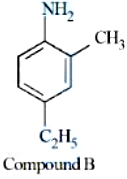
Statement II: IUPAC name of Compound B is 4-ethyl-2-methylaniline. In the light of the above statements, choose the most appropriate answer from the options given below:
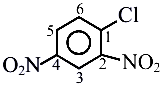
Compound A consists of a benzene ring substituted with one chlorine ($$\text{--Cl}$$) atom and two nitro ($$\text{--NO}_2$$) groups. Since both chloro and nitro groups are treated purely as prefixes with equal priority in IUPAC nomenclature, the numbering of the ring is determined by the lowest locant rule:
Path 1 (Correct): Numbering starts at the carbon attached to the chlorine atom and proceeds towards the nitro groups. This gives the locant set $$(1, 2, 4)$$.
Following alphabetical order (chloro before nitro), the correct IUPAC name is 1-chloro-2,4-dinitrobenzene.
Path 2 (Incorrect): If numbered as given in the statement, the locant set would be $$(1, 3, 4)$$, resulting in 4-chloro-1,3-dinitrobenzene. Since $$(1, 2, 4)$$ is lower than $$(1, 3, 4)$$, this path violates the lowest locant rule.
Therefore, Statement I is incorrect.
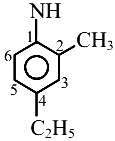
Compound B contains an amino group ($$\text{--NH}_2$$), an ethyl group ($$\text{--CH}_2\text{CH}_3$$), and a methyl group ($$\text{--CH}_3$$) attached to a benzene ring.
Therefore, Statement II is correct.
Statement I is incorrect because it violates the lowest locant rule, while Statement II correctly applies principal functional group priority and alphabetical substituent ordering.
Answer: Option D — Statement I is incorrect but Statement II is correct.
Was this solution helpful?
Click on the Email ☝️ to Watch the Video Solution
Create a FREE account and get:
_1.webp)

Educational materials for JEE preparation

Ask our AI anything

AI can make mistakes. Please verify important information.
AI can make mistakes. Please verify important information.
