
Join Our JEE Preparation Group
Prep with like-minded aspirants; Get access to free daily tests and study material.
Sign in
Please select an account to continue using cracku.in
↓ →
Join Our JEE Preparation Group
Prep with like-minded aspirants; Get access to free daily tests and study material.
Number of carbocations from the following that are not stabilized by hyperconjugation is __________
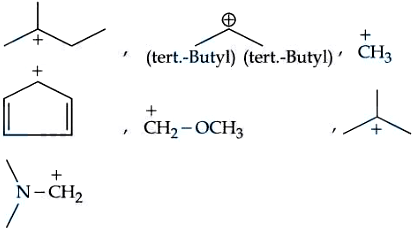
_
Correct Answer: 5
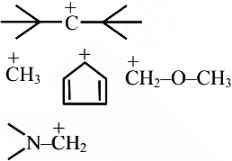
For a carbocation to be stabilized by hyperconjugation, it must possess at least one $$\alpha$$-hydrogen attached to an $$\text{sp}^3$$-hybridized carbon atom adjacent to the positively charged carbon:
$$\text{Stabilization by Hyperconjugation} \propto \text{Number of } \alpha\text{-hydrogens}$$
First Carbocation — Tris(tert-butyl)methyl cation, $$\text{C}^+\left(\text{C}(\text{CH}_3)_3\right)_3$$:
The central positively charged carbon is bonded to three quaternary carbon atoms. Since these adjacent carbons have no hydrogen atoms directly attached to them, the number of $$\alpha$$-hydrogens is 0. It is not stabilized by hyperconjugation.
Second Carbocation — Methyl cation, $$^+\text{CH}_3$$:
There are no adjacent carbon atoms attached to the positive charge at all, meaning the number of $$\alpha$$-hydrogens is 0. It is not stabilized by hyperconjugation.
Third Carbocation — Cyclopropenyl cation:
This is a non-benzenoid aromatic system stabilized entirely by the delocalization of $$\pi$$-electrons (resonance). There are no adjacent $$\text{sp}^3$$ carbon atoms carrying hydrogen atoms, so the number of $$\alpha$$-hydrogens is 0. It is not stabilized by hyperconjugation.
Fourth Carbocation — Methoxymethyl cation, $$^+\text{CH}_2\text{--O--CH}_3$$:
The positive carbon is directly attached to an oxygen atom. It is exceptionally stabilized by back-bonding (resonance) from the lone pair of electrons on the oxygen atom. Because the adjacent atom is an oxygen rather than a carbon with hydrogens, it has 0 $$\alpha$$-hydrogens for hyperconjugation.
Fifth Carbocation — Dimethylaminomethyl cation, $$(\text{CH}_3)_2\text{N--}^+\text{CH}_2$$:
Similar to the fourth case, the positive charge is highly stabilized by the strong back-bonding/resonance from the lone pair of the adjacent nitrogen atom. The adjacent atom directly attached to the positive center is Nitrogen, giving it 0 $$\alpha$$-hydrogens for hyperconjugation.
All five listed carbocations lack the necessary $$\alpha$$-hydrogens to undergo hyperconjugation stabilization, relying instead on inductive effects, resonance, or lone-pair back-bonding.
Answer: 5
Was this solution helpful?
Click on the Email ☝️ to Watch the Video Solution
Create a FREE account and get:
_1.webp)

Educational materials for JEE preparation

Ask our AI anything

AI can make mistakes. Please verify important information.
AI can make mistakes. Please verify important information.
