
Join Our JEE Preparation Group
Prep with like-minded aspirants; Get access to free daily tests and study material.
Sign in
Please select an account to continue using cracku.in
↓ →
Join Our JEE Preparation Group
Prep with like-minded aspirants; Get access to free daily tests and study material.
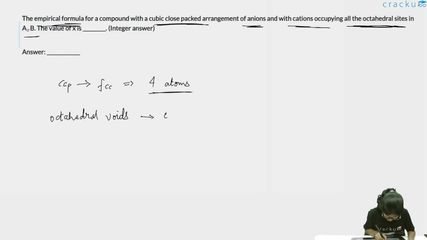
The empirical formula for a compound with a cubic close packed arrangement of anions and with cations occupying all the octahedral sites in A$$_x$$B. The value of x is _________. (Integer answer)
Correct Answer: 1
We begin by recognising that the anions $$B^{\,-}$$ form a cubic close-packed (ccp, also called fcc) lattice. A fundamental fact about a ccp lattice is that each unit cell contains $$4$$ lattice points of the constituent particle. Therefore, in one unit cell we have
$$N_B = 4$$
anions.
Next we recall the relation between the number of lattice particles and the number of interstitial voids in a ccp lattice. The rule is stated as follows:
“In a cubic close-packed (ccp) or face-centred cubic (fcc) arrangement, the number of octahedral voids is numerically equal to the number of particles that constitute the lattice.”
Applying this rule, the total number of octahedral sites present in one unit cell will be
$$N_{\text{octa}} = N_B = 4.$$
The statement of the problem tells us that the cations $$A^{\,+}$$ occupy all of these octahedral sites. Hence, in one unit cell the number of cations is
$$N_A = N_{\text{octa}} = 4.$$
We now have the absolute numbers of the two species in a single unit cell:
$$N_A : N_B = 4 : 4.$$
To obtain the empirical formula we divide by the highest common factor (here, $$4$$) so that we arrive at the simplest whole-number ratio:
$$\frac{N_A}{4} : \frac{N_B}{4} = 1 : 1.$$
Therefore, the empirical formula of the compound is
$$AB.$$
Comparing this result with the general form $$A_xB$$, we immediately read off
$$x = 1.$$
So, the answer is $$1$$.
Was this solution helpful?
Click on the Email ☝️ to Watch the Video Solution
Create a FREE account and get:
_1.webp)

Educational materials for JEE preparation

Ask our AI anything

AI can make mistakes. Please verify important information.
AI can make mistakes. Please verify important information.
