
Join Our JEE Preparation Group
Prep with like-minded aspirants; Get access to free daily tests and study material.
Sign in
Please select an account to continue using cracku.in
↓ →
Join Our JEE Preparation Group
Prep with like-minded aspirants; Get access to free daily tests and study material.
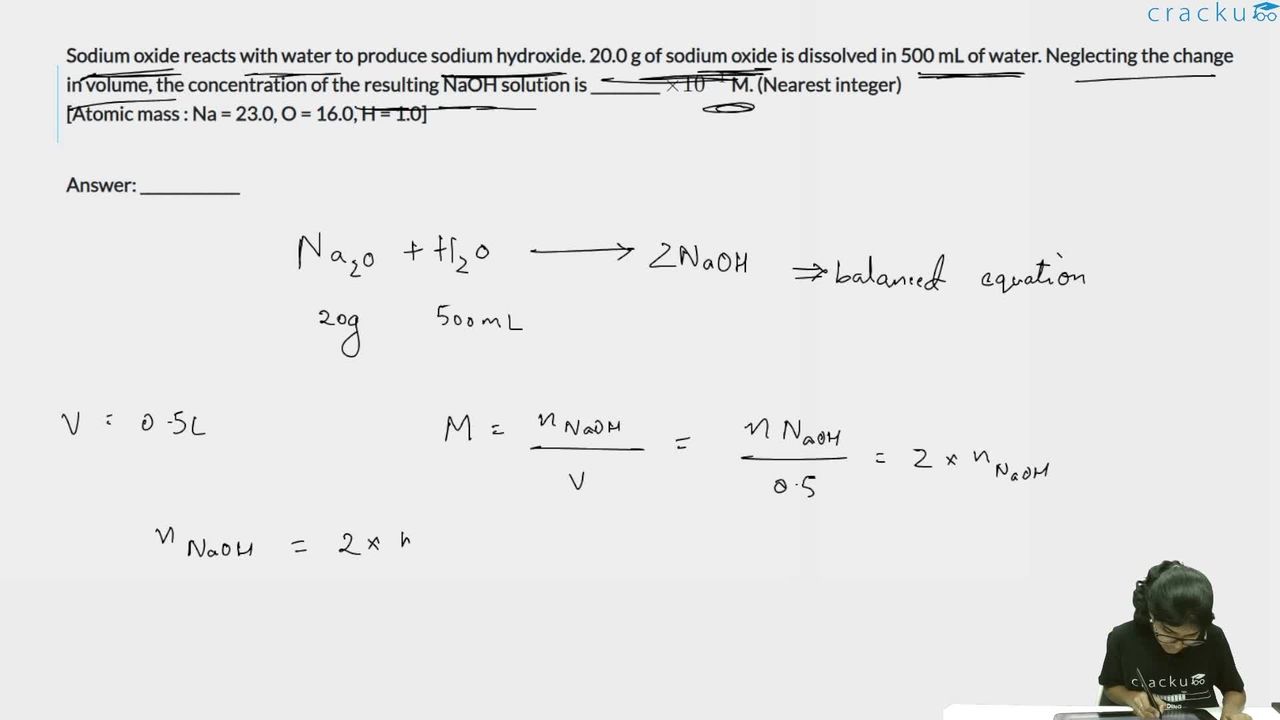
Sodium oxide reacts with water to produce sodium hydroxide. 20.0 g of sodium oxide is dissolved in 500 mL of water. Neglecting the change in volume, the concentration of the resulting NaOH solution is _________ $$\times 10^{-1}$$ M. (Nearest integer)
[Atomic mass : Na = 23.0, O = 16.0, H = 1.0]
Correct Answer: 13
First, let us write the balanced chemical equation for the reaction between sodium oxide and water.
$$\mathrm{Na_2O + H_2O \;\longrightarrow\; 2\,NaOH}$$
This tells us that $$1$$ mole of $$\mathrm{Na_2O}$$ produces $$2$$ moles of $$\mathrm{NaOH}$$.
Now we calculate the molar mass of sodium oxide. The atomic masses supplied are $$\mathrm{Na = 23.0}$$ and $$\mathrm{O = 16.0}$$, so
Molar mass of $$\mathrm{Na_2O} \;=\; 2(23.0)\;+\;16.0 \;=\; 46.0\;+\;16.0 \;=\; 62.0\ \text{g mol}^{-1}.$$
We have been given $$20.0\ \text{g}$$ of $$\mathrm{Na_2O}$$. Using the definition
Moles $$= \frac{\text{Mass}}{\text{Molar mass}},$$
we get
$$n_{\mathrm{Na_2O}} = \frac{20.0\text{ g}}{62.0\text{ g mol}^{-1}} = 0.3226\text{ mol}\;(\text{keeping extra digits for accuracy}).$$
The stoichiometric ratio from the equation is $$1:2$$, so
$$n_{\mathrm{NaOH}} = 2 \times n_{\mathrm{Na_2O}} = 2 \times 0.3226 = 0.6452\ \text{mol}$$
This amount of $$\mathrm{NaOH}$$ is dissolved in $$500\ \text{mL}$$ of water. Neglecting any volume change, the solution volume is
$$V = 500\ \text{mL} = 0.500\ \text{L}.$$
Molarity (concentration) is given by the formula
$$M = \frac{$$ Moles of solute $$}{$$ Volume of solution in litres $$}.$$
Substituting the values, we obtain
$$M = \frac{0.6452\text{ mol}}{0.500\text{ L}} = 1.2904\text{ M}.$$
We now express this value in the required form $$x \times 10^{-1}\ \text{M}$$. Writing $$1.2904\ \text{M}$$ as a multiple of $$10^{-1}$$, we have
$$1.2904\text{ M} = 12.904 \times 10^{-1}\text{ M}.$$
Rounding $$12.904$$ to the nearest integer gives $$13$$.
So, the answer is $$13$$.
Click on the Email ☝️ to Watch the Video Solution
Create a FREE account and get:
_1.webp)

Educational materials for JEE preparation

Ask our AI anything

AI can make mistakes. Please verify important information.
AI can make mistakes. Please verify important information.


