
Join Our JEE Preparation Group
Prep with like-minded aspirants; Get access to free daily tests and study material.
Sign in
Please select an account to continue using cracku.in
↓ →
Join Our JEE Preparation Group
Prep with like-minded aspirants; Get access to free daily tests and study material.
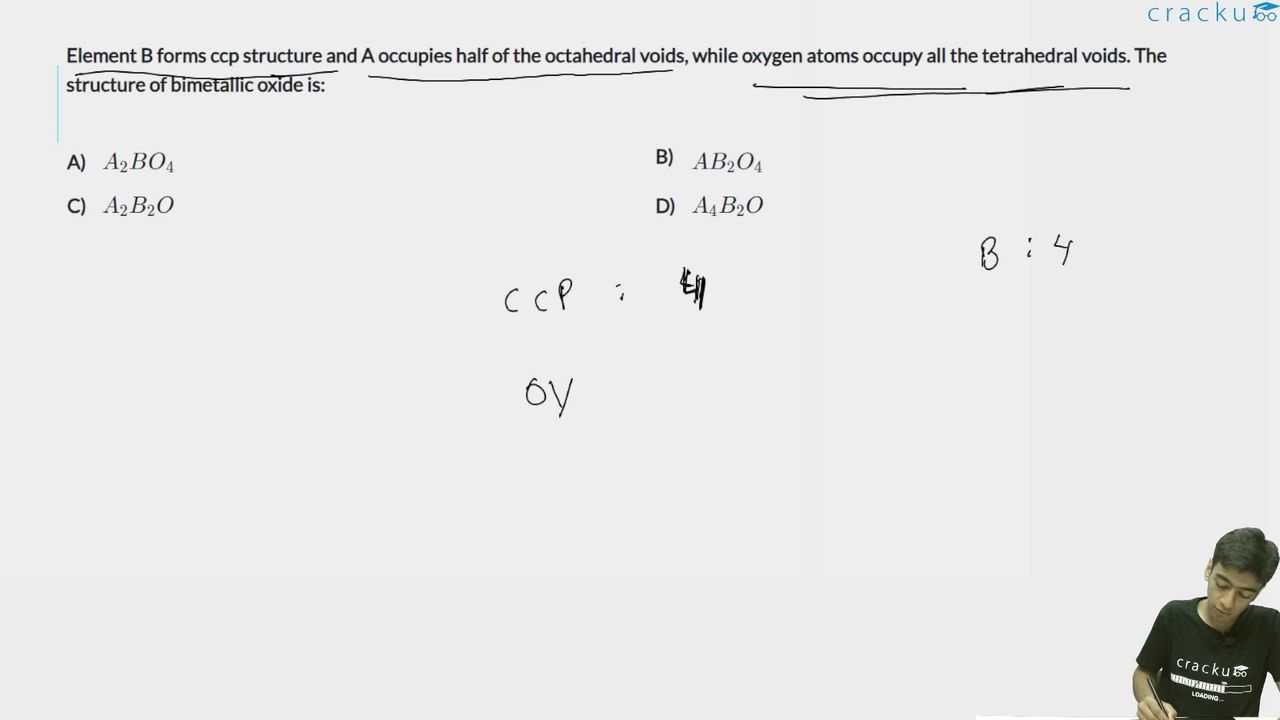
Element B forms ccp structure and A occupies half of the octahedral voids, while oxygen atoms occupy all the tetrahedral voids. The structure of bimetallic oxide is:
We have a crystal in which the atoms of element B are arranged in a cubic close-packed (ccp or fcc) lattice. It is well known that a ccp unit cell contains $$4$$ atoms of the parent element. Before proceeding, let us recall the standard relationships between the atoms present in a close-packed array and the number of interstitial (void) sites produced by that array.
In a ccp (fcc) lattice:
• Number of octahedral voids $$=$$ number of close-packed atoms present.
• Number of tetrahedral voids $$=$$ twice the number of close-packed atoms present.
Stating these facts algebraically for a single unit cell:
$$\text{Number of B atoms} = 4$$
$$\text{Number of octahedral voids} = 4$$
$$\text{Number of tetrahedral voids} = 2 \times 4 = 8$$
According to the question, element A occupies exactly one-half of all the octahedral voids. Therefore
$$\text{Number of A atoms} = \dfrac{1}{2}\times(\text{number of octahedral voids}) = \dfrac{1}{2}\times4 = 2$$
Next, every tetrahedral void is filled by an oxygen atom. So
$$\text{Number of O atoms} = \text{number of tetrahedral voids} = 8$$
Collecting the numbers obtained per unit cell, we have the ratios
$$A : B : O = 2 : 4 : 8$$
To express the composition as the simplest integral formula, divide each subscript by the highest common factor, here $$2$$:
$$A : B : O = \dfrac{2}{2} : \dfrac{4}{2} : \dfrac{8}{2} = 1 : 2 : 4$$
So the empirical formula of the bimetallic oxide becomes
$$AB_2O_4$$
Examining the options given, this matches Option B.
Hence, the correct answer is Option B.
Was this solution helpful?
Click on the Email ☝️ to Watch the Video Solution
Create a FREE account and get:
_1.webp)

Educational materials for JEE preparation

Ask our AI anything

AI can make mistakes. Please verify important information.
AI can make mistakes. Please verify important information.
