
Join Our JEE Preparation Group
Prep with like-minded aspirants; Get access to free daily tests and study material.
Sign in
Please select an account to continue using cracku.in
↓ →
Join Our JEE Preparation Group
Prep with like-minded aspirants; Get access to free daily tests and study material.
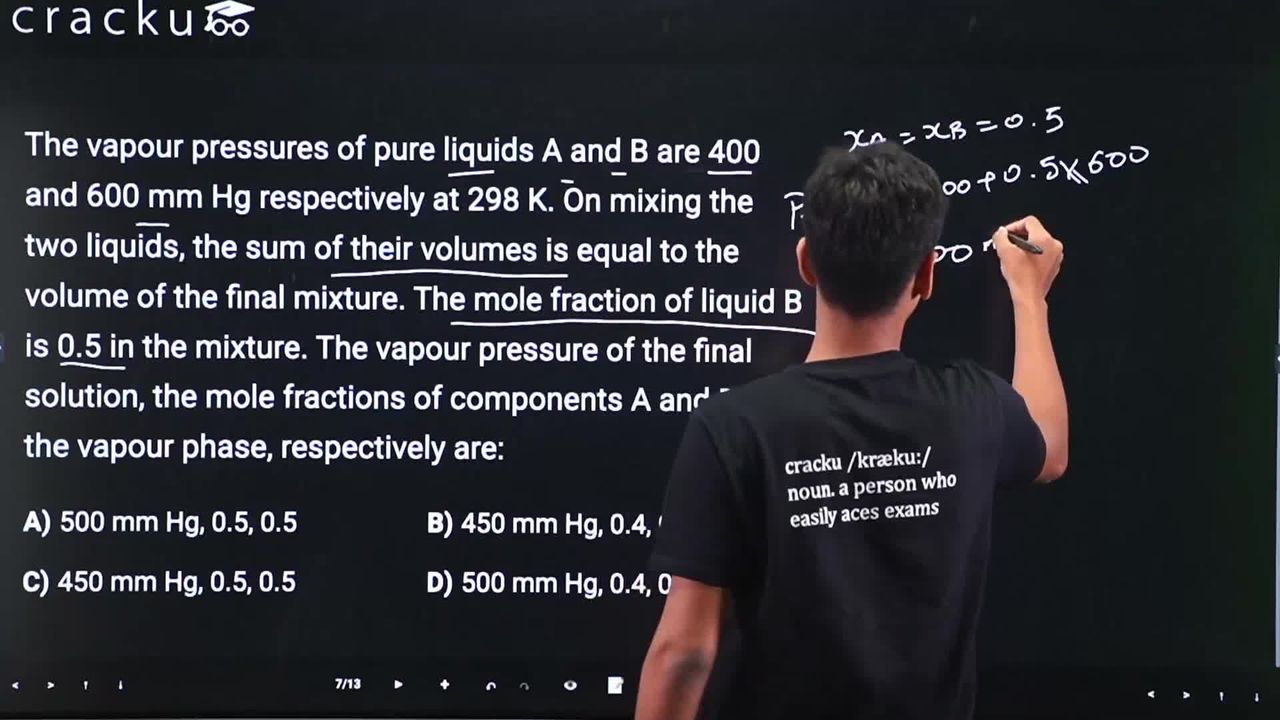
The vapour pressures of pure liquids A and B are 400 and 600 mm Hg respectively at 298 K. On mixing the two liquids, the sum of their volumes is equal to the volume of the final mixture. The mole fraction of liquid B is 0.5 in the mixture. The vapour pressure of the final solution, the mole fractions of components A and B in the vapour phase, respectively are:
For an ideal liquid solution we employ Raoult’s law, which states that the partial vapour pressure of each component equals the product of its mole fraction in the liquid phase and its vapour pressure as a pure liquid. Mathematically, for a binary mixture:
$$p_A \;=\; x_A P_A^{\,0}, \qquad p_B \;=\; x_B P_B^{\,0}$$
Here $$P_A^{\,0}$$ and $$P_B^{\,0}$$ are the vapour pressures of pure liquids A and B, while $$x_A$$ and $$x_B$$ are their mole fractions in the liquid phase.
We are given:
$$P_A^{\,0} = 400\ \text{mm Hg}, \qquad P_B^{\,0} = 600\ \text{mm Hg}$$ $$x_B = 0.5 \;\Longrightarrow\; x_A = 1 - x_B = 1 - 0.5 = 0.5$$
Now we find the partial vapour pressures of the two components in the mixture:
$$p_A = x_A P_A^{\,0} = (0.5)(400\ \text{mm Hg}) = 200\ \text{mm Hg}$$ $$p_B = x_B P_B^{\,0} = (0.5)(600\ \text{mm Hg}) = 300\ \text{mm Hg}$$
The total vapour pressure of the solution is obtained from Dalton’s law of partial pressures, which simply adds these partial pressures:
$$p_{\text{total}} = p_A + p_B = 200\ \text{mm Hg} + 300\ \text{mm Hg} = 500\ \text{mm Hg}$$
Next we determine the composition of the vapour phase. Dalton’s law also tells us that the mole fraction of each component in the vapour equals its partial pressure divided by the total vapour pressure. Thus, for component A:
$$y_A = \frac{p_A}{p_{\text{total}}} = \frac{200\ \text{mm Hg}}{500\ \text{mm Hg}} = 0.4$$
and for component B:
$$y_B = \frac{p_B}{p_{\text{total}}} = \frac{300\ \text{mm Hg}}{500\ \text{mm Hg}} = 0.6$$
We confirm that the vapour‐phase mole fractions add to unity: $$y_A + y_B = 0.4 + 0.6 = 1$$, as required.
Therefore, the vapour pressure of the final solution is $$500\ \text{mm Hg}$$, the mole fraction of A in the vapour phase is $$0.4$$, and that of B is $$0.6$$.
Hence, the correct answer is Option D.
Was this solution helpful?
Click on the Email ☝️ to Watch the Video Solution
Create a FREE account and get:
_1.webp)

Educational materials for JEE preparation

Ask our AI anything

AI can make mistakes. Please verify important information.
AI can make mistakes. Please verify important information.
