
Join Our JEE Preparation Group
Prep with like-minded aspirants; Get access to free daily tests and study material.
Sign in
Please select an account to continue using cracku.in
↓ →
Join Our JEE Preparation Group
Prep with like-minded aspirants; Get access to free daily tests and study material.
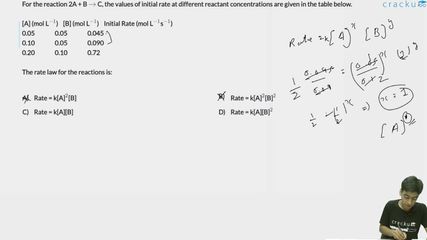
For the reaction 2A + B $$\rightarrow$$ C, the values of initial rate at different reactant concentrations are given in the table below.
[A] (mol L$$^{-1}$$) [B] (mol L$$^{-1}$$) Initial Rate (mol L$$^{-1}$$s$$^{-1}$$)
0.05 0.05 0.045
0.10 0.05 0.090
0.20 0.10 0.72
The rate law for the reactions is:
For any reaction of the general type $$aA+bB\rightarrow \text{products}$$ we write the empirical rate law as
$$\text{Rate}=k[A]^m[B]^n$$
where $$k$$ is the rate constant and $$m,n$$ are the (experimental) orders with respect to the reactants A and B, respectively. Our task is to determine the values of $$m$$ and $$n$$ from the given initial-rate data.
First, label the three experiments for easy reference:
Experiment 1: $$[A]_1=0.05\ \text{mol L}^{-1},\quad [B]_1=0.05\ \text{mol L}^{-1},\quad R_1=0.045\ \text{mol L}^{-1}\text{s}^{-1}$$
Experiment 2: $$[A]_2=0.10\ \text{mol L}^{-1},\quad [B]_2=0.05\ \text{mol L}^{-1},\quad R_2=0.090\ \text{mol L}^{-1}\text{s}^{-1}$$
Experiment 3: $$[A]_3=0.20\ \text{mol L}^{-1},\quad [B]_3=0.10\ \text{mol L}^{-1},\quad R_3=0.72\ \text{mol L}^{-1}\text{s}^{-1}$$
We now compare pairs of experiments so that only one concentration changes at a time.
Step 1: Find $$m$$ by keeping $$[B]$$ constant.
Between Experiments 1 and 2, $$[B]$$ is the same (0.05 mol L−1), so the rate ratio depends only on $$[A]$$:
$$\frac{R_2}{R_1}= \frac{k[A]_2^m[B]_2^n}{k[A]_1^m[B]_1^n} =\left(\frac{[A]_2}{[A]_1}\right)^m\left(\frac{[B]_2}{[B]_1}\right)^n =\left(\frac{[A]_2}{[A]_1}\right)^m(1)^n =\left(\frac{0.10}{0.05}\right)^m.$$
The numerical ratio of rates is $$\dfrac{0.090}{0.045}=2$$, so
$$2=\left(\frac{0.10}{0.05}\right)^m=2^m.$$
Hence $$m=1$$.
Step 2: Find $$n$$ using $$m=1$$.
Now compare Experiments 2 and 3; both $$[A]$$ and $$[B]$$ double. Using the rate law with $$m=1$$, we have
$$\frac{R_3}{R_2}= \frac{k[A]_3^1[B]_3^n}{k[A]_2^1[B]_2^n} =\left(\frac{[A]_3}{[A]_2}\right)^1\left(\frac{[B]_3}{[B]_2}\right)^n =\left(\frac{0.20}{0.10}\right)\left(\frac{0.10}{0.05}\right)^n =2\cdot 2^n.$$
The experimental rate ratio is $$\dfrac{0.72}{0.090}=8$$, so
$$8=2\cdot 2^n \quad\Longrightarrow\quad 4=2^n \quad\Longrightarrow\quad n=2.$$
Step 3: Write the complete rate law.
With $$m=1$$ and $$n=2$$, the empirical rate expression becomes
$$\text{Rate}=k[A]^1[B]^2=k[A][B]^2.$$
Step 4: (Optional) Verify $$k$$ is constant.
Using Experiment 1 data:
$$k=\frac{R_1}{[A]_1[B]_1^2} =\frac{0.045}{(0.05)(0.05)^2} =\frac{0.045}{0.000125}=360.$$
Using Experiment 2:
$$k=\frac{0.090}{(0.10)(0.05)^2} =\frac{0.090}{0.00025}=360,$$
confirming that $$k$$ is indeed constant and our orders are correct.
Therefore, the reaction follows the rate law $$\boxed{\text{Rate}=k[A][B]^2}$$, which corresponds to Option D.
Hence, the correct answer is Option D.
Was this solution helpful?
Click on the Email ☝️ to Watch the Video Solution
Create a FREE account and get:
_1.webp)

Educational materials for JEE preparation

Ask our AI anything

AI can make mistakes. Please verify important information.
AI can make mistakes. Please verify important information.
