
Join Our JEE Preparation Group
Prep with like-minded aspirants; Get access to free daily tests and study material.
Sign in
Please select an account to continue using cracku.in
↓ →
Join Our JEE Preparation Group
Prep with like-minded aspirants; Get access to free daily tests and study material.
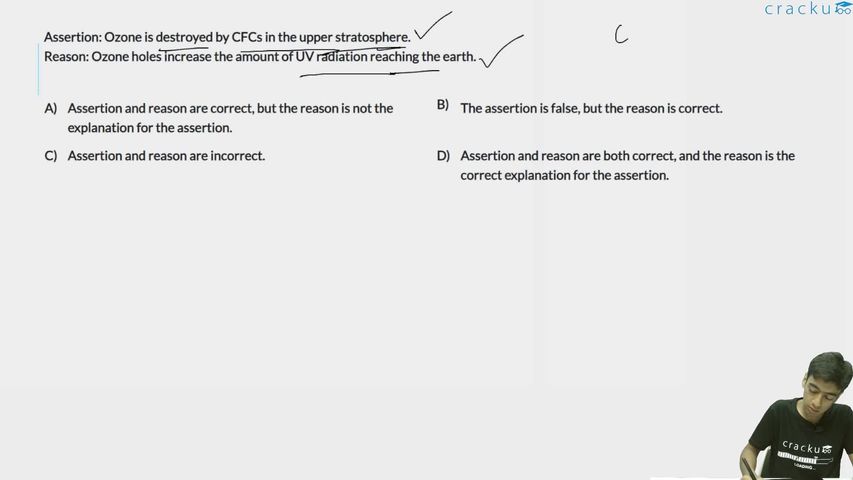
Assertion: Ozone is destroyed by CFCs in the upper stratosphere.
Reason: Ozone holes increase the amount of UV radiation reaching the earth.
We begin by reading the two statements carefully.
Assertion. “Ozone is destroyed by CFCs in the upper stratosphere.”
Reason. “Ozone holes increase the amount of UV radiation reaching the earth.”
Let us analyse the scientific facts one after another, using well-known atmospheric chemistry.
First, we recall the definition of chlorofluorocarbons. These are molecules such as $$\text{CFCl}_3,\; \text{CF}_2\text{Cl}_2$$ that are extremely stable in the lower atmosphere. Because of this stability they are able to drift up to the stratosphere without being degraded.
In the upper stratosphere, however, they encounter high-energy ultraviolet radiation ($$h\nu$$). The radiation breaks the $$\text{C-Cl}$$ bond according to the photolysis reaction
$$\text{CFCl}_3 + h\nu \;\longrightarrow\; \text{CFCl}_2 + \text{Cl}^\bullet.$$
The chlorine free radical $$\text{Cl}^\bullet$$ produced in this way acts catalytically to destroy ozone. The two elementary steps commonly written are
$$\text{Cl}^\bullet + \text{O}_3 \;\longrightarrow\; \text{ClO}^\bullet + \text{O}_2,$$
$$\text{ClO}^\bullet + \text{O} \;\longrightarrow\; \text{Cl}^\bullet + \text{O}_2.$$
Adding the two reactions and cancelling the unchanged $$\text{Cl}^\bullet$$ radical, we obtain the net effect
$$\text{O}_3 + \text{O} \;\longrightarrow\; 2\text{O}_2,$$
showing unequivocally that the presence of CFCs brings about ozone destruction. Therefore, the Assertion is true.
Next, we examine the Reason. Ozone present in the stratosphere absorbs a large fraction of the biologically harmful ultraviolet-B ($$280\text{-}315\,\text{nm}$$) radiation. If the ozone concentration is reduced (that is, if an “ozone hole” forms), the shielding effect weakens. Consequently, more UV-B reaches the troposphere and eventually the earth’s surface. Hence, the Reason statement “Ozone holes increase the amount of UV radiation reaching the earth” is scientifically correct. Therefore, the Reason is also true.
We must now decide whether the Reason explains the Assertion. The Assertion deals with the cause of ozone destruction (action of CFCs), while the Reason speaks about one of the consequences of that destruction (enhanced UV radiation). A correct explanation would have to link CFCs to ozone depletion directly, for example by mentioning chlorine radicals. The given Reason does not do that; it merely lists an effect that follows after the depletion has occurred. Hence, although both statements are correct, the Reason is not the correct explanation of the Assertion.
According to the option list, this situation corresponds to Option A: “Assertion and reason are correct, but the reason is not the explanation for the assertion.”
Hence, the correct answer is Option A.
Was this solution helpful?
Click on the Email ☝️ to Watch the Video Solution
Create a FREE account and get:
_1.webp)

Educational materials for JEE preparation

Ask our AI anything

AI can make mistakes. Please verify important information.
AI can make mistakes. Please verify important information.
