
Join Our JEE Preparation Group
Prep with like-minded aspirants; Get access to free daily tests and study material.
Sign in
Please select an account to continue using cracku.in
↓ →
Join Our JEE Preparation Group
Prep with like-minded aspirants; Get access to free daily tests and study material.
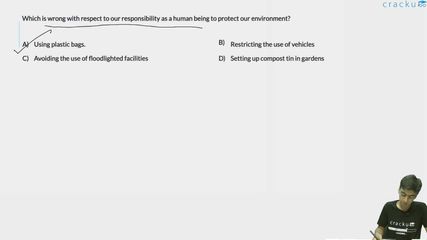
Which is wrong with respect to our responsibility as a human being to protect our environment?
We start by recalling a simple guiding idea: as responsible human beings, every action we take should either
$$ \text{reduce pollution} $$
or
$$ \text{conserve natural resources}. $$
Any activity that goes against either of these two broad goals can be labelled “wrong” from the environmental-protection point of view.
Now we examine each of the four listed activities one by one and check whether it aligns with the above guiding idea.
First option A. Using plastic bags
We know that ordinary plastic bags are non-biodegradable. Mathematically we can think of their lifetime in the soil as
$$ \text{lifetime} \; \approx \; 10^{2} \; \text{to} \; 10^{3} \; \text{years}, $$
which is extremely large. Because they neither decompose quickly nor recycle easily, they accumulate, clog drains, choke animals, and release toxic chemicals on burning. Therefore this activity
$$ \text{increases pollution} $$
and obviously violates our responsibility. So option A is environmentally wrong.
Second option B. Restricting the use of vehicles
Vehicles running on fossil fuels emit $$\text{CO}_2$$, $$\text{NO}_x$$, $$\text{SO}_2$$ and particulate matter. If we restrict their use, total emission falls, i.e.
$$ \Delta(\text{pollution}) < 0. $$
That helps the environment, so this action is correct, not wrong.
Third option C. Avoiding the use of flood-lighted facilities
Floodlights consume a large amount of electrical energy. Since most electricity is generated from coal or other fossil fuels, avoiding such lights saves energy and cuts down emissions. Hence this, too, supports environmental protection and is correct.
Fourth option D. Setting up compost tin in gardens
Composting converts kitchen and garden waste into useful manure. Symbolically,
$$ \text{Waste} \;\longrightarrow\; \text{Manure}, $$
thereby reducing landfill load and enriching soil naturally. This is clearly an eco-friendly practice and therefore correct.
Out of all four, only the first—using plastic bags—contradicts the principle of reducing pollution or conserving resources. Consequently, it is the sole “wrong” practice on the list.
Hence, the correct answer is Option A.
Was this solution helpful?
Click on the Email ☝️ to Watch the Video Solution
Create a FREE account and get:
_1.webp)

Educational materials for JEE preparation

Ask our AI anything

AI can make mistakes. Please verify important information.
AI can make mistakes. Please verify important information.
