Join Our JEE Preparation Group
Prep with like-minded aspirants; Get access to free daily tests and study material.
Sign in
Please select an account to continue using cracku.in
↓ →
Join Our JEE Preparation Group
Prep with like-minded aspirants; Get access to free daily tests and study material.
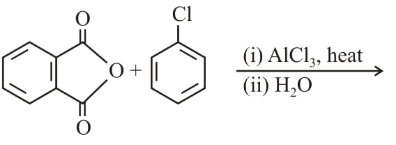
The reaction begins with a Friedel-Crafts Acylation where the Lewis acid catalyst, AlCl3, reacts with phthalic anhydride to open the anhydride ring and generate a powerful electrophilic acylium ion. This ion attacks the chlorobenzene ring, primarily at the para-position due to the directing influence of the chlorine atom and steric hindrance at the ortho-position. This first step produces a complex that, upon aqueous workup H2O, yields o-(4-chlorobenzoyl)benzoic acid.
The reaction stops here because the newly formed carbonyl group strongly deactivates the aromatic rings, making them resistant to further nucleophilic attack under these mild conditions. To achieve the second ring closure the dehydration step you would need a much stronger dehydrating agent like concentrated H2SO4 or Polyphosphoric Acid (PPA) and significant heat to force the carboxylic acid group to cyclize onto the remaining ortho-position of the chlorobenzene ring
Was this solution helpful?

Click on the Email ☝️ to Watch the Video Solution
Create a FREE account and get:
_1.webp)

Educational materials for JEE preparation

Ask our AI anything

AI can make mistakes. Please verify important information.
AI can make mistakes. Please verify important information.