
Join Our JEE Preparation Group
Prep with like-minded aspirants; Get access to free daily tests and study material.
Sign in
Please select an account to continue using cracku.in
↓ →
Join Our JEE Preparation Group
Prep with like-minded aspirants; Get access to free daily tests and study material.
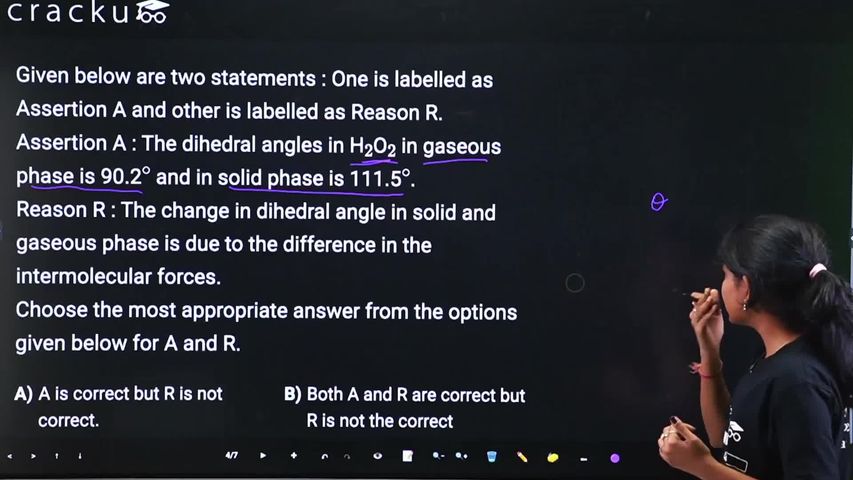
Given below are two statements : One is labelled as Assertion A and other is labelled as Reason R.
Assertion A : The dihedral angles in H$$_2$$O$$_2$$ in gaseous phase is 90.2$$^\circ$$ and in solid phase is 111.5$$^\circ$$.
Reason R : The change in dihedral angle in solid and gaseous phase is due to the difference in the intermolecular forces.
Choose the most appropriate answer from the options given below for A and R.
Hydrogen peroxide $$\mathrm{(H_2O_2)}$$ has a non-planar (open-book) structure in both the gas phase and the solid phase.
Each oxygen atom is approximately $$sp^3$$ hybridized and contains two lone pairs. Due to lone pair-lone pair repulsion, the molecule does not adopt a planar arrangement and instead possesses a finite dihedral angle between the two $$\mathrm{O-H}$$ bonds.
In the gas phase:
In the solid phase (at $$110\ \mathrm{K}$$):
The variation in bond lengths and angles between the gas and solid phases arises from intermolecular interactions, particularly hydrogen bonding in the solid state.
Hence, hydrogen peroxide exists as a non-planar molecule with a dihedral angle of approximately $$111.5^\circ$$ in the gas phase and $$90.2^\circ$$ in the solid phase.
Was this solution helpful?
Click on the Email ☝️ to Watch the Video Solution
Create a FREE account and get:
_1.webp)

Educational materials for JEE preparation

Ask our AI anything

AI can make mistakes. Please verify important information.
AI can make mistakes. Please verify important information.


