
Join Our JEE Preparation Group
Prep with like-minded aspirants; Get access to free daily tests and study material.
Sign in
Please select an account to continue using cracku.in
↓ →
Join Our JEE Preparation Group
Prep with like-minded aspirants; Get access to free daily tests and study material.
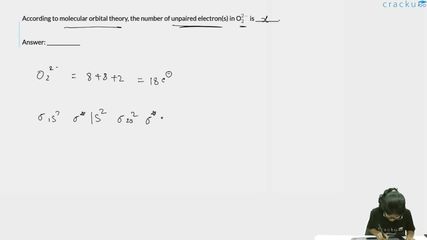
According to molecular orbital theory, the number of unpaired electron(s) in O$$_2^{2-}$$ is _________.
Correct Answer: 0
First, we recall the basic postulate of Molecular Orbital (MO) Theory: when two atomic orbitals combine, they form one bonding molecular orbital and one antibonding molecular orbital. Electrons are filled into these MOs according to the Aufbau principle, obeying the Pauli Exclusion Principle and Hund’s Rule, just as in atomic orbitals.
For an oxygen atom the atomic number is 8, so a neutral O2 molecule contains
$$2 \times 8 = 16$$
electrons in total. Out of these, $$1s$$ core electrons (two per atom) do not influence magnetism, but we shall still count every electron explicitly so that no step is skipped.
When we talk about the peroxide ion $$ \mathrm{O_2^{2-}} $$, we must add two more electrons to the 16 already present in the neutral molecule:
$$16 + 2 = 18$$
Thus $$ \mathrm{O_2^{2-}} $$ possesses 18 electrons to be filled into molecular orbitals.
The energy ordering of MOs for homonuclear diatomic molecules of oxygen and heavier elements is
$$\sigma_{1s},\; \sigma_{1s}^{*},\; \sigma_{2s},\; \sigma_{2s}^{*},\; \sigma_{2p_z},\; \pi_{2p_x} = \pi_{2p_y},\; \pi_{2p_x}^{*} = \pi_{2p_y}^{*},\; \sigma_{2p_z}^{*}$$
Now we shall place all 18 electrons one after another.
1. The $$ \sigma_{1s} $$ bonding orbital receives 2 electrons:
$$\sigma_{1s}^2$$
2. The $$ \sigma_{1s}^{*} $$ antibonding orbital also receives 2 electrons:
$$\sigma_{1s}^{*\,2}$$
3. The $$ \sigma_{2s} $$ bonding orbital receives 2 electrons:
$$\sigma_{2s}^2$$
4. The $$ \sigma_{2s}^{*} $$ antibonding orbital receives 2 electrons:
$$\sigma_{2s}^{*\,2}$$
Up to this point we have placed
$$2 + 2 + 2 + 2 = 8$$
electrons. Ten electrons remain.
5. Next comes the $$ \sigma_{2p_z} $$ bonding orbital, which can hold 2 electrons. We place them as
$$\sigma_{2p_z}^2$$
Total electrons used so far:
$$8 + 2 = 10$$
Eight electrons are left.
6. The degenerate $$ \pi_{2p_x} $$ and $$ \pi_{2p_y} $$ bonding orbitals together can hold 4 electrons. According to Hund’s Rule we put one electron in each first, then pair them, yielding
$$\pi_{2p_x}^2\,\pi_{2p_y}^2$$
Electrons used so far:
$$10 + 4 = 14$$
Four electrons remain.
7. We now arrive at the degenerate antibonding orbitals $$ \pi_{2p_x}^{*} $$ and $$ \pi_{2p_y}^{*} $$. These two orbitals together can accommodate 4 electrons.
For the neutral O2 molecule (16 electrons) we would place only two electrons here, giving one electron to each orbital and resulting in two unpaired electrons. However, in $$ \mathrm{O_2^{2-}} $$ we have two extra electrons, so all four available spots in the pair of antibonding $$\pi^{*}$$ orbitals will now be filled:
$$\pi_{2p_x}^{*\,2}\,\pi_{2p_y}^{*\,2}$$
Electrons accounted for:
$$14 + 4 = 18$$
No electrons remain unplaced, so the electronic configuration is complete.
Because every MO that currently contains electrons now has them in pairs (each electron is matched with another of opposite spin inside the same orbital), there are absolutely no singly-occupied molecular orbitals. In other words, the count of unpaired electrons is
$$0.$$
Hence, the correct answer is Zero.
Was this solution helpful?
Click on the Email ☝️ to Watch the Video Solution
Create a FREE account and get:
_1.webp)

Educational materials for JEE preparation

Ask our AI anything

AI can make mistakes. Please verify important information.
AI can make mistakes. Please verify important information.
