
Join Our JEE Preparation Group
Prep with like-minded aspirants; Get access to free daily tests and study material.
Sign in
Please select an account to continue using cracku.in
↓ →
Join Our JEE Preparation Group
Prep with like-minded aspirants; Get access to free daily tests and study material.
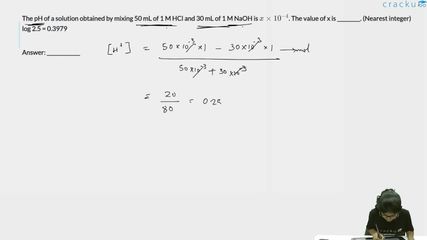
The pH of a solution obtained by mixing 50 mL of 1 M HCl and 30 mL of 1 M NaOH is $$x \times 10^{-4}$$. The value of x is _________. (Nearest integer)
log 2.5 = 0.3979
Correct Answer: 6021
We first calculate the number of millimoles present before mixing. For an acid or a base, the relation between molarity, volume and millimoles is given by
$$\text{millimoles} = M \times V(\text{mL})$$
For the strong acid $$\mathrm{HCl}$$ we have
$$50\ \text{mL}\times 1\ \text{M}=50\ \text{millimoles}.$$
For the strong base $$\mathrm{NaOH}$$ we have
$$30\ \text{mL}\times 1\ \text{M}=30\ \text{millimoles}.$$
The neutralisation reaction is
$$\mathrm{HCl + NaOH \rightarrow NaCl + H_2O}$$
Since the reaction proceeds 1 : 1, $$30$$ millimoles of $$\mathrm{HCl}$$ are completely consumed by the $$30$$ millimoles of $$\mathrm{NaOH}$$. The excess unreacted acid is
$$50-30 = 20\ \text{millimoles \ of } \mathrm{HCl}.$$
These $$20$$ millimoles of $$\mathrm{HCl}$$ remain in the final solution. The total volume after mixing becomes
$$50\ \text{mL}+30\ \text{mL}=80\ \text{mL}=0.08\ \text{L}.$$
Hence the molarity of $$\mathrm{H^+}$$ ions in the mixture is
$$[\mathrm H^+] = \frac{20\ \text{mmol}}{0.08\ \text{L}} = \frac{0.020\ \text{mol}}{0.08\ \text{L}} = 0.25\ \text{M} = 2.5\times 10^{-1}\ \text{M}.$$
We now use the definition of pH:
$$\text{pH} = -\log[\mathrm H^+].$$
Substituting $$[\mathrm H^+] = 2.5\times10^{-1}\ \text{M}$$ gives
$$\text{pH} = -\log\!\left(2.5\times10^{-1}\right).$$
Using the logarithmic identity $$\log(ab)=\log a +\log b$$, we write
$$\log\!\left(2.5\times10^{-1}\right)=\log 2.5 +\log10^{-1} =0.3979-1 =-0.6021.$$
Therefore
$$\text{pH}= -(-0.6021)=0.6021.$$
The problem states the pH in the form $$x\times10^{-4}$$. We write
$$0.6021 = 6021\times10^{-4}.$$
Thus $$x = 6021$$ (nearest integer).
So, the answer is $$6021$$.
Click on the Email ☝️ to Watch the Video Solution
Create a FREE account and get:
_1.webp)

Educational materials for JEE preparation

Ask our AI anything

AI can make mistakes. Please verify important information.
AI can make mistakes. Please verify important information.


