
Join Our JEE Preparation Group
Prep with like-minded aspirants; Get access to free daily tests and study material.
Sign in
Please select an account to continue using cracku.in
↓ →
Join Our JEE Preparation Group
Prep with like-minded aspirants; Get access to free daily tests and study material.
The geometry around boron in the product 'B' formed from the following reaction is
$$BF_3 + NaH \xrightarrow{450K} A + NaF$$
$$A + NMe_3 \rightarrow B$$
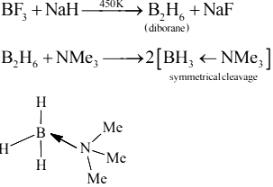
When boron trifluoride ($$\text{BF}_3$$) reacts with sodium hydride ($$\text{NaH}$$) at around $$450\text{ K}$$, it undergoes a reduction reaction to form diborane ($$\text{B}_2\text{H}_6$$) along with sodium fluoride ($$\text{NaF}$$):
$$2\text{BF}_3 + 6\text{NaH} \xrightarrow{450\text{K}} \text{B}_2\text{H}_6 + 6\text{NaF}$$
Therefore, product 'A' is diborane, $$\text{B}_2\text{H}_6$$.
Diborane ($$\text{B}_2\text{H}_6$$) is an electron-deficient molecule that easily undergoes cleavage by Lewis bases. When treated with a relatively small, bulky tertiary amine like trimethylamine ($$\text{NMe}_3$$), it undergoes symmetric cleavage to yield a stable Lewis acid-base adduct:
$$\text{B}_2\text{H}_6 + 2\text{NMe}_3 \rightarrow 2\text{BH}_3\cdot\text{NMe}_3$$
Therefore, product 'B' is the monomeric adduct, $$\text{BH}_3\cdot\text{NMe}_3$$.
In the adduct $$\text{BH}_3\cdot\text{NMe}_3$$, the boron atom accepts a lone pair of electrons from the nitrogen atom of the trimethylamine molecule via a coordinate (dative) bond.
The spatial arrangement corresponding to $$\text{sp}^3$$ hybridization with zero lone pairs is completely symmetrical, giving it a tetrahedral geometry.
The coordination of the lone pair from trimethylamine changes the geometry around the boron atom from trigonal planar (in $$\text{BH}_3$$ fragments) to tetrahedral in the final complex.
Answer: Option B — tetrahedral
Was this solution helpful?
Click on the Email ☝️ to Watch the Video Solution
Create a FREE account and get:
_1.webp)

Educational materials for JEE preparation

Ask our AI anything

AI can make mistakes. Please verify important information.
AI can make mistakes. Please verify important information.
