
Join Our JEE Preparation Group
Prep with like-minded aspirants; Get access to free daily tests and study material.
Sign in
Please select an account to continue using cracku.in
↓ →
Join Our JEE Preparation Group
Prep with like-minded aspirants; Get access to free daily tests and study material.
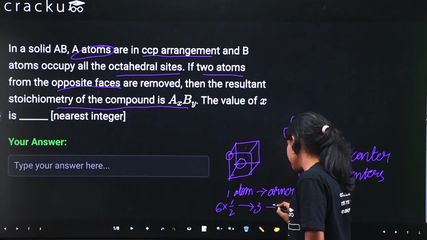
In a solid AB, A atoms are in ccp arrangement and B atoms occupy all the octahedral sites. If two atoms from the opposite faces are removed, then the resultant stoichiometry of the compound is $$A_xB_y$$. The value of $$x$$ is ______ [nearest integer]
Correct Answer: 3
We need to find the value of x in the stoichiometry $$A_xB_y$$ after removing two A atoms from opposite faces of a solid AB with ccp arrangement.
In a ccp (FCC) unit cell, A atoms are arranged in cubic close packing:
Corner A atoms: 8 corners × $$\frac{1}{8}$$ = 1
Face-center A atoms: 6 faces × $$\frac{1}{2}$$ = 3
Total A atoms per unit cell = 1 + 3 = 4
B atoms occupy all octahedral sites:
Body center: 1 × 1 = 1
Edge centers: 12 × $$\frac{1}{4}$$ = 3
Total B atoms per unit cell = 1 + 3 = 4
Initial formula: $$A_4B_4$$ = AB
Two A atoms are removed from opposite faces. Each face-center atom contributes $$\frac{1}{2}$$ to the unit cell.
Removing 2 face-center atoms reduces A by: $$2 \times \frac{1}{2} = 1$$
New A atoms = 4 - 1 = 3
B atoms remain = 4 (unchanged)
The formula becomes $$A_3B_4$$.
So $$x = 3$$.
Therefore, the value of x is 3.
Was this solution helpful?
Click on the Email ☝️ to Watch the Video Solution
Create a FREE account and get:
_1.webp)

Educational materials for JEE preparation

Ask our AI anything

AI can make mistakes. Please verify important information.
AI can make mistakes. Please verify important information.
