
Join Our JEE Preparation Group
Prep with like-minded aspirants; Get access to free daily tests and study material.
Sign in
Please select an account to continue using cracku.in
↓ →
Join Our JEE Preparation Group
Prep with like-minded aspirants; Get access to free daily tests and study material.
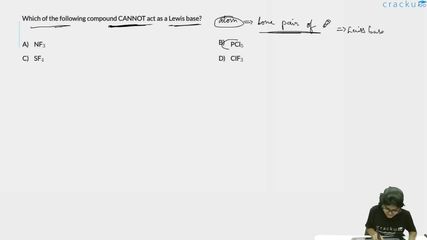
A Lewis base is a species that can donate a lone pair of electrons. For a molecule to act as a Lewis base, its central atom must have at least one lone pair of electrons available for donation.
In $$NF_3$$, nitrogen has one lone pair and can donate it, so it acts as a Lewis base. In $$SF_4$$, sulfur has one lone pair available for donation. In $$ClF_3$$, chlorine has two lone pairs and can donate one of them.
However, in $$PCl_5$$, phosphorus uses all five of its valence electrons to form five bonds with chlorine atoms. The phosphorus atom has no lone pairs remaining, meaning it cannot donate any electron pair to act as a Lewis base. In fact, $$PCl_5$$ is an electron-deficient species at phosphorus and tends to act as a Lewis acid instead.
Therefore, the compound that cannot act as a Lewis base is $$PCl_5$$, which is option (B).
Was this solution helpful?
Click on the Email ☝️ to Watch the Video Solution
Create a FREE account and get:
_1.webp)

Educational materials for JEE preparation

Ask our AI anything

AI can make mistakes. Please verify important information.
AI can make mistakes. Please verify important information.
