We first notice that the unknown appears only through the exponential of $$x$$. A very standard trick in such cases is to declare a new variable equal to the common base of all exponentials.
Let us write $$y=e^{x}\,.$$
Because the exponential function is always positive, we immediately have
$$y=e^{x}>0.$$
Now we rewrite every exponential term in the equation in powers of $$y$$:
$$$\begin{aligned}
e^{6x}-e^{4x}-2e^{3x}-12e^{2x}+e^{x}+1 &= y^{6}-y^{4}-2y^{3}-12y^{2}+y+1.
\end{aligned}$$$
So the original transcendental equation is equivalent to the algebraic one
$$$y^{6}-y^{4}-2y^{3}-12y^{2}+y+1=0,\qquad\text{with }y>0.$$$
We now tackle this sixth-degree polynomial. The coefficients suggest that it might break into lower-degree factors. To discover a factorisation we try to rearrange the terms in pairs and look for a common pattern.
Group the first three and the last three terms:
$$y^{6}-y^{4}-2y^{3}\ \;-\;\ 12y^{2}+y+1.$$
Within the first group $$y^{6}-y^{4}-2y^{3}$$ we can factor out $$y^{3}$$:
$$y^{6}-y^{4}-2y^{3}=y^{3}\bigl(y^{3}-y-2\bigr).$$
Within the second group $$-12y^{2}+y+1$$ we can factor out $$-1$$ to make the inner bracket resemble the previous bracket:
$$-12y^{2}+y+1 = -\bigl(12y^{2}-y-1\bigr).$$
We next notice that $$12y^{2}-y-1$$ happens to be a scalar multiple of $$y^{3}-y-2$$ when we evaluate at suitable $$y$$. To test this idea we divide $$y^{3}-y-2$$ by $$y-2$$:
Using the factor theorem,
$$$\bigl(y^{3}-y-2\bigr)\big|_{y=2}=8-2-2=4\neq0,\qquad
\bigl(y^{3}-y-2\bigr)\big|_{y=1}=1-1-2=-2\neq0.$$$
Thus $$y-1$$ and $$y-2$$ are not factors. We abandon that line and instead try a direct polynomial long division of the full sixth-degree expression by the quadratic $$y^{2}+1$$ which is often helpful with symmetric-looking ends (the constant term is $$1$$ matching the leading coefficient).
Divide $$y^{6}-y^{4}-2y^{3}-12y^{2}+y+1$$ by $$y^{2}+1$$:
1. The leading term $$y^{6}$$ divided by $$y^{2}$$ gives $$y^{4}$$. Multiply back:
$$y^{4}\cdot(y^{2}+1)=y^{6}+y^{4}.$$
Subtract this from the dividend:
$$\bigl(y^{6}-y^{4}\bigr)-\bigl(y^{6}+y^{4}\bigr)=-2y^{4}.$$
Bring down the rest to make a new dividend:
$$-2y^{4}-2y^{3}-12y^{2}+y+1.$$
2. Now divide the new leading term $$-2y^{4}$$ by $$y^{2}$$ to get $$-2y^{2}$$.
Multiply back: $$-2y^{2}\cdot(y^{2}+1)=-2y^{4}-2y^{2}.$$
Subtract again:
$$$\bigl(-2y^{4}-2y^{3}-12y^{2}\bigr)-\bigl(-2y^{4}-2y^{2}\bigr)=-2y^{3}-10y^{2}.$$$
Bring down the remaining $$+y+1$$:
$$-2y^{3}-10y^{2}+y+1.$$
3. Divide the new leading term $$-2y^{3}$$ by $$y^{2}$$ to get $$-2y$$.
Multiply back: $$-2y(y^{2}+1)=-2y^{3}-2y.$$
Subtract:
$$$\bigl(-2y^{3}-10y^{2}+y\bigr)-\bigl(-2y^{3}-2y\bigr)=-10y^{2}+3y.$$$
Again bring down the constant $$+1$$:
$$-10y^{2}+3y+1.$$
4. Divide $$-10y^{2}$$ by $$y^{2}$$ to get $$-10$$.
Multiply back: $$-10(y^{2}+1)=-10y^{2}-10.$$
Subtract once more:
$$$\bigl(-10y^{2}+3y+1\bigr)-\bigl(-10y^{2}-10\bigr)=3y+11.$$$
The remainder is $$3y+11,$$ not zero. Hence $$y^{2}+1$$ is not a factor. However we have gleaned useful intermediate coefficients: the (synthetic) quotient so far is $$y^{4}-2y^{2}-2y-10.$$
At this point systematic long division has not exposed a factor that eliminates the remainder, so we switch to the Rational Root Theorem for the polynomial in $$y$$. Possible rational roots are of the form $$\pm1,\pm\frac1{1},\pm\frac1{\,1}$$ - in short only $$\pm1$$. We already evaluated $$P(1)=-12\neq0$$ and $$P(-1)=-10\neq0$$, so our polynomial has no rational roots.
Because $$y>0,$$ we are concerned only with positive real zeros. Let us therefore apply Descartes’ Rule of Signs to count the number of positive roots of
$$P(y)=y^{6}-y^{4}-2y^{3}-12y^{2}+y+1.$$
Write down the sequence of coefficients with their signs:
$$+\;-\;-\;-\;+\;+\;.$$
Count the sign changes:
$$$+ \to - \;(1),\; - \to -\;(0),\; - \to -\;(0),\; - \to +\;(1),\; + \to +\;(0).$$$
There are exactly $$2$$ sign changes. Descartes’ Rule tells us that the number of positive real roots is either exactly $$2$$ or less than $$2$$ by an even integer. Thus the only possibilities are $$2$$ or $$0.$$
To decide which of the two occurs, we study the behaviour of $$P(y)$$ for $$y>0.$$
We compute its value at two convenient positive points to see whether the polynomial changes sign.
At $$y=1$$:
$$P(1)=1-1-2-12+1+1=-12<0.$$
At $$y=0^{+}$$ (that is, for $$y$$ tending to $$0$$ from the right) the dominant terms are the constant $$+1$$ and the linear term $$+y$$; every higher power vanishes, so
$$P(0^{+})\approx1>0.$$
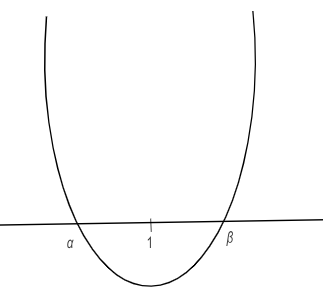
Thus the sign goes from positive near $$0$$ to negative at $$y=1$$, guaranteeing at least one root in the interval $$(0,1).$$ So we cannot have the “zero roots” scenario. Consequently there must be exactly $$2$$ positive real roots.
However the question asks for the number of real roots of the original equation in $$x$$. Because $$y=e^{x}$$ is a one-to-one, strictly increasing correspondence from the entire real line onto the interval $$\bigl(0,\infty\bigr),$$ each positive root $$y_{0}$$ of the polynomial produces exactly one real root $$x_{0}=\ln y_{0}$$ of the exponential equation, and no other roots occur.
Hence the exponential equation possesses precisely $$2$$ real roots.
Hence, the correct answer is Option A.
 JEE WhatsApp Group