
Join Our JEE Preparation Group
Prep with like-minded aspirants; Get access to free daily tests and study material.
Sign in
Please select an account to continue using cracku.in
↓ →
Join Our JEE Preparation Group
Prep with like-minded aspirants; Get access to free daily tests and study material.
A building construction work can be completed by two masons A and B together in 22.5 days. Mason A alone can complete the construction work in 24 days less than mason B alone. Then mason A alone will complete the construction work in :
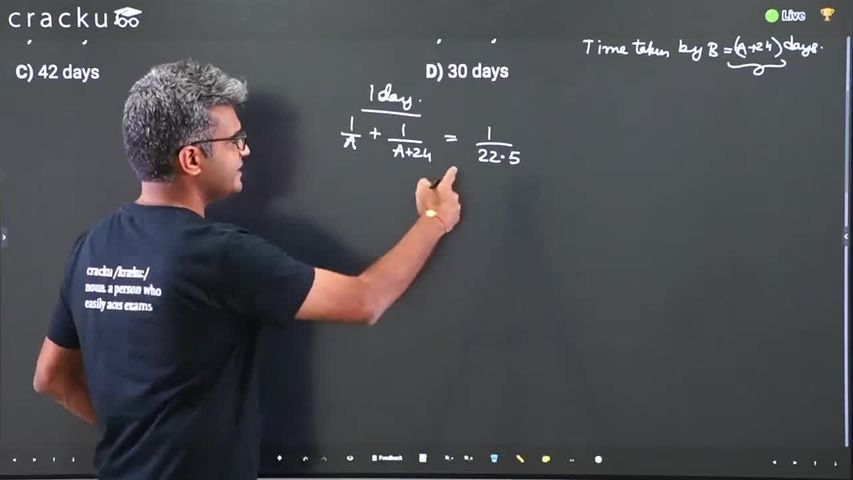
Let the time taken by A to complete the construction be $$ a$$ days. Then B’s time = $$ a + 24$$ days.
If the total work is say 1 unit, then work done by A in one day is $$\frac{1}{a} $$ units , and work by B is $$ \frac{1}{a+24} $$ units.
Given, $$ \dfrac{1}{a} + \dfrac{1}{a+24} = \dfrac{1}{22.5} $$ [work done by A in one day+ work by B in one day= total work done in one day]
or, $$ \dfrac{(a+24) + a}{a(a+24)} = \dfrac{1}{22.5} $$
or, $$ \dfrac{2a + 24}{a(a+24)} = \dfrac{1}{22.5} $$
or, $$ 22.5(2a + 24) = a(a+24) $$
or, $$ 45a + 540 = a^2 + 24a$$
or, $$ a^2 - 21a - 540 = 0 $$
or, $$ a = \dfrac{21 \pm \sqrt{21^2 + 4 \cdot 540}}{2} $$
or, $$ a = \dfrac{21 \pm \sqrt{441 + 2160}}{2}= \dfrac{21 \pm \sqrt{2601}}{2} = \dfrac{21 \pm 51}{2} $$
Since, the number of days cannot be negative, so $$ a = \dfrac{72}{2} = 36 \text{days} $$
Was this solution helpful?
Click on the Email ☝️ to Watch the Video Solution
Create a FREE account and get:
_1.webp)

Educational materials for JEE preparation

Ask our AI anything

AI can make mistakes. Please verify important information.
AI can make mistakes. Please verify important information.
