
Join Our JEE Preparation Group
Prep with like-minded aspirants; Get access to free daily tests and study material.
Sign in
Please select an account to continue using cracku.in
↓ →
Join Our JEE Preparation Group
Prep with like-minded aspirants; Get access to free daily tests and study material.
Let $$\alpha$$ and $$\beta$$ be the roots of the equation $$x^{2}+2ax+\left(3a+10\right)=0$$ such that $$\alpha < 1 < \beta$$. Then the set of all possible values of $$a$$ is :
Given:
$$x^{2}+2ax+\left(3a+10\right)=0$$
Now $$\alpha$$ and $$\beta$$ be the roots given that $$\alpha < 1 < \beta$$.
Thus roots are distinct and real.
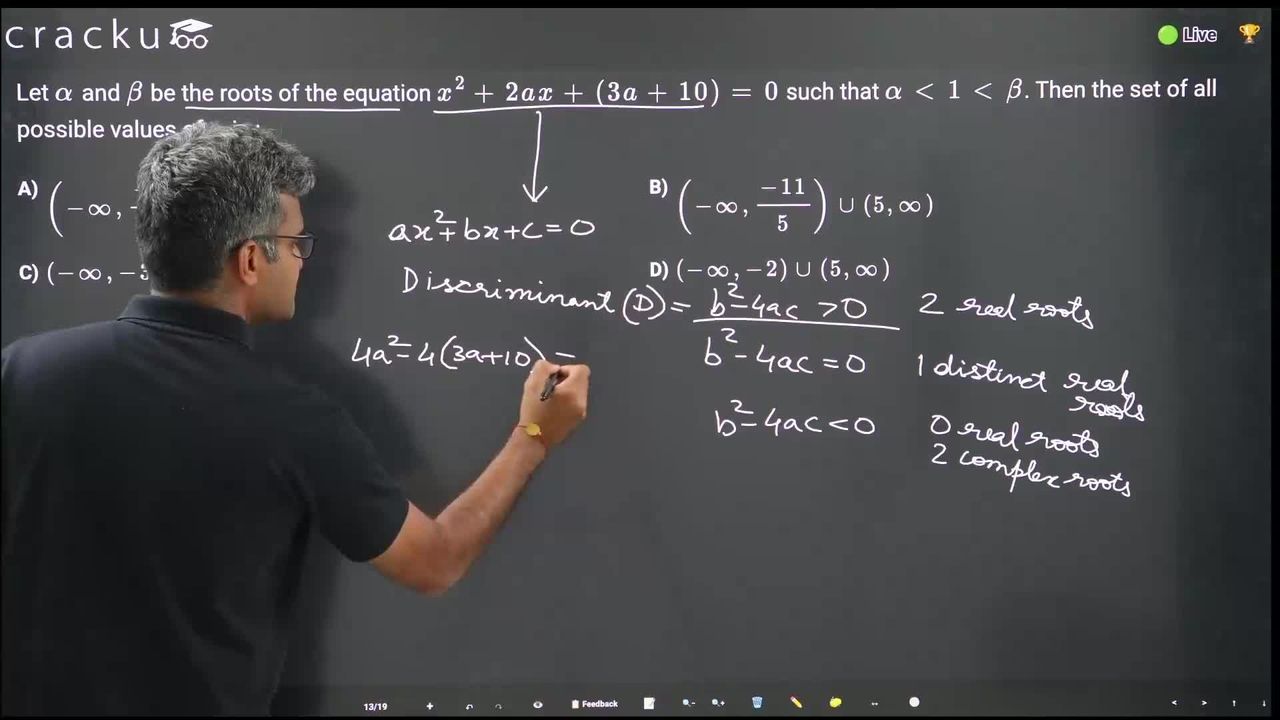
$$\Rightarrow$$ $$D > 0$$
$$\Rightarrow$$ $$4a^2 - 4(3a + 10) > 0$$
$$\Rightarrow$$ $$a^2 - 3a - 10 > 0$$
$$\Rightarrow$$ $$(a - 5)(a + 2) > 0$$
$$\Rightarrow$$ $$a < - 2$$ OR $$ a > 5$$ ----- (i)
The graph of the equation will be an upward parabola as the coefficient of $$x^2$$ is $$1$$, which is greater than $$0$$
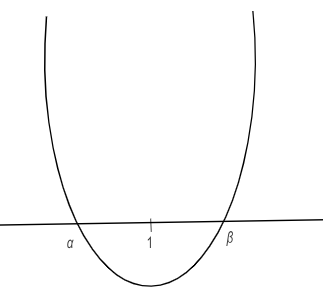
Thus, we if we put $$x = 1$$ in the given quadratic equation, the value should be negative.
$$\Rightarrow$$ $$1 + 2a + (3a + 10) < 0$$
$$\Rightarrow$$ $$ 5a < -11$$
$$\Rightarrow$$ $$a < -\dfrac{11}{5}$$ ----(ii)
Thus by taking the intersection of (i) and (ii), we get the final interval for $$a$$ as,
$$a \in \left(-\infty, -\dfrac{11}{5}\right)$$
Hence, option A is the correct choice.
Was this solution helpful?
Click on the Email ☝️ to Watch the Video Solution
Create a FREE account and get:
_1.webp)

Educational materials for JEE preparation

Ask our AI anything

AI can make mistakes. Please verify important information.
AI can make mistakes. Please verify important information.
