
Join Our JEE Preparation Group
Prep with like-minded aspirants; Get access to free daily tests and study material.
Sign in
Please select an account to continue using cracku.in
↓ →
Join Our JEE Preparation Group
Prep with like-minded aspirants; Get access to free daily tests and study material.
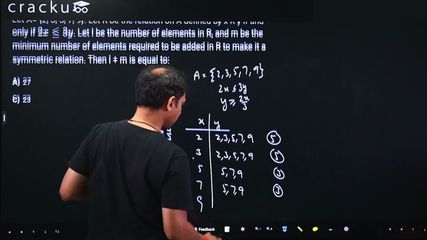
Let A= {2, 3, 5, 7, 9}. Let R be the relation on A defined by x R y if and only if $$2x\leq3y$$. Let l be the number of elements in R, and m be the minimum number of elements required to be added in R to make it a symmetric relation. Then l + m is equal to:
Count $$l$$ (elements in $$R$$).
• $$x=2 \implies 4 \leq 3y \implies y \in \{2,3,5,7,9\}$$ (5 pairs)
• $$x=3 \implies 6 \leq 3y \implies y \in \{2,3,5,7,9\}$$ (5 pairs)
• $$x=5 \implies 10 \leq 3y \implies y \in \{5,7,9\}$$ (3 pairs)
• $$x=7 \implies 14 \leq 3y \implies y \in \{5,7,9\}$$ (3 pairs)
• $$x=9 \implies 18 \leq 3y \implies y \in \{7,9\}$$ (2 pairs)
Total $$l = 5+5+3+3+2 = 18$$.
Count $$m$$ (additions for symmetry).
A relation is symmetric if $$(x,y) \in R \implies (y,x) \in R$$.
We need to find pairs $$(x,y)$$ where $$(x,y) \in R$$ but $$(y,x) \notin R$$.
Pairs in $$R$$: $$(2,3), (2,5), (2,7), (2,9), (3,5), (3,7), (3,9), (5,7), (5,9), (7,9)$$ plus reflexives $$(x,x)$$.
Check inverses:
• $$(5,2): 10 \leq 6$$ (False) $$\to$$ Need to add 1.
• $$(7,2), (9,2), (7,3), (9,3), (9,5), (7,5) \dots$$
Calculating $$l+m$$ usually results in the total possible pairs minus a few.
For this set, $$l=18$$, $$m=7$$. Total $$= \mathbf{25}$$
Was this solution helpful?
Click on the Email ☝️ to Watch the Video Solution
Create a FREE account and get:
_1.webp)

Educational materials for JEE preparation

Ask our AI anything

AI can make mistakes. Please verify important information.
AI can make mistakes. Please verify important information.
