
Join Our JEE Preparation Group
Prep with like-minded aspirants; Get access to free daily tests and study material.
Sign in
Please select an account to continue using cracku.in
↓ →
Join Our JEE Preparation Group
Prep with like-minded aspirants; Get access to free daily tests and study material.
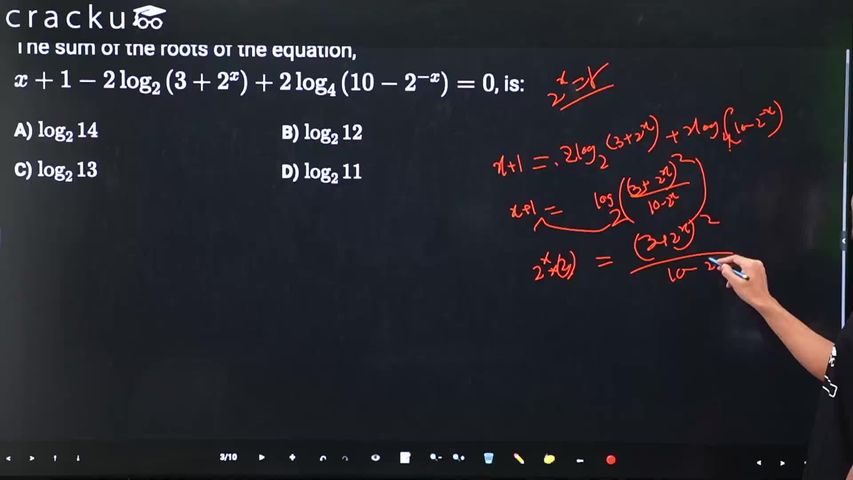
The sum of the roots of the equation, $$x+1-2\log_2\left(3+2^x\right)+2\log_4\left(10-2^{-x}\right)=0$$, is:
The given equation is:
$$x + 1 - 2 \log_2(3 + 2^x) + 2 \log_4(10 - 2^{-x}) = 0$$
First, we simplify the term $$2 \log_4(10 - 2^{-x})$$ using the base change property $$\log_{a^k} b = \frac{1}{k} \log_a b$$:
$$2 \log_{2^2}(10 - 2^{-x}) = 2 \cdot \frac{1}{2} \log_2(10 - 2^{-x}) = \log_2(10 - 2^{-x})$$
Now, substitute this back into the equation:
$$x + 1 - 2 \log_2(3 + 2^x) + \log_2(10 - 2^{-x}) = 0$$
Move the logarithmic terms to one side and the linear terms to the other:
$$x + 1 = 2 \log_2(3 + 2^x) - \log_2(10 - 2^{-x})$$
$$x + 1 = \log_2((3 + 2^x)^2) - \log_2(10 - 2^{-x})$$
Using the quotient rule $$\log_a M - \log_a N = \log_a \frac{M}{N}$$:
$$x + 1 = \log_2 \left( \frac{(3 + 2^x)^2}{10 - 2^{-x}} \right)$$
Convert from logarithmic form to exponential form ($$2^{x+1}$$):
$$2^{x+1} = \frac{(3 + 2^x)^2}{10 - 2^{-x}}$$
$$2 \cdot 2^x = \frac{(3 + 2^x)^2}{10 - \frac{1}{2^x}}$$
Let $$2^x = t$$. The equation becomes:
$$2t = \frac{(3 + t)^2}{10 - \frac{1}{t}}$$ $$2t = \frac{(3 + t)^2}{\frac{10t - 1}{t}}$$
$$2t = \frac{t(3 + t)^2}{10t - 1}$$
Since $$t = 2^x$$, $$t$$ cannot be $$0$$. We can divide both sides by $$t$$:
$$2 = \frac{(3 + t)^2}{10t - 1}$$
$$2(10t - 1) = (3 + t)^2$$
$$20t - 2 = 9 + 6t + t^2$$
$$t^2 - 14t + 11 = 0$$
Let the roots of the quadratic equation in $$t$$ be $$t_1$$ and $$t_2$$. These correspond to $$2^{x_1}$$ and $$2^{x_2}$$ where $$x_1, x_2$$ are the roots of the original equation.
The product of the roots $$t_1 t_2$$ is:
$$t_1 t_2 = \frac{c}{a} = 11$$
Since $$t_1 = 2^{x_1}$$ and $$t_2 = 2^{x_2}$$:
$$2^{x_1} \cdot 2^{x_2} = 11$$
$$2^{x_1 + x_2} = 11$$
Taking $$\log_2$$ on both sides:
$$x_1 + x_2 = \log_2 11$$
Click on the Email ☝️ to Watch the Video Solution
Create a FREE account and get:
_1.webp)

Educational materials for JEE preparation

Ask our AI anything

AI can make mistakes. Please verify important information.
AI can make mistakes. Please verify important information.


