
Join Our JEE Preparation Group
Prep with like-minded aspirants; Get access to free daily tests and study material.
Sign in
Please select an account to continue using cracku.in
↓ →
Join Our JEE Preparation Group
Prep with like-minded aspirants; Get access to free daily tests and study material.
If $$m$$ is chosen in the quadratic equation $$(m^2 + 1)x^2 - 3x + (m^2 + 1)^2 = 0$$ such that the sum of its roots is greatest, then the absolute difference of the cubes of its roots is:
We start with the quadratic equation
$$ (m^{2}+1)x^{2}-3x+(m^{2}+1)^{2}=0 $$
Let its two real roots be $$\alpha$$ and $$\beta$$. For a general quadratic $$ax^{2}+bx+c=0$$ we know the standard relationships
$$ \alpha+\beta=\frac{-\,b}{a}, \qquad \alpha\beta=\frac{c}{a}. $$
Here we can read off
$$ a=m^{2}+1,\; b=-3,\; c=(m^{2}+1)^{2}. $$
So the sum of the roots is
$$ \alpha+\beta=\frac{-(-3)}{m^{2}+1}=\frac{3}{m^{2}+1}. $$
Because $$m^{2}+1>0$$ for every real $$m$$, the quantity $$3/(m^{2}+1)$$ is positive and will be largest when the denominator $$m^{2}+1$$ is as small as possible. The least value of $$m^{2}+1$$ is obtained when $$m=0$$, giving $$m^{2}+1=1$$. Therefore the sum of the roots is maximized when
$$ m=0\quad\text{and}\quad \alpha+\beta=3. $$
With $$m=0$$, the given quadratic reduces to
$$ x^{2}-3x+1=0. $$
We now find the actual roots. Using the quadratic formula for $$x^{2}-3x+1=0$$, we have
$$ x=\frac{3\pm\sqrt{(-3)^{2}-4\cdot1\cdot1}}{2\cdot1} =\frac{3\pm\sqrt{9-4}}{2} =\frac{3\pm\sqrt{5}}{2}. $$
Thus
$$ \alpha=\frac{3+\sqrt{5}}{2},\qquad \beta =\frac{3-\sqrt{5}}{2}. $$
We are asked for the absolute difference of the cubes of the roots, that is,
$$ \left|\alpha^{3}-\beta^{3}\right|. $$
To avoid long numerical cubing, we use the algebraic identity
$$ \alpha^{3}-\beta^{3}=(\alpha-\beta)\,(\alpha^{2}+\alpha\beta+\beta^{2}). $$
First we find $$\alpha-\beta$$:
$$ \alpha-\beta=\frac{3+\sqrt{5}}{2}-\frac{3-\sqrt{5}}{2} =\sqrt{5}. $$
Next we evaluate $$\alpha^{2}+\alpha\beta+\beta^{2}$$. We already have the convenient symmetric sums
$$ \alpha+\beta=3,\qquad \alpha\beta=1. $$
Now,
$$ (\alpha+\beta)^{2} = \alpha^{2}+2\alpha\beta+\beta^{2}. $$
Therefore,
$$ \alpha^{2}+\beta^{2}=(\alpha+\beta)^{2}-2\alpha\beta =3^{2}-2\cdot1=9-2=7. $$
Adding $$\alpha\beta=1$$ to this gives
$$ \alpha^{2}+\alpha\beta+\beta^{2}=7+1=8. $$
Putting everything into the identity, we get
$$ \alpha^{3}-\beta^{3} =(\alpha-\beta)\,(\alpha^{2}+\alpha\beta+\beta^{2}) =(\sqrt{5})(8)=8\sqrt{5}. $$
The value is already positive, so its absolute value stays the same:
$$ \left|\alpha^{3}-\beta^{3}\right|=8\sqrt{5}. $$
Hence, the correct answer is Option D.
Was this solution helpful?
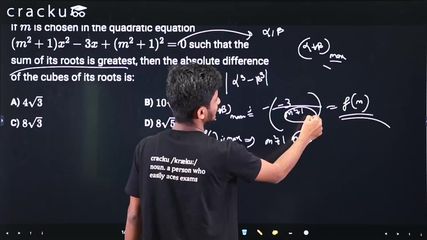
Click on the Email ☝️ to Watch the Video Solution
Create a FREE account and get:
_1.webp)

Educational materials for JEE preparation

Ask our AI anything

AI can make mistakes. Please verify important information.
AI can make mistakes. Please verify important information.


