
Join Our JEE Preparation Group
Prep with like-minded aspirants; Get access to free daily tests and study material.
Sign in
Please select an account to continue using cracku.in
↓ →
Join Our JEE Preparation Group
Prep with like-minded aspirants; Get access to free daily tests and study material.
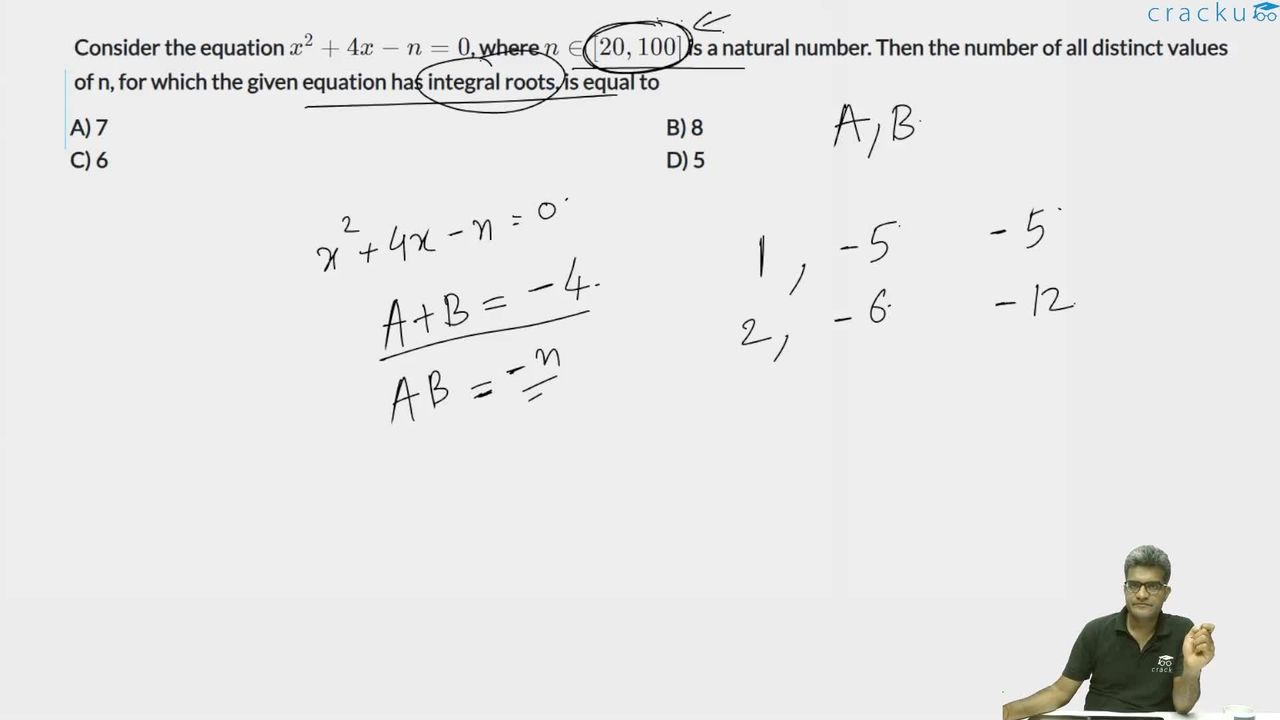
Consider the equation $$x^2 + 4x - n = 0$$, where $$n \in [20, 100]$$ is a natural number. Then the number of all distinct values of n, for which the given equation has integral roots, is equal to
Let $$\alpha$$ and $$\beta$$ be the roots of the equation.
$$\Rightarrow$$ $$\alpha + \beta = -4$$ and $$\alpha\beta = -n$$
The roots of the equation should be integral.
We want pairs such that the sum of the roots is $$-4$$ and the product of the roots is $$-n$$, where $$n$$ lies in $$[20, 100]$$. Hence, the following possible pairs exist. We can enumerate the cases and find out the number of distinct values of $$n$$
$$(3, -7) \Rightarrow n = 21$$
$$(4, -8) \Rightarrow n = 32$$
$$(5, -9) \Rightarrow n = 45$$
$$(6, -10) \Rightarrow n = 60$$
$$(7, -11) \Rightarrow n = 77$$
$$(8, -12) \Rightarrow n = 96$$
This gives 6 possible values of $$n$$
Thus, option C is the correct choice.
Was this solution helpful?
Click on the Email ☝️ to Watch the Video Solution
Create a FREE account and get:
_1.webp)

Educational materials for JEE preparation

Ask our AI anything

AI can make mistakes. Please verify important information.
AI can make mistakes. Please verify important information.
