
Join Our JEE Preparation Group
Prep with like-minded aspirants; Get access to free daily tests and study material.
Sign in
Please select an account to continue using cracku.in
↓ →
Join Our JEE Preparation Group
Prep with like-minded aspirants; Get access to free daily tests and study material.
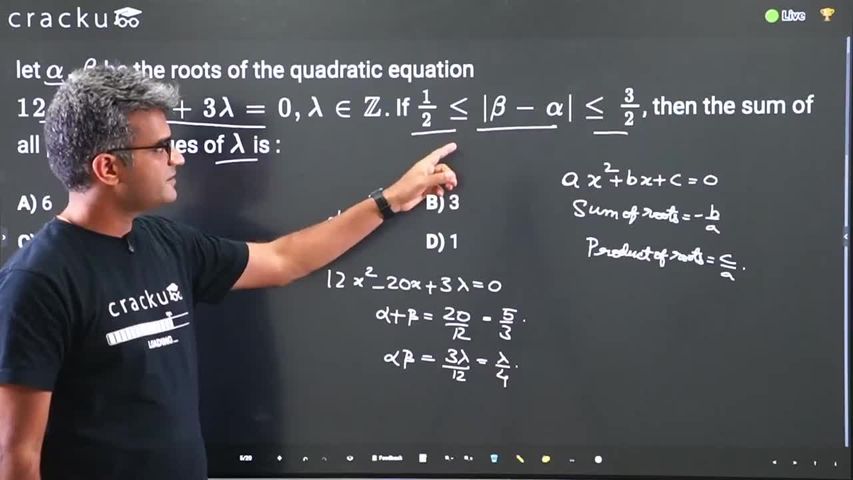
let $$\alpha, \beta$$ be the roots of the quadratic equation $$12x^{2}-20x+3\lambda=0, \lambda\in \mathbb{Z}$$. If $$\frac{1}{2}\leq |\beta-\alpha|\leq\frac{3}{2}$$, then the sum of all possible values of $$\lambda$$ is :
We have the equation: $$12x^{2}-20x+3\lambda=0, \lambda\in Z$$
Sum of the roots: $$\alpha+\beta\ =-\dfrac{b}{a}=-\ \dfrac{\left(-20\right)}{12}=\dfrac{5}{3}$$
Product of the roots: $$\alpha\ \beta\ =\dfrac{c}{a}=\dfrac{3λ}{12}=\dfrac{λ}{4}$$
Now, we know that: $$\left(\beta\ -\alpha\ \right)^2=\left(\beta\ +\alpha\ \right)^2-4\alpha\ \beta\ $$
$$\left(\beta\ -\alpha\ \right)^2=\left(\dfrac{5}{3}\right)^2-4\left(\dfrac{λ}{4}\right)$$
$$\left(\beta\ -\alpha\ \right)^2=\dfrac{25}{9}-λ$$
$$\left(\beta\ -\alpha\ \right)^2=\dfrac{25-9λ}{9}$$
Taking the square root of both sides:
$$\left|\beta\ -\alpha\right|=\dfrac{\sqrt{\left(25-9λ\right)}}{3}$$
Now, we are given that:
$$\dfrac{1}{2}\le\ \left|\beta\ -\alpha\right|\le\ \dfrac{3}{2}$$
Substituting:
$$\dfrac{1}{2}\le\ \dfrac{\sqrt{\left(25-9λ\right)}}{3}\le\dfrac{3}{2}$$
Multiplying by 3:
$$\dfrac{3}{2}\le\ \sqrt{\left(25-9λ\right)}\le\dfrac{9}{2}$$
Or, $$\dfrac{9}{4}\le\ 25-9λ\le\dfrac{81}{4}$$
Subtracting 25 from all three:
$$-\dfrac{91}{4}\le\ -9λ\le-\dfrac{19}{4}$$
Dividing all three by -9:
$$\dfrac{91}{36}\ge\ \ λ\ge\dfrac{19}{36}$$
Or, we can say, $$0.527 \leq \lambda \leq 2.527$$
The only integers that fall within the range [0.527, 2.527] are: 1 and 2.
Hence, the sum of all possible values of $$\lambda$$ is 3.
Was this solution helpful?
Click on the Email ☝️ to Watch the Video Solution
Create a FREE account and get:
_1.webp)

Educational materials for JEE preparation

Ask our AI anything

AI can make mistakes. Please verify important information.
AI can make mistakes. Please verify important information.
