
Join Our JEE Preparation Group
Prep with like-minded aspirants; Get access to free daily tests and study material.
Sign in
Please select an account to continue using cracku.in
↓ →
Join Our JEE Preparation Group
Prep with like-minded aspirants; Get access to free daily tests and study material.
lf the mean deviation about the median of the numbers k, 2k, 3k, ..... , 1000k is 500, then $$k^{2}$$ is equal to :
Total number of terms, $$N=1000$$, is even.
For an even-sized ordered list, the median is the average of the $$\frac{N}{2}$$-th and $$\left(\frac{N}{2}+1\right)$$-th terms.
The $$500$$-th term is $$500k$$ and the $$501$$-st term is $$501k$$.
$$M$$ equals $$\frac{500k+501k}{2}=\frac{1001k}{2}=500.5k$$.
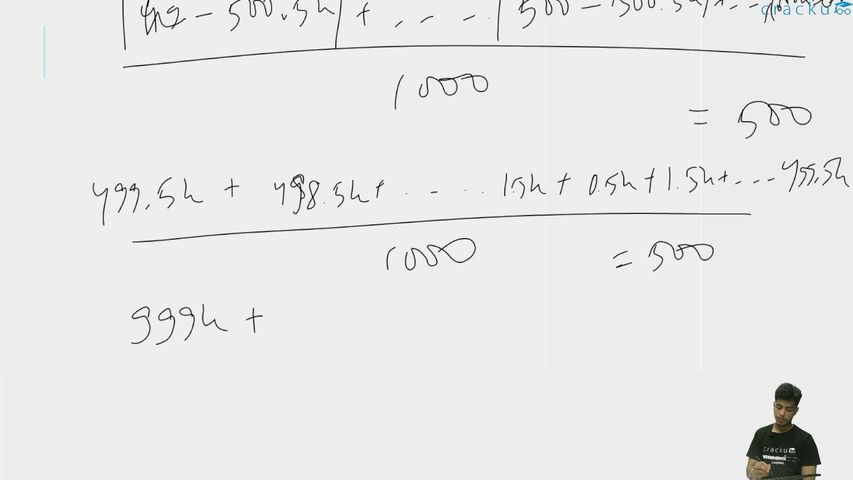
$$\text{M.D.}=\frac{1}{1000}\sum_{i=1}^{1000}\left|ik-500.5k\right|$$
$$=\frac{k}{1000}\sum_{i=1}^{1000}\left|i-500.5\right|.$$
$$S=\sum_{i=1}^{1000}\left|i-500.5\right|.$$
Because the list is symmetric around $$500.5$$, the absolute differences come in equal pairs.
For $$i=1,2,\dots ,500$$ we have distances
$$499.5,498.5,\dots ,0.5,$$
an arithmetic progression with
first term $$a_1=499.5$$, last term $$a_{500}=0.5$$, number of terms $$n=500$$.
Sum of these 500 terms:
$$S_{500}=\frac{n}{2}\left(a_1+a_{500}\right)=\frac{500}{2}(499.5+0.5)=250\times500=125\,000.$$
The same sum occurs for $$i=501,502,\dots ,1000$$ (distances $$0.5,1.5,\dots ,499.5$$).
$$S=2\times125\,000=250\,000.$$
Mean deviation about the median equals $$500$$, so
$$\frac{k}{1000}\times250\,000=500.$$
$$k^{2}=2^{2}=4.$$
Was this solution helpful?
Click on the Email ☝️ to Watch the Video Solution
Create a FREE account and get:
_1.webp)

Educational materials for JEE preparation

Ask our AI anything

AI can make mistakes. Please verify important information.
AI can make mistakes. Please verify important information.
