
Join Our JEE Preparation Group
Prep with like-minded aspirants; Get access to free daily tests and study material.
Sign in
Please select an account to continue using cracku.in
↓ →
Join Our JEE Preparation Group
Prep with like-minded aspirants; Get access to free daily tests and study material.
Among the statements
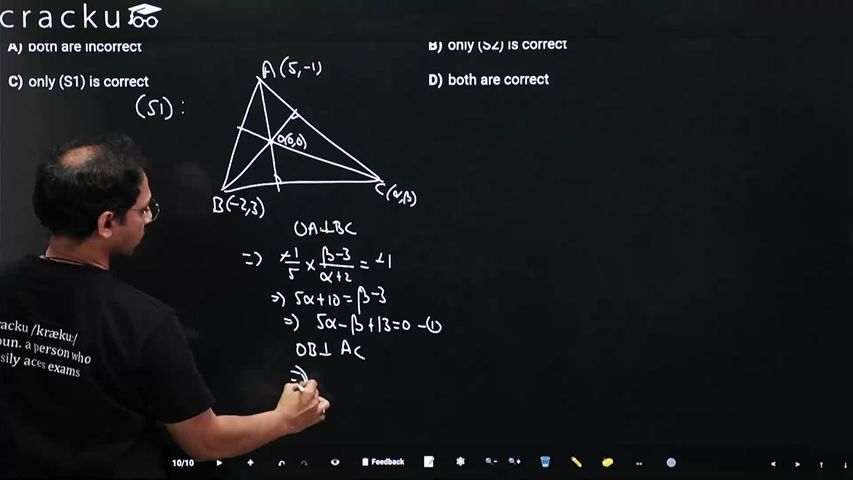
(S1) : If A(5, -1) and B(-2, 3) are two vertices of a triangle, whose orthocentre is (0, 0), then its third vertex is (- 4,- 7) and
(S2) : If positive numbers 2a, b, c are three consecutive terms of an A.P., then the lines ax + by + c = 0 are concurrent at (2,-2),
Let A(5, -1) and B(-2, 3) be two vertices of a triangle whose orthocentre is O(0, 0)
Let C = (h, k). Since OA is perpendicular to BC, the dot product of vectors OA = (5, -1) and BC = (h + 2, k - 3) must be zero.
5(h + 2) + (−1)(k − 3) = 0
5h − k = −13.
OB is perpendicular to AC, so the dot product of OB = (−2, 3) and AC = (h − 5, k + 1) must be zero
−2(h − 5) + 3(k + 1) = 0
−2h + 3k = −13. '
Solving these two equations
h = −4 and k = −7, so C = (−4, −7).
Therefore, statement (S1) is true.
Next, let positive numbers 2a, b, c form an arithmetic progression, so b − 2a = c − b and hence c = 2b − 2a.
The general line ax + by + c = 0 then becomes ax + by + 2b − 2a = 0, or equivalently a(x − 2) + b(y + 2) = 0.
Since a and b are arbitrary positive parameters, this equation can hold only if x − 2 = 0 and y + 2 = 0, showing that every such line passes through the point (2, −2).
Thus, statement (S2) is also true.
Was this solution helpful?
Click on the Email ☝️ to Watch the Video Solution
Create a FREE account and get:
_1.webp)

Educational materials for JEE preparation

Ask our AI anything

AI can make mistakes. Please verify important information.
AI can make mistakes. Please verify important information.
