
Join Our JEE Preparation Group
Prep with like-minded aspirants; Get access to free daily tests and study material.
Sign in
Please select an account to continue using cracku.in
↓ →
Join Our JEE Preparation Group
Prep with like-minded aspirants; Get access to free daily tests and study material.
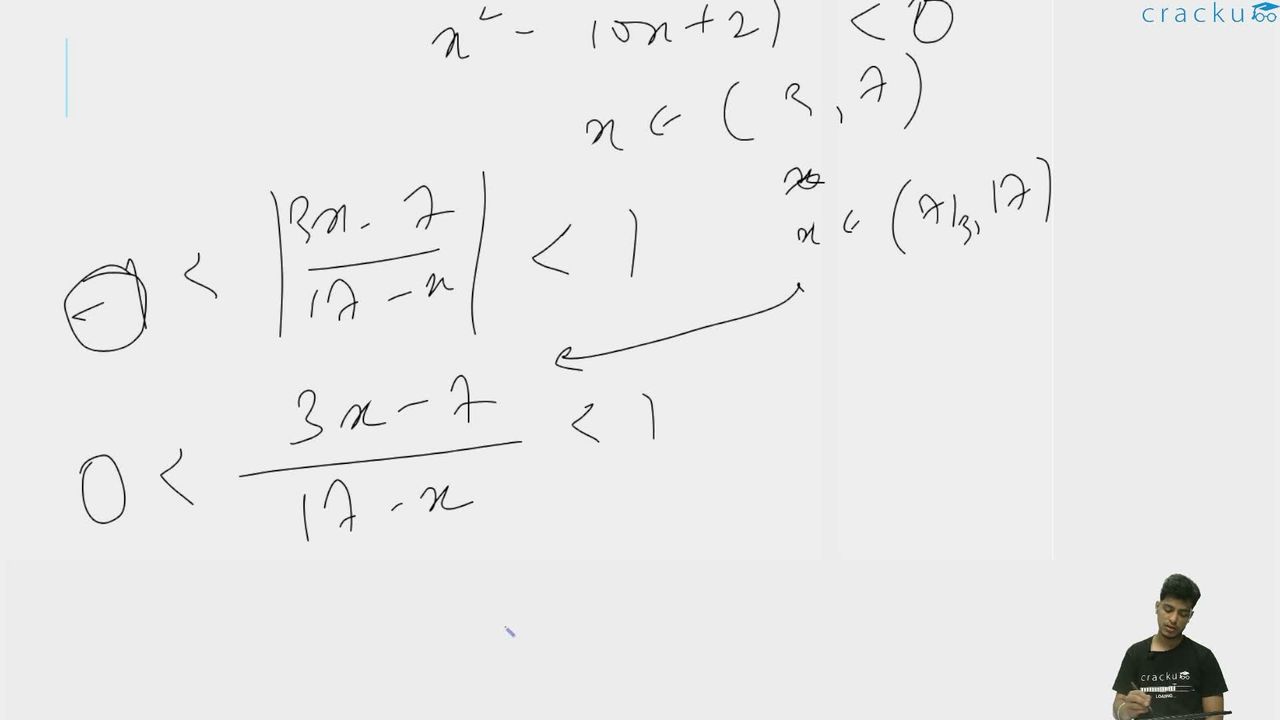
Let the domain of the function f(x) = $$\log_{3}\log_{5}(7-\log_{2}(x^{2}-10x+85))+\sin^{-1}\left(|\frac{3x-7}{17-x}|\right)$$ be $$(\alpha, \beta)$$. Then $$\alpha + \beta$$ is equal to :
The term inside the base-2 logarithm is $$x^{2}-10x+85=(x-5)^{2}+60$$ which is always positive for all $$x\in\mathbb{R}$$.
Argument of the base-5 logarithm
For $$\log_{5}\bigl(7-\log_{2}(x^{2}-10x+85)\bigr)$$ we require
$$7-\log_{2}(x^{2}-10x+85) \gt 1$$
The inequality is strict because the result of the base-5 logarithm, $$\log_{5}(y)$$, must be positive
$$\log_{2}(x^{2}-10x+85) \lt 6$$
Converting to exponential form,
$$(x-5)^{2}+60 \lt 2^{6}=64$$
$$\Longrightarrow\;3 \lt x \lt 7$$
Argument of the base-3 logarithm
Because $$\log_{5}(7-\log_{2}(\ldots))\gt 0$$ is already ensured in Step 2, the outer logarithm $$\log_{3}(\ldots)$$ is automatically defined on $$3\lt x\lt 7$$. No further restriction arises here.
Argument of $$\sin^{-1}$$
For $$\sin^{-1}\!\left(\left|\dfrac{3x-7}{17-x}\right|\right)$$ we need
$$\left|\dfrac{3x-7}{17-x}\right|\le 1$$ and also $$17-x\neq 0\;(\text{i.e.\ }x\neq 17).$$
The absolute-value inequality is equivalent to
$$(3x-7)^{2}\le(17-x)^{2}$$
$$9x^{2}-42x+49\;\le\;x^{2}-34x+289$$
$$\Longrightarrow\;8x^{2}-8x-240\le 0$$
$$(x-6)(x+5)\le 0$$
$$\Longrightarrow\;-5\le x\le 6$$
Since $$x\neq 17$$ is already outside this range, it causes no extra restriction.
Intersection of all conditions
$$3\lt x\le 6$$
Thus the domain can be written as $$(\alpha,\beta)=(3,6)$$.
(The point $$x=6$$ satisfies every condition but the interval symbol chosen in the question is open; this does not affect the values of $$\alpha$$ and $$\beta$$.)
$$\alpha+\beta = 3+6 = 9$$
Was this solution helpful?
Click on the Email ☝️ to Watch the Video Solution
Create a FREE account and get:
_1.webp)

Educational materials for JEE preparation

Ask our AI anything

AI can make mistakes. Please verify important information.
AI can make mistakes. Please verify important information.
