
Join Our JEE Preparation Group
Prep with like-minded aspirants; Get access to free daily tests and study material.
Sign in
Please select an account to continue using cracku.in
↓ →
Join Our JEE Preparation Group
Prep with like-minded aspirants; Get access to free daily tests and study material.
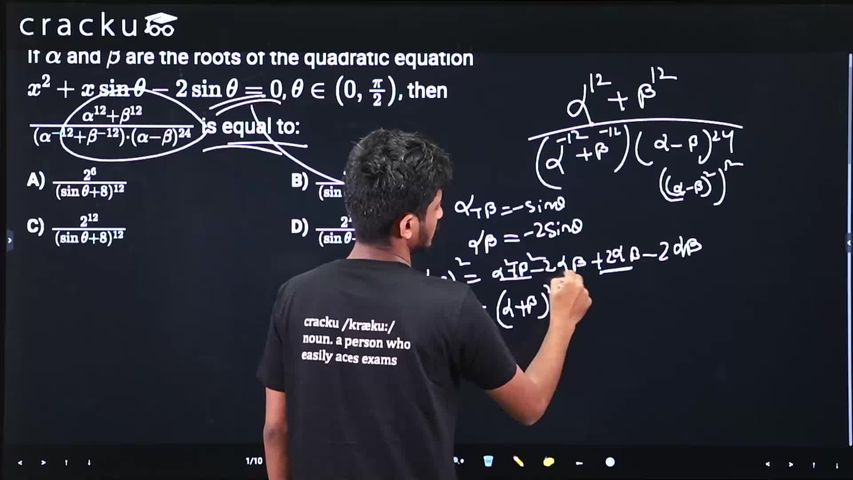
If $$\alpha$$ and $$\beta$$ are the roots of the quadratic equation $$x^2 + x\sin\theta - 2\sin\theta = 0$$, $$\theta \in \left(0, \frac{\pi}{2}\right)$$, then $$\frac{\alpha^{12} + \beta^{12}}{(\alpha^{-12} + \beta^{-12})\cdot(\alpha - \beta)^{24}}$$ is equal to:
We start with the quadratic equation
$$x^{2}+x\sin\theta-2\sin\theta=0,\qquad\theta\in\left(0,\frac{\pi}{2}\right).$$
For a quadratic $$ax^{2}+bx+c=0,$$ the sum and product of its roots are given by the well-known relations
$$\alpha+\beta=-\frac{b}{a},\qquad\alpha\beta=\frac{c}{a}.$$
Here $$a=1,\;b=\sin\theta,\;c=-2\sin\theta.$$ Substituting these values we get
$$\alpha+\beta=-\sin\theta,\qquad\alpha\beta=-2\sin\theta.$$
The required expression is
$$\frac{\alpha^{12}+\beta^{12}}{\left(\alpha^{-12}+\beta^{-12}\right)\,(\alpha-\beta)^{24}}.$$
First we simplify the factor $$\alpha^{-12}+\beta^{-12}.$$ Using the property $$x^{-n}=\dfrac{1}{x^{n}},$$ we have
$$\alpha^{-12}+\beta^{-12} =\frac{1}{\alpha^{12}}+\frac{1}{\beta^{12}} =\frac{\beta^{12}+\alpha^{12}}{\alpha^{12}\beta^{12}} =\frac{\alpha^{12}+\beta^{12}}{(\alpha\beta)^{12}}.$$
Substituting this into the whole fraction gives
$$\frac{\alpha^{12}+\beta^{12}} {\bigl[\dfrac{\alpha^{12}+\beta^{12}}{(\alpha\beta)^{12}}\bigr]\, (\alpha-\beta)^{24}} \;=\; \frac{\alpha^{12}+\beta^{12}}{\alpha^{12}+\beta^{12}} \cdot \frac{(\alpha\beta)^{12}}{(\alpha-\beta)^{24}} \;=\; \frac{(\alpha\beta)^{12}}{(\alpha-\beta)^{24}}.$$
Thus all dependence on $$\alpha^{12}+\beta^{12}$$ itself has vanished, and the task is now to evaluate $$\alpha\beta$$ and $$\alpha-\beta.$$
We already know $$\alpha\beta=-2\sin\theta,$$ so
$$(\alpha\beta)^{12}=(-2\sin\theta)^{12}=2^{12}\,(\sin\theta)^{12},$$
because an even power removes the sign.
Next we compute $$\alpha-\beta.$$ Using the identity
$$(\alpha-\beta)^{2}=(\alpha+\beta)^{2}-4\alpha\beta,$$
we substitute the values we have found:
$$(\alpha-\beta)^{2} =(-\sin\theta)^{2}-4(-2\sin\theta) =\sin^{2}\theta+8\sin\theta =\sin\theta\bigl(\sin\theta+8\bigr).$$
Since we finally need $$(\alpha-\beta)^{24},$$ we raise both sides to the 12th power (note that any sign ambiguity disappears because the exponent is even):
$$(\alpha-\beta)^{24} =\bigl[(\alpha-\beta)^{2}\bigr]^{12} =\Bigl[\sin\theta\bigl(\sin\theta+8\bigr)\Bigr]^{12} =(\sin\theta)^{12}\,(\sin\theta+8)^{12}.$$
Putting everything together we get
$$\frac{(\alpha\beta)^{12}}{(\alpha-\beta)^{24}} =\frac{2^{12}(\sin\theta)^{12}} {(\sin\theta)^{12}(\sin\theta+8)^{12}} =\frac{2^{12}}{(\sin\theta+8)^{12}}.$$
This matches Option C.
Hence, the correct answer is Option 3.
Was this solution helpful?
Click on the Email ☝️ to Watch the Video Solution
Create a FREE account and get:
_1.webp)

Educational materials for JEE preparation

Ask our AI anything

AI can make mistakes. Please verify important information.
AI can make mistakes. Please verify important information.
