
Join Our JEE Preparation Group
Prep with like-minded aspirants; Get access to free daily tests and study material.
Sign in
Please select an account to continue using cracku.in
↓ →
Join Our JEE Preparation Group
Prep with like-minded aspirants; Get access to free daily tests and study material.
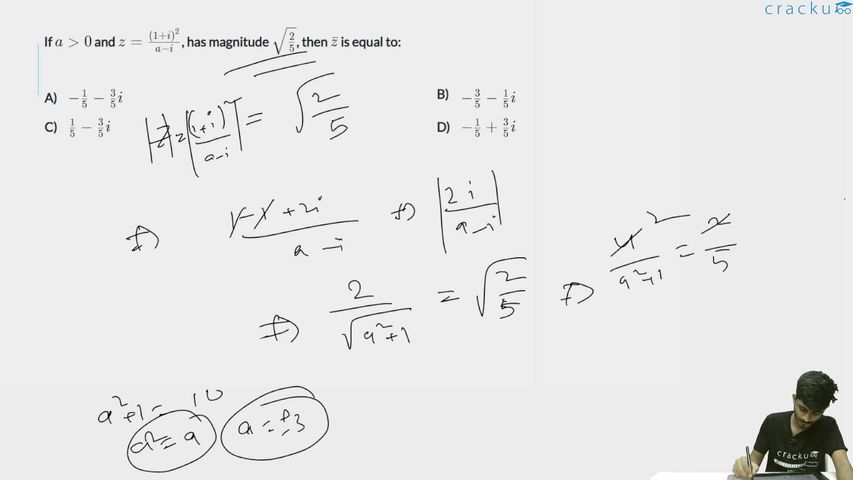
If $$a > 0$$ and $$z = \frac{(1+i)^2}{a-i}$$, has magnitude $$\sqrt{\frac{2}{5}}$$, then $$\bar{z}$$ is equal to:
We have the complex number defined as $$z=\dfrac{(1+i)^2}{\,a-i\,}$$ with the real constant $$a>0$$ and with the magnitude condition $$|z|=\sqrt{\dfrac{2}{5}}.$$ Our task is to determine the value of the conjugate $$\bar z$$.
First we simplify the numerator. Expanding $$(1+i)^2$$ gives
$$\bigl(1+i\bigr)^2=1+2i+i^2=1+2i-1=2i.$$
So the expression for $$z$$ becomes
$$z=\dfrac{2i}{a-i}.$$
Next we use the property of moduli for a quotient of two complex numbers. The formula is
$$\biggl|\dfrac{u}{v}\biggr|=\dfrac{|u|}{|v|}.$$
Applying this to our case, we obtain
$$|z|=\biggl|\dfrac{2i}{a-i}\biggr|=\dfrac{|2i|}{\,|a-i|\,}.$$
The modulus of $$2i$$ is simply the absolute value of its coefficient, so $$|2i|=2.$$ Hence
$$\dfrac{2}{|a-i|}=\sqrt{\dfrac{2}{5}}.$$
Solving for $$|a-i|$$ we cross-multiply:
$$|a-i|=\dfrac{2}{\sqrt{2/5}}=\dfrac{2}{\sqrt{2}\,/\sqrt{5}}=2\cdot\dfrac{\sqrt{5}}{\sqrt{2}}=\dfrac{2\sqrt5}{\sqrt2}=\sqrt2\,\sqrt5=\sqrt{10}.$$
Now we translate this magnitude back into an algebraic condition. The modulus of a complex number $$x+iy$$ is given by $$|x+iy|=\sqrt{x^2+y^2}.$$ For $$a-i,$$ the real part is $$a$$ and the imaginary part is $$-1,$$ so
$$|a-i|=\sqrt{a^{2}+(-1)^{2}}=\sqrt{a^{2}+1}.$$
Equating the two expressions for the modulus gives
$$\sqrt{a^{2}+1}=\sqrt{10}\quad\Longrightarrow\quad a^{2}+1=10\quad\Longrightarrow\quad a^{2}=9.$$
Because the question states that $$a>0,$$ we take the positive root and obtain
$$a=3.$$
With this value in hand we can now write $$z$$ explicitly:
$$z=\dfrac{2i}{3-i}.$$
To express $$z$$ in the standard form $$x+iy$$ we rationalize the denominator by multiplying numerator and denominator by the conjugate of the denominator, namely $$3+i.$$ Thus
$$z=\dfrac{2i}{3-i}\cdot\dfrac{3+i}{3+i} =\dfrac{2i(3+i)}{(3-i)(3+i)}.$$
The denominator simplifies using the identity $$(x-iy)(x+iy)=x^{2}+y^{2}.$$ Here $$x=3$$ and $$y=1,$$ so
$$(3-i)(3+i)=3^{2}+1^{2}=9+1=10.$$
Now we expand the numerator:
$$2i(3+i)=2i\cdot3+2i\cdot i=6i+2i^{2}=6i+2(-1)=6i-2.$$
Therefore
$$z=\dfrac{-2+6i}{10}=-\dfrac{2}{10}+\dfrac{6}{10}i=-\dfrac15+\dfrac35\,i.$$
Taking the complex conjugate simply changes the sign of the imaginary part. Hence
$$\bar z=-\dfrac15-\dfrac35\,i.$$
This value matches Option A in the given list.
Hence, the correct answer is Option A.
Was this solution helpful?
Click on the Email ☝️ to Watch the Video Solution
Create a FREE account and get:
_1.webp)

Educational materials for JEE preparation

Ask our AI anything

AI can make mistakes. Please verify important information.
AI can make mistakes. Please verify important information.
