
Join Our JEE Preparation Group
Prep with like-minded aspirants; Get access to free daily tests and study material.
Sign in
Please select an account to continue using cracku.in
↓ →
Join Our JEE Preparation Group
Prep with like-minded aspirants; Get access to free daily tests and study material.
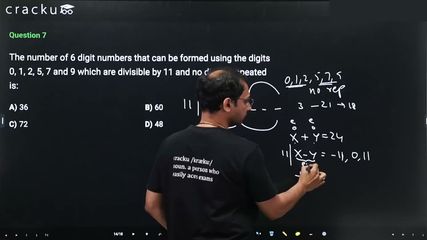
The number of 6 digit numbers that can be formed using the digits 0, 1, 2, 5, 7 and 9 which are divisible by 11 and no digit is repeated is:
We have to form six-digit numbers with the six distinct digits 0, 1, 2, 5, 7 and 9. Because every digit is used exactly once, each admissible arrangement is a permutation of this complete set, but only those permutations that satisfy the divisibility rule for 11 will be counted.
First, recall the test for divisibility by 11: a number is divisible by 11 if and only if the alternating sum of its digits is a multiple of 11. Writing a six-digit number as $$d_1d_2d_3d_4d_5d_6$$ (with $$d_1$$ the left-most digit), the rule states
$$\bigl(d_1+d_3+d_5\bigr)\;-\;\bigl(d_2+d_4+d_6\bigr)\equiv 0\pmod{11}.$$
Let us denote
$$S_{\text{odd}} \;=\; d_1+d_3+d_5,$$ $$S_{\text{even}} = d_2+d_4+d_6.$$
Since the six given digits are all used, their total sum is fixed:
$$0+1+2+5+7+9 \;=\; 24.$$
Thus
$$S_{\text{odd}}+S_{\text{even}} = 24.$$
To satisfy the 11-test we need
$$S_{\text{odd}}-S_{\text{even}}\equiv 0\pmod{11}.$$
The difference between two sums of three digits cannot exceed 18 in magnitude, so the only multiple of 11 lying in the interval $$[-18,18]$$ is 0 itself. Hence we must have
$$S_{\text{odd}}-S_{\text{even}} = 0,$$
which gives
$$S_{\text{odd}} = S_{\text{even}} = 12.$$
We now seek all unordered triples of the set {0,1,2,5,7,9} that add up to 12. Listing every possibility:
$$0+5+7 = 12,\qquad 1+2+9 = 12.$$
No other combination of three distinct digits from the set sums to 12, so the only way to split the six digits into two equal-sum groups is
$$\{0,5,7\}\quad\text{and}\quad\{1,2,9\}.$$
Either of these two triples can occupy the odd positions while the other occupies the even positions. Therefore there are exactly
$$2\;$$ ways to assign the two triples to the two position sets.
Once an assignment is fixed, the three chosen digits can be permuted among their three designated positions. Each set therefore contributes
$$3!\times 3! = 6\times 6 = 36$$
arrangements. Multiplying by the two possible assignments gives an initial count
$$2\times 36 = 72.$$
However, some of these 72 arrangements do not represent valid six-digit numbers because a number is not allowed to start with 0. Let us remove the invalid cases.
• If the triple $$\{0,5,7\}$$ occupies the odd positions, the left-most position $$d_1$$ can receive the digit 0. Fixing $$d_1=0,$$ the remaining two odd positions $$d_3,d_5$$ can be filled with the digits 5 and 7 in $$2! = 2$$ ways. The even positions admit $$3! = 6$$ permutations of the digits 1, 2 and 9. Consequently the number of inadmissible arrangements with a leading zero equals
$$2\times 6 = 12.$$
• If the triple $$\{1,2,9\}$$ occupies the odd positions, then $$d_1$$ is one of 1, 2 or 9, never 0, so no additional arrangements are excluded in this case.
Hence the total count of acceptable six-digit numbers is
$$72-12 = 60.$$
Therefore we can form 60 different six-digit numbers using the digits 0, 1, 2, 5, 7 and 9, each used once, that are divisible by 11.
Hence, the correct answer is Option B.
Was this solution helpful?
Click on the Email ☝️ to Watch the Video Solution
Create a FREE account and get:
_1.webp)

Educational materials for JEE preparation

Ask our AI anything

AI can make mistakes. Please verify important information.
AI can make mistakes. Please verify important information.
