
Join Our JEE Preparation Group
Prep with like-minded aspirants; Get access to free daily tests and study material.
Sign in
Please select an account to continue using cracku.in
↓ →
Join Our JEE Preparation Group
Prep with like-minded aspirants; Get access to free daily tests and study material.
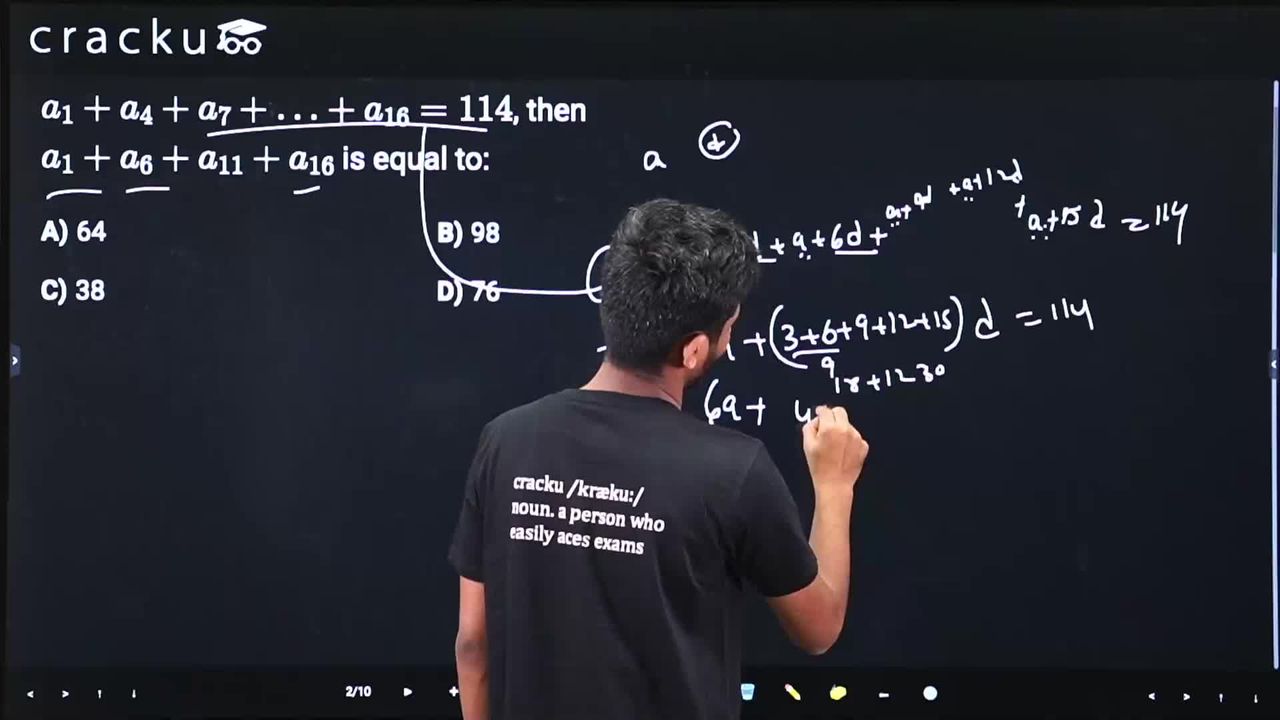
If $$a_1, a_2, a_3, \ldots, a_n$$ are in A.P. and $$a_1 + a_4 + a_7 + \ldots + a_{16} = 114$$, then $$a_1 + a_6 + a_{11} + a_{16}$$ is equal to:
Let us denote the first term of the arithmetic progression by $$a_1=a$$ and the common difference by $$d$$. The general (n-th) term of an A.P. is given by the well-known formula
$$a_n \;=\; a + (n-1)d.$$
We are told that the terms whose positions differ by three units, starting from the first term and ending at the 16-th term, add up to $$114$$. Concretely we have
$$a_1 + a_4 + a_7 + a_{10} + a_{13} + a_{16}=114.$$
Using the general term formula for each of these, we write every one of them explicitly in terms of $$a$$ and $$d$$:
$$\begin{aligned} a_1 &= a + (1-1)d = a,\\[2pt] a_4 &= a + (4-1)d = a + 3d,\\[2pt] a_7 &= a + (7-1)d = a + 6d,\\[2pt] a_{10} &= a + (10-1)d = a + 9d,\\[2pt] a_{13} &= a + (13-1)d = a + 12d,\\[2pt] a_{16} &= a + (16-1)d = a + 15d. \end{aligned}$$
Adding these six expressions term by term we get
$$\begin{aligned} a_1 + a_4 + a_7 + a_{10} + a_{13} + a_{16} &= \bigl(a + a + a + a + a + a\bigr) + (0 + 3 + 6 + 9 + 12 + 15)d\\[2pt] &= 6a + 45d. \end{aligned}$$
The question states that this total equals $$114$$, so we have the linear equation
$$6a + 45d = 114.$$
Dividing the entire equation by $$3$$ for simplicity, we arrive at
$$2a + 15d = 38. \qquad (1)$$
Now we need the value of the sum $$a_1 + a_6 + a_{11} + a_{16}$$. Let us again express each of these terms using the formula for the n-th term:
$$\begin{aligned} a_1 &= a + (1-1)d = a,\\[2pt] a_6 &= a + (6-1)d = a + 5d,\\[2pt] a_{11} &= a + (11-1)d = a + 10d,\\[2pt] a_{16} &= a + (16-1)d = a + 15d. \end{aligned}$$
Adding these four terms gives
$$\begin{aligned} a_1 + a_6 + a_{11} + a_{16} &= \bigl(a + a + a + a\bigr) + (0 + 5 + 10 + 15)d\\[2pt] &= 4a + 30d. \qquad (2) \end{aligned}$$
Equation (1) already relates $$2a + 15d$$ to the numerical value $$38$$. To find $$4a + 30d$$ we simply multiply equation (1) by $$2$$ on both sides:
$$\begin{aligned} 2 \times (2a + 15d) &= 2 \times 38,\\[2pt] 4a + 30d &= 76. \end{aligned}$$
But the left-hand side here is exactly the expression obtained in (2). Therefore
$$a_1 + a_6 + a_{11} + a_{16} \;=\; 76.$$
Hence, the correct answer is Option D.
Was this solution helpful?
Click on the Email ☝️ to Watch the Video Solution
Create a FREE account and get:
_1.webp)

Educational materials for JEE preparation

Ask our AI anything

AI can make mistakes. Please verify important information.
AI can make mistakes. Please verify important information.
