For the following questions answer them individually
A particle of mass m is moving along a trajectory given by
$$x = x_0 + a\cos\omega_1 t$$
$$y = y_0 + b\sin\omega_2 t$$
The torque, acting on the particle about the origin, at t = 0 is:
A ball is thrown upward with an initial velocity $$V_0$$ from the surface of the earth. The motion of the ball is affected by a drag force equal to $$m\gamma v^2$$ (where m is the mass of the ball, $$v$$ is its instantaneous velocity and $$\gamma$$ is a constant). Time taken by the ball to rise to its zenith is:
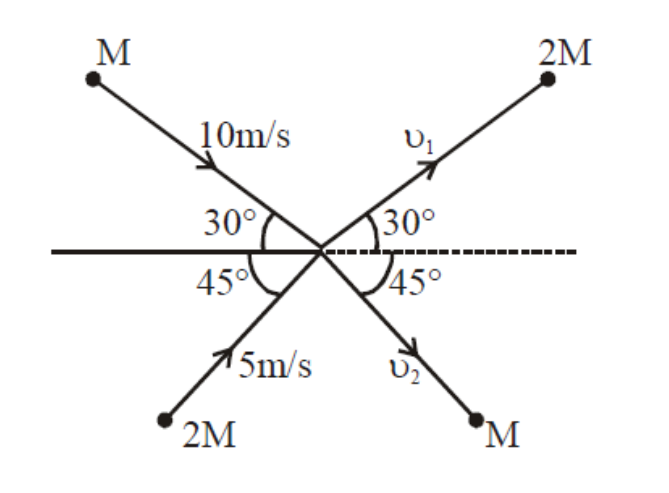
Two particles of masses M and 2M are moving with speeds of 10 m s$$^{-1}$$ and 5 m s$$^{-1}$$, as shown in the figure. They collide at the origin and after that they move along the indicated directions with speeds $$v_1$$ and $$v_2$$, respectively. The values of $$v_1$$ and $$v_2$$ are, nearly
A thin disc of mass M and radius R has mass per unit area $$\sigma(r) = kr^2$$ where r is the distance from its centre. Its moment of inertia about an axis going through its centre of mass and perpendicular to its plane is:
Two coaxial discs, having moments of inertia $$I_1$$ and $$\frac{I_1}{2}$$, are rotating with respective angular velocities $$\omega_1$$ and $$\frac{\omega_1}{2}$$, about their common axis. They are brought in contact with each other and thereafter they rotate with a common angular velocity. If $$E_f$$ and $$E_i$$ are the final and initial total energies, then $$(E_f - E_i)$$ is:
The value of acceleration due to gravity at Earth's surface is 9.8 m s$$^{-2}$$. The altitude above its surface at which the acceleration due to gravity decreases to 4.9 m s$$^{-2}$$, is close to: (Radius of earth = $$6.4 \times 10^6$$ m)
The ratio of surface tensions of mercury and water is given to be 7.5, while the ratio of their densities is 13.6. Their contact angles, with glass, are close to 135° and 0°, respectively. If it is observed that mercury gets depressed by an amount $$h$$ in a capillary tube of radius $$r_1$$, while water rises by the same amount $$h$$ in a capillary tube of radius $$r_2$$, then the ratio $$\frac{r_1}{r_2}$$ is close to
n moles of an ideal gas with constant volume heat capacity $$C_V$$ undergo an isobaric expansion by certain volume. The ratio of the work done in the process, to the heat supplied is:
A cylinder with fixed capacity of 67.2 litre contains helium gas at STP. The amount of heat needed to raise the temperature of the gas by 20°C is:
[Given that R = 8.31 J mol$$^{-1}$$ K$$^{-1}$$]
A $$25 \times 10^{-3}$$ m$$^3$$ volume cylinder is filled with 1 mol of O$$_2$$ gas at room temperature (300 K). The molecular diameter of O$$_2$$, and its root mean square speed, are found to be 0.3 nm and 200 m/s, respectively. What is the average collision rate (per second) for an O$$_2$$ molecule?