
Join Our JEE Preparation Group
Prep with like-minded aspirants; Get access to free daily tests and study material.
Sign in
Please select an account to continue using cracku.in
↓ →
Join Our JEE Preparation Group
Prep with like-minded aspirants; Get access to free daily tests and study material.
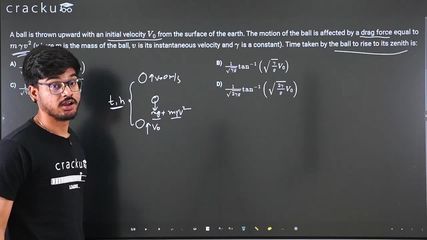
A ball is thrown upward with an initial velocity $$V_0$$ from the surface of the earth. The motion of the ball is affected by a drag force equal to $$m\gamma v^2$$ (where m is the mass of the ball, $$v$$ is its instantaneous velocity and $$\gamma$$ is a constant). Time taken by the ball to rise to its zenith is:
Let us take the upward direction as positive. While the ball is rising, two forces act downward: its weight $$mg$$ and the quadratic drag $$m\gamma v^{2}$$ (opposite to the velocity because the velocity is upward). Therefore the net force is downward and the equation of motion is
$$m\frac{dv}{dt}= -\,mg \;-\; m\gamma v^{2}.$$
Dividing by $$m$$ we obtain the differential equation for the velocity:
$$\frac{dv}{dt}= -\,g \;-\; \gamma v^{2}.$$
We now separate the variables, keeping all terms involving $$v$$ on one side and $$t$$ on the other:
$$\frac{dv}{g+\gamma v^{2}} = -\,dt.$$
The ball starts with velocity $$v=V_{0}$$ at time $$t=0$$ and reaches the zenith when $$v=0$$ at time $$t=T$$. We therefore integrate between these limits:
$$\displaystyle \int_{V_{0}}^{0}\frac{dv}{g+\gamma v^{2}} = - \int_{0}^{T} dt.$$
The right-hand integral gives $$-T$$, so flipping the limits on the left removes the minus sign:
$$T = \int_{0}^{V_{0}}\frac{dv}{g+\gamma v^{2}}.$$
Before evaluating the integral, we recall the standard formula
$$\int\frac{dx}{a + b x^{2}} = \frac{1}{\sqrt{ab}}\;\tan^{-1}\!\left(x\sqrt{\frac{b}{a}}\right) + C.$$
In our case $$a=g$$ and $$b=\gamma$$. Substituting these into the formula, we obtain
$$\int_{0}^{V_{0}}\frac{dv}{g+\gamma v^{2}} = \frac{1}{\sqrt{g\gamma}}\;\tan^{-1}\!\left(v\sqrt{\frac{\gamma}{g}}\right)\Bigg|_{0}^{V_{0}}.$$
Evaluating at the limits gives
$$T = \frac{1}{\sqrt{g\gamma}}\left[\tan^{-1}\!\left(V_{0}\sqrt{\frac{\gamma}{g}}\right) - \tan^{-1}(0)\right].$$
Since $$\tan^{-1}(0)=0$$, this simplifies neatly to
$$T = \frac{1}{\sqrt{\gamma g}}\;\tan^{-1}\!\left(\sqrt{\frac{\gamma}{g}}\,V_{0}\right).$$
Hence, the correct answer is Option B.
Was this solution helpful?
Click on the Email ☝️ to Watch the Video Solution
Create a FREE account and get:
_1.webp)

Educational materials for JEE preparation

Ask our AI anything

AI can make mistakes. Please verify important information.
AI can make mistakes. Please verify important information.
