
Join Our JEE Preparation Group
Prep with like-minded aspirants; Get access to free daily tests and study material.
Sign in
Please select an account to continue using cracku.in
↓ →
Join Our JEE Preparation Group
Prep with like-minded aspirants; Get access to free daily tests and study material.
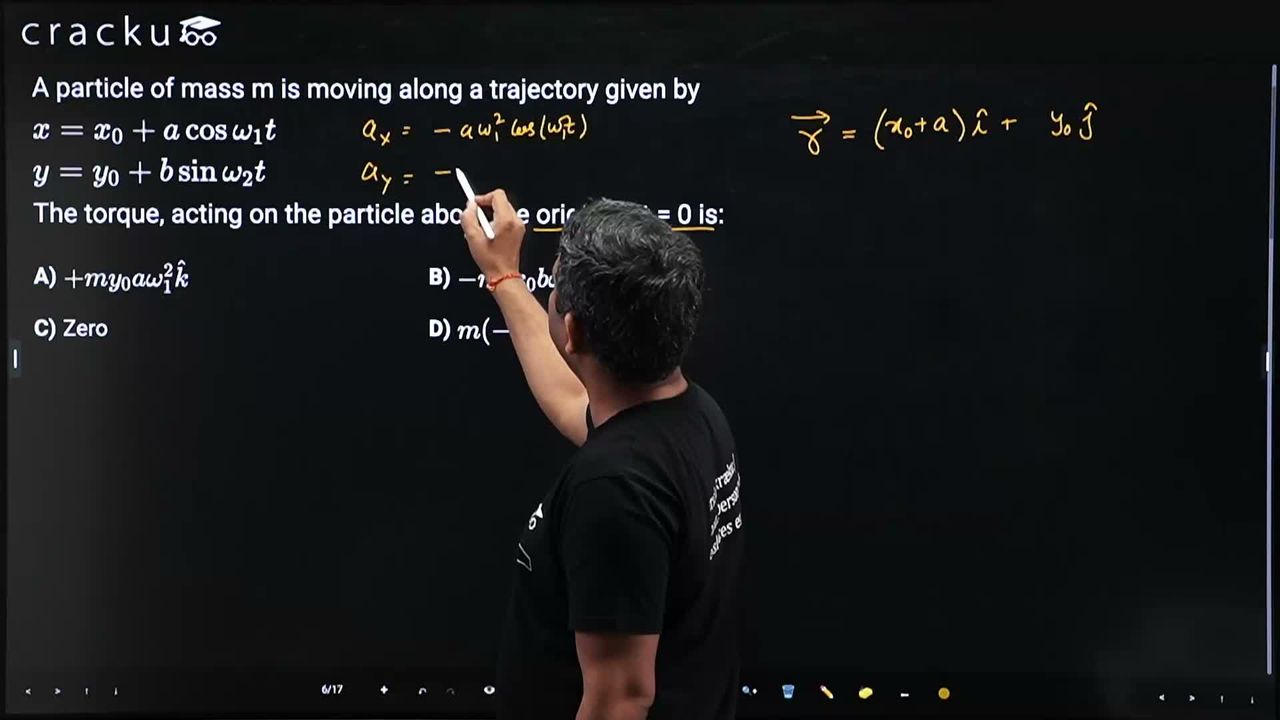
A particle of mass m is moving along a trajectory given by
$$x = x_0 + a\cos\omega_1 t$$
$$y = y_0 + b\sin\omega_2 t$$
The torque, acting on the particle about the origin, at t = 0 is:
We begin by noting that the position vector of the particle with respect to the origin is
$$\vec r = x\hat i + y\hat j = \bigl(x_0 + a\cos\omega_1 t\bigr)\hat i + \bigl(y_0 + b\sin\omega_2 t\bigr)\hat j.$$
The torque about the origin is defined as
$$\vec\tau = \vec r \times \vec F,$$
where $$\vec F = m\vec a$$ is the net force and $$\vec a$$ is the acceleration. Therefore, we first calculate the acceleration components.
Differentiating the given coordinates twice with respect to time, we have
$$x = x_0 + a\cos\omega_1 t \;\;\Longrightarrow\;\; \dot x = -a\omega_1\sin\omega_1 t, \qquad \ddot x = -a\omega_1^2\cos\omega_1 t,$$
$$y = y_0 + b\sin\omega_2 t \;\;\Longrightarrow\;\; \dot y = b\omega_2\cos\omega_2 t, \qquad \ddot y = -b\omega_2^2\sin\omega_2 t.$$
Hence the acceleration vector is
$$\vec a = \ddot x\,\hat i + \ddot y\,\hat j = \bigl(-a\omega_1^2\cos\omega_1 t\bigr)\hat i + \bigl(-b\omega_2^2\sin\omega_2 t\bigr)\hat j.$$
Multiplying by the mass $$m$$ gives the force
$$\vec F = m\vec a = \bigl(-ma\omega_1^2\cos\omega_1 t\bigr)\hat i + \bigl(-mb\omega_2^2\sin\omega_2 t\bigr)\hat j.$$
Now we set up the cross product $$\vec\tau = \vec r \times \vec F$$. Using the determinant form,
$$ \vec\tau = \begin{vmatrix} \hat i & \hat j & \hat k\\ x & y & 0\\ F_x & F_y & 0 \end{vmatrix} = \bigl(xF_y - yF_x\bigr)\,\hat k. $$
Substituting $$x = x_0 + a\cos\omega_1 t,\; y = y_0 + b\sin\omega_2 t,\; F_x = -ma\omega_1^2\cos\omega_1 t,\; F_y = -mb\omega_2^2\sin\omega_2 t,$$ we get
$$\vec\tau = \Bigl[(x_0 + a\cos\omega_1 t)\!\bigl(-mb\omega_2^2\sin\omega_2 t\bigr) - (y_0 + b\sin\omega_2 t)\!\bigl(-ma\omega_1^2\cos\omega_1 t\bigr)\Bigr]\hat k.$$
We have to evaluate this at $$t = 0$$. At that instant, $$\cos 0 = 1$$ and $$\sin 0 = 0$$, so
$$x(0) = x_0 + a,\qquad y(0) = y_0,$$
$$F_x(0) = -ma\omega_1^2,\qquad F_y(0) = 0.$$
Therefore
$$\vec\tau(0) = \bigl[(x_0 + a)\cdot 0 - y_0\!\cdot(-ma\omega_1^2)\bigr]\hat k = \bigl[0 + my_0a\omega_1^2\bigr]\hat k = +my_0a\omega_1^2\,\hat k.$$
Hence, the correct answer is Option A.
Was this solution helpful?
Click on the Email ☝️ to Watch the Video Solution
Create a FREE account and get:
_1.webp)

Educational materials for JEE preparation

Ask our AI anything

AI can make mistakes. Please verify important information.
AI can make mistakes. Please verify important information.
